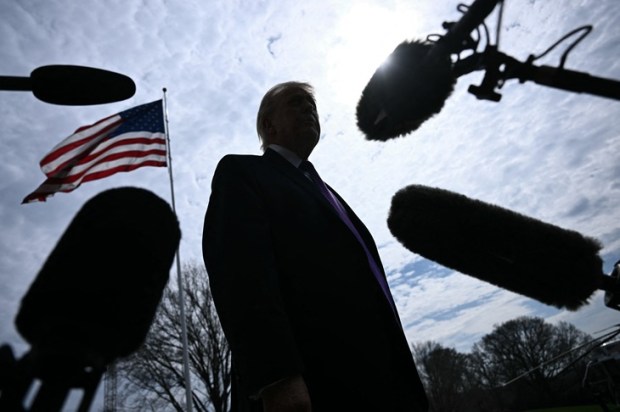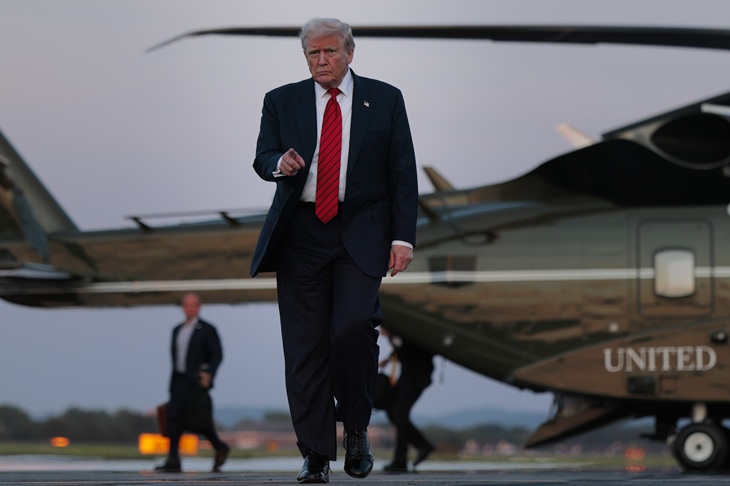
The biggest threat to Australia’s security might not be its Keystone Cops military industrial complex, or its failing energy sector, but the misreporting, deliberate or otherwise, on its key security partner, the US, and its Commander-in-Chief, Donald J Trump.
Our media, public intellectuals, and gas bags all seem determined to recycle Democrat talking points. The result? A precipitous decline in favourable perceptions of the US.
For Australia, this is an existential problem as they provide our national security insurance that our government is not willing to self-insure.
According to the Lowy Institute Poll 2025, only 36 per cent of Australians ‘trust the United States to act responsibly in the world’, and 72 per cent have no, or not too much, confidence in Donald Trump. This makes Trump statistically indistinguishable from Xi Jinping, who scores 71 per cent on the same measure.
Recent evidence of how malign this is situation can be is found in the biased editing of footage where Donald Trump spoke at Capitol Hill on January 6, 2020. Why are we surprised? Western Media were perennially wrong about the Russia Gate Hoax too.
Part of the problem is that those paid to analyse the US situation accurately are just as clueless as those with the biggest mouths. I recently watched a panel discussion on China involving an economist and three foreign affairs specialists – one with a particularly personal reason to abhor the Chinese CCP regime. None of them could make sense of Trump and his policies.
It reminded me of Donald Horne’s quote:
‘Australia is a lucky country run mainly by second-rate people who share its luck.’
There were three major criticisms of Trump: that he is stupid, he is erratic, and he has no plan.
These combine in an argument that Trump is a buffoon running the largest economy in the world who is destroying it and the international order. With China revving-up its belligerence, now is a good time to revisit those propositions.
There are some things I think most people can agree on about Trump, like him or loathe him. He’s a businessman and a wheeler-dealer. He cares more about outcomes than processes and he’s been closely acquainted with existential threats. Financially, at least four times businesses he has been closely associated with have sought bankruptcy protection, and personally there was the bullet that almost liquidated him.
Another thing that is underappreciated about Trump is his fascination with things military. Though he actively avoided service, he attended school at New York Military Academy – a school with military uniforms and discipline, but without specific military subjects – and frequently invokes Generals Patton and MacArthur, as well as citing China’s best-known military strategist, and a favourite of Xi Jinping, Sun Tzu.
He’s also a reality TV host and promoter, which is not irrelevant when considering how the US Congress operates. With a likely change of control of Congress in 2027, Trump has two years, with just more than one to go, to cement change into place before he becomes a lame duck.
There are three lenses to view Trump’s actions through – businessman, amateur military buff, and reality TV host – which are arranged like intersecting Venn diagrams.
The businessman is going to treat the US like a business, which suits the warrior, because he knows logistics and manufacturing strength determine wars, while the reality show host is working out how to sell all of this and squeeze it into two years (half hoping that he might actually be able to beat the odds and squeeze four years out).
While most leaders believe the status quo will always be there, Trump knows just how quickly disaster can unfold. He views the US as a business on its way to bankruptcy and irrelevancy, combined with the military understanding that peace is only won through strength.
The America that bought Trump in the 2024 election is one that has severe financial problems. It has overpromised and overgeared. How do you fix this? You cut and you build, and you might also surreptitiously raise taxes.
Elon Musk’s hugely ambitious Department of Government Efficiency (DOGE) was a cutting exercise, along with the President’s Financial Year 2026 Budget Proposal which targeted a decrease of 24 per cent of non-defence discretionary outlays, while the Republicans’ fight over the government lockdown was a rear-guard action against baking in more Obamacare spending.
Then you build income, which you can do either by increasing taxes or increasing the revenue base on which the taxes are levied, or both.
Tariffs can be characterised as achieving both. On the one hand they are a sneaky value-added tax, but only applied on foreign-produced goods, allowing you to kid your audience that the foreigners will pay the tax rather than them.
On the other you can claim to be bringing industry back to the United States. While the current unemployment rate is only 4 per cent the US has an underemployment rate of around 8 per cent, and a low participation rate of only 62.6 per cent, with men in particular discouraged and out of the market. That’s somewhere over 10 million Americans who can become employees of repatriated businesses and taxpayers reducing outlays by coming off welfare.
You can also make it easier to grow industry in America. He’s done this by reducing business taxes and regulation and reducing the cost of energy – ‘drill baby drill’. American businesses have also been incentivised to bring back foreign cash with lowered tax rates.
The businessman also understands a business is not just figures, but people, and the people in the business are suffering.
Covid-era inflation has pushed up costs for food and housing. Graduates drown in student debt. Universities, have become infected by gender and race ideology, failing in their role as the producers of empirical knowledge, so the degrees are worth less while costing more.
Americans are chronically unhealthy. The US spends more on health per capita than any other country but is ranked 33 out of 50 OECD countries for life expectancy.
They’re not safe. Crime is out of control in certain cities, with judges and prosecutors refusing to enforce the law. International borders were porous to a flood of illegal immigrants, many of them young men of military age, who were basically waved through the border by the previous administration.
There was political violence, and suppression of free speech, and the country is still traumatised from Covid lockdowns and vaccine mandates. The security agencies had also been weaponised against opponents of the Democratic administration, and law courts weaponised as well.
Trump is addressing all of these. Petrol is $3.00 a gallon (about $1.15 AUD per litre). He adjusted tariffs on 200 agricultural items when he realised they were impacting cost of living. And now the Federal Reserve has reacted to pressure by lowering interest rates.
Universities have been put on notice that they need to get back to their core purpose and elevate merit as a core principle. Robert Kennedy Junior has the job of reengineering public health.
For private health there is an alternative to Obamacare in the wings which would direct money to individuals rather than insurance companies in a scheme with similarities to Singapore’s health system.
Trump is also onto the crime and immigration issues. The borders are closed to illegal immigrants, and he is deporting as many illegals as he can find (so far an estimated 2.5 million), despite the objections of some states. His deployment of the National Guard in Washington DC was partly performative, and sends a message on crime of the broken windows variety.
The risk to free speech via government coercion of social media companies has been lifted, and appointees like Kash Patel and Pam Bondi seem to be cleaning-up the Secret Service and prosecution arms of the federal government.
What about the warrior? There is considerable overlap at some levels with the businessman because a functioning economy speaks to war potential. But in Trump’s mind America is already at war overseas, and even domestically.
He sees many of the illegal immigrants crossing the border as an invasion. And enemies can be found amongst legally admitted refugees such as an individual who allegedly ambushed and killed two National Guardsmen. Or Somalis in Minnesota, alleged to be involved in widespread fraud of federal government programs with some of the money possibly funnelled to al-Shabaab, a Somali terrorist organisation.
At another level he sees the civic unrest caused by actors like Antifa as being enemy action, even if not foreign enemies and issued an executive order designating them a domestic terrorist organisation. This is an organisation that has received support from some Democrat legislators, so add ‘civil’ to the other adjectives applied to war.
This element is carried over to the universities. Charlie Kirk was killed at a university by an assassin who, it is alleged, appears to have been affected by postmodern transgender ideology. Surveys show that young Americans, predominantly left of centre, believe that it is permissible to kill your domestic political enemies. Where do these young Americans get these ideas? Maybe they are being taught them, and universities have classrooms full of budding John Wilkes Booths.
And then there is the hot war in Ukraine, and the embers of a hot war in the Middle East and the threat of another hot war breaking out over Taiwan. All of the antagonists have ties in some way to the Chinese Communist Party who is the US’s main strategic rival inferring if not a conspiracy, then convergent opportunism.
Trump would be well aware that many wars are lost by fighting on too many fronts. That’s why he is closing fronts down, at an acceptable cost to the US, whether that is acceptable to the other players.
In this context Trump’s demand that his allies pay their way is not only reasonable, It is a recognition that the US, now only 26 per cent of world GDP, cannot do what it could just after the second world war with 50 per cent of world GDP.
Trade, tariffs, and reindustrialisation play their part here too. The Chinese didn’t go free trade when they joined the WTO, they went full-mercantilist. As a result, they have 30 per cent of global manufacturing (versus 42 per cent for the Western Allies) and a headlock on 85 per cent of rare earths production critical to modern technologies and guided munitions.
They’ve supplied the materials to build the energy transition for advanced Western nations on the back of an industrial system that only waves at transitioning, leaving them with the advantage of cheap, reliable power.
They also have an educated workforce and are competitive with the USA in key technologies, if not ahead. That gives them a potentially determinative hand in any combat.
This is where tariffs play a double role. Trump is using them to try to wrest back as much manufacturing as he can from China by making its exports more expensive. He is also using them as leverage to encourage friendly countries to invest in the USA – ‘I’ll lower your tariffs even more if you invest hundreds of billions in the US economy.’
Critics pay attention to the bizarre formula for calculating tariffs, but the formula is just a negotiating technique. Trump wants to anchor his offer, and to do that effectively you have to have some justification, no matter how irrational.
The US is also investing in countries like Australia to change the shape of the rare earths market.
Sun Tzu councils that the way to win war is to bluff your opponent out of it. Xi Jinping knows that, hence his ‘wolf warrior diplomacy’. Trump know it too. He’s renamed the Department of Defence, the Department of War, and he’s put it on a war footing, cutting layers of approvals out of procurement.
Which leaves us with the reality TV host. Trump understands that what makes reality TV work is that the audience buys into the drama and identifies with particular players. Politics has been described as ‘show business for ugly people’. Not good enough for Trump. He’s assembled a Cabinet straight from central casting – square jaws, gym-honed abs, fake eyelashes, winter tans, blonde hair, the lot. And they’ve been empowered to throw their weight around.
Trump needs this because he is trying to simultaneously carry multiple story lines, just like many reality TV shows do, and he wants audience buy-in. The more heroes and villains, the more likelihood of buy-in.
While this approach is instinctive for Trump it is also existential in his view for America. When you take an almost apocalyptic view of where your country is, have a legislative agenda more ambitious than any other, and where probability says you have only two years before your opponents reassert power in the Congress, you need to be able to bring as many voters with you as possible.
It’s also why the Tweets figure as they do. Conventional politics says you pick a few phrases that resonate with voters and run on them repeating them until you are almost nauseous because voters have short attention spans. Trump knows voters actually have long attention spans … as long as they are interested. So rather than communicating by slogan, he’s communicating by detail via soap opera.
Trump may not be the President Australians wanted, but he is the President reality delivered. Understanding him – shorn of caricature and partisan contempt – is not optional for a country whose security depends on America’s strength and resolve. The world is reorganising itself, and so is the United States. Whether we like Trump or not matters less than whether we are capable of seeing him clearly. Nations that fail to understand their allies do not remain lucky for long.