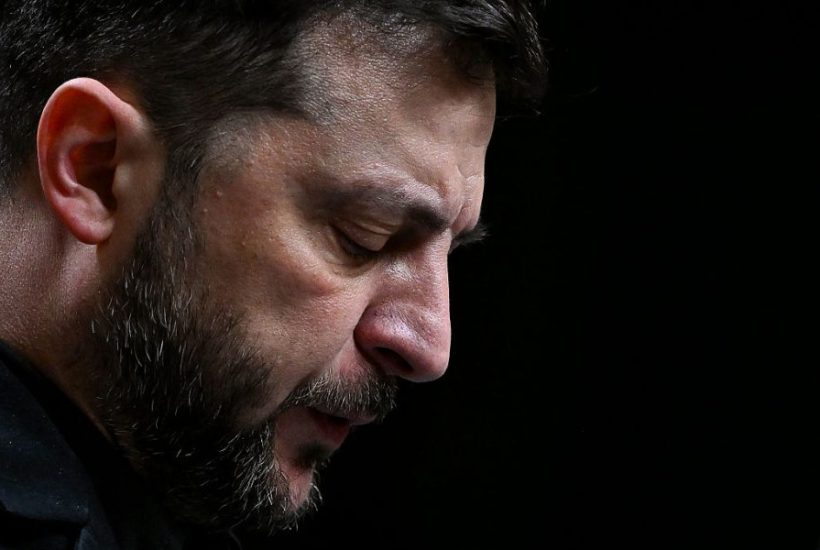
Painfully and chaotically, the outline of the peace deal that will eventually end Russia’s invasion of Ukraine is emerging as the US leans on Kyiv to abandon key red lines. It may still be months before the guns finally fall silent. But one by one various roadblocks to an eventual agreement are falling away. Crucially, this week Volodymyr Zelensky conceded that his country needed new presidential and parliamentary elections. Moreover, for the first time, he floated the possibility that a Ukrainian military withdrawal from Donbas could be put to a national referendum.
‘The Ukrainian people must answer the territorial question,’ Zelensky told reporters on Thursday. ‘I say clearly: yes, I support elections.’
Ukraine has been under martial law since Russia’s February 2022 invasion, renewed every 90 days by the Rada, the country’s parliament. Until now, Zelensky has insisted that elections in wartime are banned by law. But Donald Trump this week cast doubt on the democratic legitimacy of the president – whose term would ordinarily have ended in May lsat year. In response, Zelensky announced that he had ‘told MPs to draft laws that let Ukraine hold elections during martial law’ and called on allies to ‘help us organise elections safely and on time’.
Holding elections in war-torn Ukraine will be no easy task
Zelensky – whose current approval ratings stand at 20 per cent – may have just rung the death knell on his own political career. But the true breakthrough is his suggestion that the painful concessions demanded by Putin could be put to a national vote. The Kremlin has demanded that Ukraine surrender the remaining 20 per cent of Donetsk province which the Russians have so far failed to capture. Voters will be faced with a horrible Sophie’s choice: to fight on indefinitely or buy peace at the price of abandoning even more land to the enemy.
On a tactical level, Zelensky’s referendum plan is a neat jujitsu move, turning the tables on the White House. Trump blasted Ukraine for being insufficiently democratic – Zelensky replied by offering to put his peace plan to the vote. Trump also claimed that Ukrainians want the war to end – Zelensky’s response was fine, lets ask them.
More importantly for Ukraine’s future, a democratic vote could lessen the chances of civil strife in the aftermath of a peace deal. The idea that traitors stabbed Germany in the back in 1918 poisoned the politics of the Weimar republic. Bitter disagreements between Irish republicans over whether to sign a treaty with the British Empire in 1921 boiled over into a civil war. A national vote to ratify letting Donbas go will be contentious, but a democratic mandate for what former foreign minister Dmitro Kuleba recently called a ‘tactical defeat’ will help Ukraine move on. As Zelensky told reporters, ‘We must end the war and do it from a strong position.’
Which way a national referendum goes will depend, naturally, on exactly what kind of deal is being put to voters. A straight Ukrainian withdrawal, forcing hundreds of thousands of residents to choose between abandoning their homes or living under Russian occupation, is unthinkable. But the outline of a workaround is emerging.
‘The Americans are testing a plan,’ Zelensky reported. ‘Ukrainian troops leave part of Donetsk, Russian troops stay out and the area becomes a “free economic” or “demilitarised zone”.’ Instead of rejecting this Korean-style scenario out of hand, Zelensky commented that any withdrawal has to be mutual. ‘We must keep talking and settle the pullback rules,’ he said. “If our troops step back 5 kilometres, Russian troops must step back 5 kilometres … and we need real monitors on the ground who watch every step.’
What’s in a name? A lot, in this case. There may not be much practical difference between ‘capitulation’ and the ‘creation of a free economic zone’ on the ground in Donetsk. But war-weary Ukrainian voters who reject surrender may be persuaded to accept a demilitarised buffer between their country and Russia.
Holding elections in war-torn Ukraine will be no easy task. Electoral rolls are a mess, with millions of citizens internally displaced. The last national census was held in 2001. Voting rights for roughly 10 million Ukrainian refugees abroad, mostly in Europe, will have to be somehow guaranteed. Will Ukrainians living under Russian occupation or those who have fled to Russia itself get a vote?
As Ukraine is a parliamentary-presidential republic, three elections will have to be held at the same time for parliament, the presidency, and a peace deal. With no candidate currently on more than 20 per cent of the vote (Zelensky is a whisker ahead of former Army chief Valery Zaluzhny, on 19.75 per cent) a second-round runoff election is almost inevitable.
Then there are the practicalities of arranging a ceasefire long enough for elections to be organised and ballot boxes brought to a million soldiers, half of whom are currently deployed on the front lines. On top of all that, for the process to be credibly recognised as free and fair, observers from the Organisation for Security and Cooperation in Europe (OSCE) will have to be deployed and their safety guaranteed.
More dangerously for Ukraine’s war effort and military unity, the country’s press will have to be released from tight wartime censorship, which will likely open a Pandora’s box of morale-shredding corruption allegations. For the duration of the war, most of Ukraine’s usually voluble politicians have kept quiet for patriotic reasons – while the few who have spoken out against Zelensky’s leadership are either in exile or in jail on charges of collaboration with the Kremlin. Free elections will release a tidal wave of recriminations even as the war remains only temporarily suspended.
The practical and political difficulties are legion. Nonetheless, with talk of elections and a demilitarized zone now on the table, the war’s endgame has taken a significant step towards its conclusion. Zelensky argues that the Trump plan resembles a frozen conflict rather than a lasting peace. Yet the examples of Korea and Cyprus show that frozen conflicts can remain stable for decades.
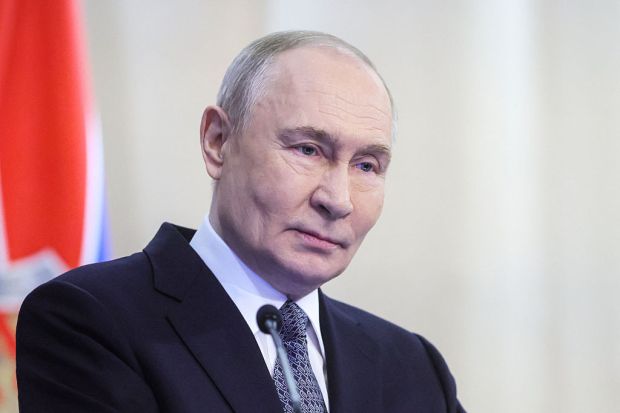
The main jeopardy to a peace deal remains the same as the reason the invasion was launched in the first place: Putin’s maximalist demands that Ukraine return to Moscow’s sphere of influence. So far, Zelensky has been making all the concessions. But if the war is to end, the Kremlin will have to make some concessions of its own. The demand that Ukraine recognise its lost territories as Russian is a deal-breaker – though it is possible that the US will unilaterally agree. Russia’s insistence that Ukraine constitutionally commit to never joining Nato could potentially be moved into a separate agreement made by the US not to further expand the alliance eastwards. And most crucially of all, Ukraine will remain democratic and independent of Russia.
There are a hundred moving parts to these negotiations and a hundred ways that Putin could sabotage the process. The outcome will inevitably be messy, and will leave some Ukrainians feeling betrayed and others wondering what their sacrifice was all for if the final deal is worse than the one Kyiv rejected in Istanbul in April 2022. But one thing is clear – the end of the war has just moved significantly closer.