Johannesburg, the wealthiest city in Africa and home to more than 12,000 millionaires is about to become a ghost town. Just over a week before Christmas, there’s a lull in the traffic as homes in both the suburbs and the sprawling black townships empty out.
On 16 December, the Day of Reconciliation marks 187 years since the Battle of Blood River when a party of 464 voortrekkers or white pioneers who had left British rule in the Cape to search for a homeland, moved east and passed through the Zulu kingdom. The trekkers, born in Africa of Dutch and French descent and speaking a blend that would become known as Afrikaans, had been granted free passage by the Zulu monarch Dingaan; with their wagons, horses and cattle they were looking for a place to settle.
Dingaan had taken the throne in 1828 by murdering his half-brother King Shaka, founder of the Zulu nation and a military genius to rival Alexander the Great. Shaka defeated surrounding clans and incorporated them as the Romans did with their empire, and it’s because of him that Zulus remain the largest ethnic group in South Africa.
But Dingaan’s rule was now threatened by another sibling, Mpande, who had established good relations with the white migrants, offering them the land they sought … if they helped him replace the king. And so unfolded a tale worthy of Shakespeare.
After a succession of battles, between rival Zulu armies and Dingane’s forces against the whites, the trekkers decided to move on the royal capital at Gingindlovu, 70 miles north of Durban. The palace was in difficult terrain for an attack, so they stopped on the banks of the nearby Ncome River.
This was 50 years before the better-known clashes between British forces and the Zulu, including the famous battle of Rorke’s Drift.
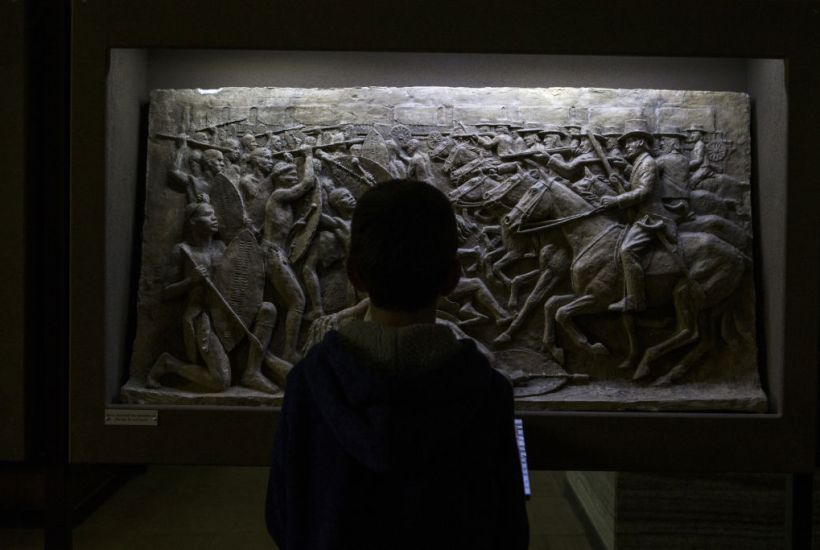
Dingane sent six regiments with more than 20 000 warriors to liquidate the trekkers who, deeply religious, held a night of prayer, making a covenant with God that should He grant them victory, the anniversary of the battle would be remembered with a public holiday. Their advantage lay in a pair of canons that fired buckshot and when on Sunday 16 December the Zulus attacked, they fell in their hundreds.
Shaka had replaced the long throwing spear with a short assegai for a stab-and-rip assault, forcing his soldiers to engage one-on-one with the enemy. It was this that brought victory in the early wars. Now, with the wagons in a circle, guns blazing and shrapnel from the canons, they were unable to close in. And as the wounded tried to retreat across the Ncome, its waters were said to turn red. Blood River.
Victorious, the trekkers moved on Gingindlovu only to find that Dingane had fled. They attended Mpande’s coronation and either stayed to farm or moved west, joining other trekkers and taking land from local tribes to establish the Transvaal and Orange Free State. Gold and diamonds were found and the British empire, having conquered the Zulu, invaded these two republics in 1899 and the resulting Boer War raged until 1901.
When peace came, the Zulu territory in Natal and the British colony at Cape of Good Hope were, in 1910, combined with the Transvaal and Free State to create what is now South Africa.
Every year, the Battle of Blood River and the covenant with God is marked with a holiday on 16 December, and the site is a national monument.
In 1994, after two world wars and the end apartheid and white rule, the new government of Nelson Mandela revised the calendar of national days. Some were dropped, others were created, but there was agreement that Blood River marked an important event in history, now celebrated as the Day of Reconciliation. In a country with 11 national languages and a history of conflict, what could be more appropriate?
The site is a national monument
Those with money head for the coast and time off in Durban or Cape Town. The summer heat rarely afflicts Jo’burg, sitting as it does on a plateau more than 5000-feet above sea level. Even so, mountain resorts – still cool but without their winter snow – are full, ditto the 8000-square-mile Kruger National Park to the east and hundreds of private reserves that offer photographic and hunting safaris, but mostly a peaceful place to see in the new year.
With the world’s third-highest murder rate, South Africa sounds frightening but most crime is in the cities. Rural areas are safer and at game reserves with their guards and rangers, children can run free while parents relax.
Unemployment, notably among black youth, is chronic, fuelled by a rapid urbanisation as school-leavers come to the city in search of work. Now they go home to join family. The festive break may be short, but the anniversary of Blood River means people leave the city on the 16th and return a fortnight later after seeing in the new year.
And so a battle, almost two centuries ago, has become a blessing for all.