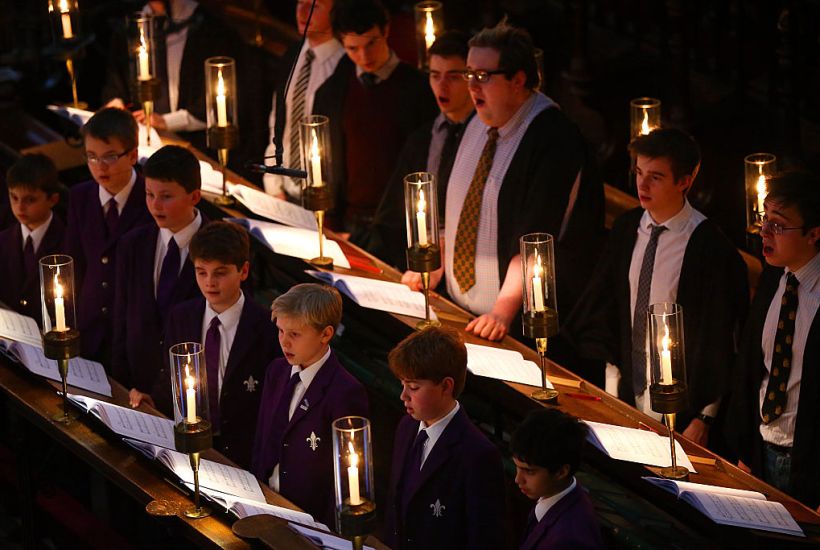
Picking up the children from school recently, I heard the lovely old carol ‘In Dulce Jubilo’ drifting slowly across the quadrangle. It was a recorded version played over loudspeakers as part of the Christmas light switch-on, rather than the work of rosy-cheeked choristers in gowns, and yet I felt a sudden, unexpected catch in my throat, and a pricking at the corner of my eyes. I am still trying to work out why I reacted, involuntarily, in that way. ‘In Dulce Jubilo’ does not have any specific personal resonance for me. Perhaps it was something to do with the poignant timelessness of the scene – children hurrying between ancient buildings, chatting merrily and bundled up against the cold, while warm light glows in cosy windows. It’s true too that as a parent, each successive Christmas means your children are growing up, and time is marching on. And of course, when you reach a certain age, this time of year takes on a slightly bittersweet flavour. It is freighted with memories of Christmases long ago, of the roads not taken, of people who have drifted from our lives, or those who – in the words of the fine old prayer – now rejoice upon another shore, in a greater light.
More than any other holiday or celebration, the spirit of Christmas is inextricable from music. Seasonal hymns have a kind of Proustian effect, whisking me back in time. ‘God Bless Ye Merry Gentleman’ is indelibly linked in my mind with brass bands in railway stations and market squares. I can never hear ‘Away in a Manger’ without thinking of childhood Christingles, which at All Saints, Lydd, always ended with the children standing in the side aisles to sing. As I grew older, I learned to love ‘Nine Lessons and Carols by Candlelight’ in the various country parishes where my clergyman father has officiated. In undergraduate days, Christmas dinners would generally conclude with a hearty rendition of ‘The Twelve Days’, led by the choir with substantial audience participation, most of us in what P.G. Wodehouse used to call a state of advanced refreshment. Pleasingly, ‘The Twelve Days’ has become a firm favourite of my children, re-establishing itself as part of the musical texture of my Christmas in a very different context.
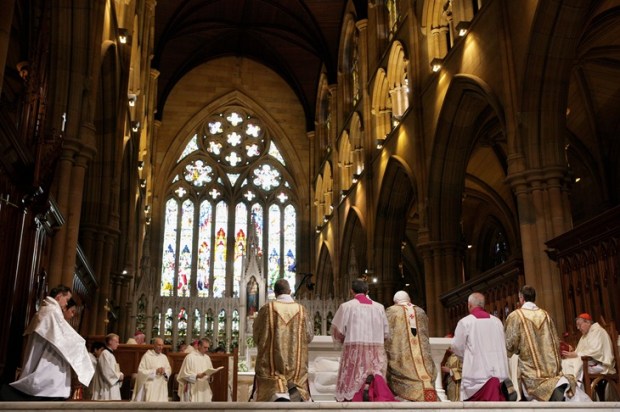
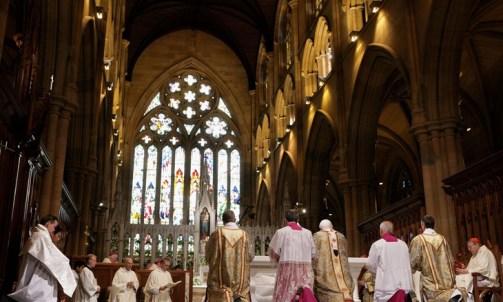
More recently, I discovered Vaughan Williams’s ‘Fantasia on Christmas Carols’. As with ‘In The Bleak Midwinter’ – a work that has grown on me considerably since my primary school class was painstakingly taught to sing it properly by the stern but dedicated Mrs Green in the early 1990s – the Fantasia beautifully captures the solemnity and melancholy of the north European midwinter, as well as the joy and exuberance of the festival, and seems somehow to have a profoundly English feel. It conjures mental pictures of snow lying silently on village greens and hard frosts on rolling fields, and the high windows of ancient churches faintly illuminated against the darkness. Cynics would dismiss this as nostalgist, and they are probably right, but if we can’t look back fondly on old traditions and enduring landscapes at Christmas, when can we do so? I pray in aid no less an authority than Charles Dickens. In A Christmas Carol, when Scrooge is shown a vision of the boisterous celebrations organised by his first boss Fezziwig, many years before the novel’s 1840s setting, music and dancing are an important part of the scene: ‘the great effect of the evening came after the Roast and Boiled, when the fiddler…struck up Sir Roger de Coverley. Then old Fezziwig stood out to dance with Mrs Fezziwig. Top couple, too; with a good stiff piece of work cut out for them; three or four and 20 pair of partners.’
We do have contemporary equivalents of this kind of raucous workplace merrymaking, although every year there are reports that in the age of harassment lawsuits and health and safety assessments, the traditional December blowout is an endangered species of entertainment. Where they do still happen, they are normally accompanied by the modern secular festive repertoire, everything from ‘Let It Snow!’ to ‘Rock ‘n’ Roll Christmas ‘and all points in between (for my money, ‘Fairytale of New York’ is the best modern Christmas pop song). A perennial grumble about Christmas songs is that they aren’t as good as they used to be, a concern mentioned by Slade 52 years ago in ‘Merry Xmas Everybody’. I do wonder, though, whether one of the sentiments behind that complaint is a feeling that it is right and proper to listen to familiar standards at this time of year. The atmosphere of the season is deeply entwined with past experiences – White Christmas, which was first released during the second world war and is now treated as an old favourite, is itself intensely nostalgic for a past which is enormously distant for people in 2025, in both chronological and cultural terms.
Nostalgia comes in for a lot of criticism, and perhaps we oughtn’t to wallow in the past too indulgently. Equally, however, the widely-shared preference for the established and the comfortable at Christmas does reflect something important; a desire for rootedness, and for constancy, a firm place to stand and take stock in an ever-changing world. I once spent part of Christmas in a small village in Gloucestershire, and attended a lively party at one of the local farms. We sang the Gloucestershire Wassail, which dates to at least the 1700s and probably further back than that. It was comforting to think of the many generations who had preceded us, keeping the feast in a way that was recognisably akin to our own festivities. The ancient rhythms remind us that human life, and communal jollification, have been going on for a long time, and will carry on long after we’re gone. There is a certain poignancy in that realisation, but it is also a tiding of comfort and joy.