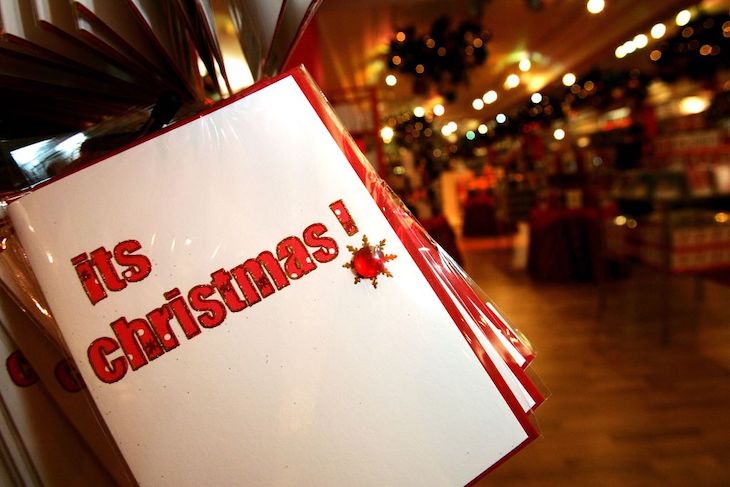
These days I barely know what my own handwriting looks like; about my friends, the knowledge is all but lost. Seeing their pen strokes has grown rare. But for a brief period each winter that odd intimacy returns as Christmas cards – some with messages, most with just a scribbled name – land on my mat.
I adore receiving cards. Even ones from people I cordially dislike, or frankly loathe, are welcome
There used to be something exciting about the sound of the postman’s footsteps, of letters being pushed through the door, of their thump as they landed within. That was in the days when there was a great deal of post. Even then unexpected letters from old friends arrived rarely, and, strange to say, the endowment begging me to write full time never arrived at all. But back when the arrival of the post was an important daily ritual, there was always a faint shimmer of possibility.
At Christmas the feeling returns, and the sound of the postman pushing letters through the door still brings that flutter of anticipation. I adore receiving cards. Even ones from people I cordially dislike, or frankly loathe, are welcome. Hearing them arrive, opening and reading them, hanging them from the strings tacked along my home’s wooden beams, all gladdens my heart. I am happy with the most generic images if the signature is handwritten, its scrawl the proof that we still lodge in each other’s thoughts.
I deny hypocrisy, which requires pretense, but I admit to double standards: I am one of those people who loves receiving Christmas cards yet is poor at sending them. But this year I have done better. In As Good As It Gets, Jack Nicholson, forced to pay a compliment to Helen Hunt, tells her that he’s started taking his medication. ‘I don’t quite get,’ she replies, ‘how that’s a compliment for me,’ and she goes to leave. ‘You make me want to be a better man,’ he explains, and she stays.
What I mean to imply is that writing for The Spectator about Christmas makes me want to be a better man. Sometimes life reminds you of the value of small gestures, and this year I have ordered Christmas cards, and stamps, and sent them. This says more about Christmas, perhaps, than The Spectator, and without doubt it says something about how losing my son made me consider more consciously what remains.
In Herman Melville’s novella, Bartleby, the scrivener, loses his hold on life, his sense that it is worth the struggle. Melville’s narrator discovers at the end that Bartleby has worked, of all places, in Washington’s Dead Letter Office, and imagines the scene with horror:
‘Sometimes from out the folded paper the pale clerk takes a ring: – the finger it was meant for, perhaps, moulders in the grave; a bank-note sent in swiftest charity: – he whom it would relieve, nor eats nor hungers any more; pardon for those who died despairing; hope for those who died unhoping; good tidings for those who died stifled by unrelieved calamities.’
Cards do the opposite. They connect us, remind us that our existence matters, even to those we last met a continent or a lifetime away. That picture of a robin in the snow, or faux-whimsical cat in a Christmas tree, is evidence that someone, as the Quakers say, holds us in the light. A card can say a great deal, and contain nothing but a signature.
After my son’s death we received a large number of cards, many from people we knew only a little, some from those we did not know at all. They made us feel, correctly, that we lived as part of a community. Undoubtedly the fact that we are rural helped, clustered in our lanes and cottages and ringed by fields. But Christmas cards are a way of sustaining a community across geography. And across years, too, with exchanges between those who perhaps have not met in decades, but whose memories also make up a shared space, bordered by the long fields of time.
There is no time limit on sending a Christmas card, no point at which it is too late to matter, or unwelcome for not being in an unbroken annual line. I hope that someone will read one of my cards and say, with the pleasure that remembrance brings, ‘Oh, yes, Druin, I remember him.’
‘Every book is, in an intimate sense, a circular letter to the friends of him who writes it,’ wrote Robert Louis Stevenson, in his preface to Travels with a Donkey in the Cevennes. ‘They alone take his meaning; they find private messages, assurances of love, and expressions of gratitude, dropped for them in every corner. The public is but a generous patron who defrays the postage.’
Christmas cards are as close as most of us get to such circular letters. They are small tokens that help defray the cost of life’s journey, and they are very welcome.