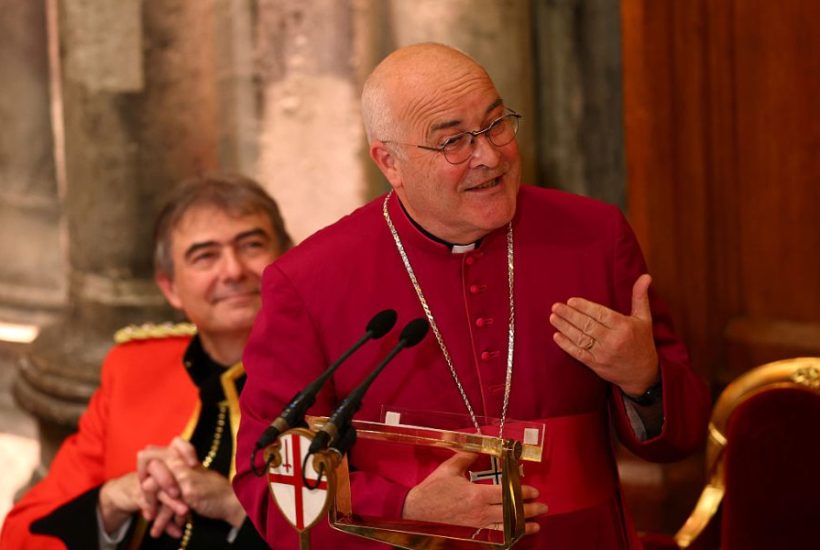
The Church of England’s House of Bishops met to discuss the Living in Love and Faith (LLF) project yesterday: that is, the project to change the rules about blessings of single-sex relationships so as to allow stand-alone services (such blessings being currently permitted only as an incidental part of some other service) and, additionally, to eventually open the door to priests being able to enter into single-sex civil unions.
At yesterday’s meeting the bishops, as expected – although much to the fury of LGBT campaigners – confirmed their decision made in October to mothball the project. Though their precise formal statement has been left until after Christmas, it is now clear that LLF will not proceed in the near future.
Many thinking Anglicans will rejoice. Even in the absence of personal qualms about the morality of gay relationships, LLF would have sat very awkwardly indeed with the (officially unchanged) existing doctrine of heterosexual marriage, which broadly remains that sex in it is all right and intimacy outside it undesirable. Believing six impossible things before breakfast, like the Red Queen, might have seemed easy by comparison.
Look more closely, however, and the prospects are less comforting. For one thing, the shelving of LLF was not so much whole-hearted as forced by circumstance. The problem was canon law: the bishops had, it seems clear, been advised that there were strong legal arguments that this change could only be brought in under Canon B2, which would have demanded an as yet unavailable two-thirds majority in each house of Synod.
The shelving of LLF was not so much whole-hearted as forced by circumstance
That pressure remains, and stays strong. A clear majority of bishops, including the Archbishop of York, Stephen Cottrell, have little time for the Church’s present attitude and are seriously impatient to change it: the fact that many of their congregations are a good deal more sceptical cuts little ice. Typical was the Bishop of Newcastle, Helen-Ann Hartley, who during the discussions yesterday went online to lay down the line to the Geordie faithful. She called unapologetically for, as she put it, ‘full inclusion for LGBTQI+ people’ and an end to ‘the erosion of the witness of real lives and a disregard for the fear and distress our LGBTQI+ siblings live with’.
And it’s not only the episcopate. Demands to bring in LLF by hook or by crook come from all kinds of pressure groups, ranging from senior clergy (for example, the Deans of Bristol and St Edmundsbury, both of whom have preached sharply in favour) and organisations such as Inclusive Church and Together for the Church of England. The Alliance, a conservative Anglican group with friends in high places, suggested yesterday that a ‘steering group’ had already been quietly set up to find a way to do this. We have certainly not heard the last of the argument.
That argument, moreover, should give us pause: much of it ranges from the dubiously logical to the simply naive. It’s all very well to say, for example, that gay people are excluded from the Church. But in any ordinary sense of the word they are not, any more than the Church excludes thieves, adulterers or grinders of the poor. Their conduct may be disapproved of, but that is different. Again, it is of course true that (as the Dean of Bristol, Mandy Ford, said last Sunday) Jesus regularly upended convention in the name of universal love: but there is an enormous danger here of reducing the Church’s teaching to a kind of denatured lanyard-class ‘be kind, and don’t offend’, which is most certainly not what our Lord intended.
Indeed, one problem with the whole campaign in favour of the LLF project is that while there is certainly room for muscular disagreement about the scriptural view of sexuality, in many ways the argument avoids this and begins to look remarkably secular. The concentration on the modish idea of ‘inclusion’ is one example, as is the concentration on the need to promote equality, or the stress on the need to ensure that the promulgation of church doctrine on sexuality does not cause ‘harm’. In a civil service training session or NHS hospital, this would be quite expected – but spiritual it is most certainly not.
This last point should be a warning sign for the Church. The justification for having a church as part of the state, and for having Lords spiritual as well as temporal in the Lords, is that good secular government needs specifically religious backing and guidance. Unfortunately, the House of Bishops now looks less and less fit to give it. From being a body that habitually aimed to impose a spiritual check on secular authority, it is now looking more and more like a group tasked by the secular ruling class with persuading its faithful to accept its prescriptions. If we now see more people asking ‘What is the point of the Church of England?’ and calling for its disestablishment as an outdated erastian anomaly, a large part of the episcopacy might consider whether it is not part of the problem.