With public reaction to the Bondi shootings increasingly and inevitably subject to partisan political framings, one of the most fascinating aspects to emerge is the painting of conservative figures as opportunistic in using the tragedy for political gain.
At various stages, all of us are subject to personal tragedy – the death of a loved one or close colleague – and must find a way to overcome grief. Even if this is achieved through the shared support of family and friends, ultimately it is the individual who must identify and negotiate a path forward in a way that restores their emotional stability and functionality.
Large-scale national tragedies strike at the psyche in a different way. Individuals personally detached from natural disasters or acts of gross violence which occur in another location, typically share a desire for the wider community to unite; through collective grief, shared empathy, and a common hope and desire to prevent similar events from occurring again.
Here, it is the job of society’s leaders to adopt the complex dual role of mourner and hand-holder-in chief, and dependable reassurer that from such awful lows, the community will emerge stronger and safer. Along with that comes a broad expectation that, in the process, those leaders will not be undermined. That unification around the greater cause is paramount.
Hence the outrage expressed towards political figures like ex-Prime Minister John Howard, ex-treasurer Josh Frydenberg, and Opposition Leader Sussan Ley, among others, for their overt criticism of Prime Minister Anthony Albanese; what RedBridge pollster Kos Samaras described in a post on Facebook last week, as ‘politicians treating a national wound like a campaign opportunity’.
Let’s deal with the obvious first.
Perhaps Frydenberg will seek to re-enter politics at the 2028 election. Even if he was to – and he made it clear that he is yet to seriously canvass that possibility – any objective reading of his extraordinary outburst outside the Bondi Pavilion would surely conclude that here was an emotionally wrought individual demanding that he, his family, and members of his faith again be allowed to feel safe in their own country. No more, no less.
Extrapolation into anything further – seizing an opportunity to position for a future tilt at the Liberal leadership – could only be derived from having access to Frydenberg’s inner thoughts, or allowing one’s own partisan political biases to override what should have been clear and obvious.
As for Sussan Ley, Andrew Hastie, James Paterson, Pauline Hanson, and other politicians who stand to benefit from Albanese being unfavourably assessed for his handling of the crisis, rather than ask, ‘Why are these people so callous in taking political advantage of a national tragedy?’ Perhaps a better question might be, ‘Why does such an obvious vacuum exist into which questioning of government action (or inaction) in the lead up to the tragedy, and the immediate response, is both inevitable and necessary?’
Of course, the response of Ley and others to hold Albanese accountable is political. What else can it be? But, in all of the demands for bipartisanship, I’m yet to see anyone articulate what this means in practice.
The Liberals have been rightly lambasted in recent years for lacking policy conviction. In that context, why would Ley stand shoulder to shoulder with Albanese and echo his focus on stricter gun control if her party believed that this was at best a partial, low-level response or, at worst, a cynical attempt to deflect from the underlying issue?
Why would Ley effectively condone Albanese’s parking of the Special Envoy to Combat Antisemitism, Jillian Segal’s report, tabled in July this year, selected elements of which are only now, belatedly seeing the light of day, after the damage has been done?
Bipartisanship works best when responses and policies are co-authored and responsibility is shared. Or alternatively, when a course of action is so compellingly obvious and right, that to adopt a contrarian position makes no sense at all.
Neither of those conditions apply here. How is Albanese and Labor’s role in overseeing an environment where antisemitism has been allowed to fester, and Albanese’s carefully curated words and actions in the aftermath, any less political than what his political opponents stand accused of?
Samaras points to the Covid pandemic, stating: ‘Australians weren’t asking for perfect people, they wanted seriousness, competence, and a sense that leaders were on the same side as the public. They all had mixed views about the pandemic response but they just wanted adults running the country to get them through it all. But when politics turned into theatre, trust evaporated.’
Samaras’ comments appear to be targeted at conservative politicians who he says, are ‘too far up their own backsides to see the derailed train they are on’. Yet I’d wager that, once they realised they weren’t going to suddenly drop dead (within five kilometres of their house), what the bulk of the population wanted during Covid was two things not explicitly mentioned by Samaras; honesty and authenticity.
In that sense, South Australia’s Chief Public Health Officer Nicola Spurrier, exhorting fans in the outer not to touch a stray AFL football might be excused as amateurish, misplaced nannying, whereas Victorian Premier Daniel Andrews’ constant quoting of health advice in support of draconian curfews, later contradicted and shown to be largely non-existent by his own Chief Health Officer, Brett Sutton, only served to highlight a problem with growing politicisation and lack of accountability in public office feeding widespread distrust in authority.
Early on during the crisis, Prime Minister Scott Morrison invited the State Premiers into a National Cabinet, so as to form a response that was national and bipartisan. Did this action lead to better outcomes?
Hardly. I’d argue that Morrison succeeded in doing little more than highlighting his own shortcomings and his diminished authority, as Australians, perhaps for the first time, got to understand the relative power vested to the states under Federation, and then watch on as some state premiers – either for their own political purposes, or out of misplaced parochialism, or both – ran their own race anyway.
With bipartisanship exposed as a myth it’s not difficult to come to the conclusion this is now being used as nothing more than a convenient screen to mask Albanese’s problematic position.
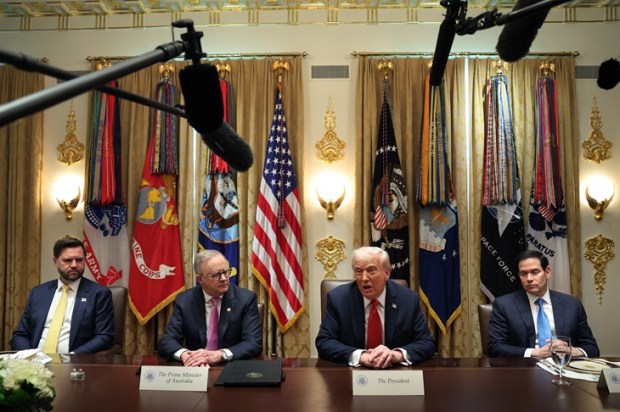
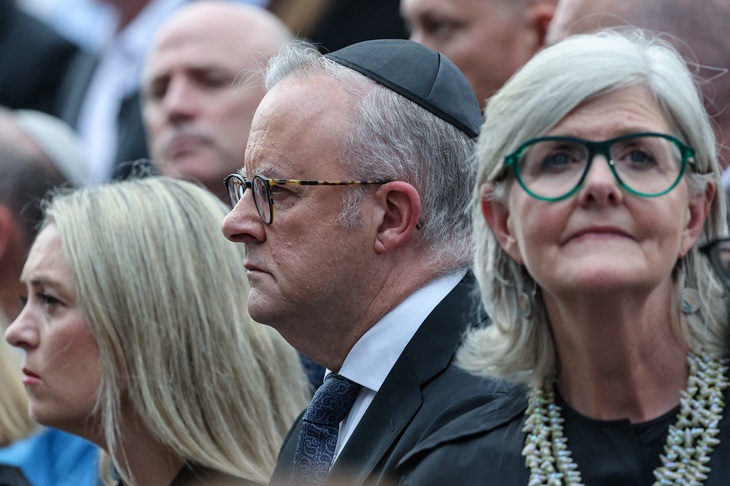
Albanese has not been invited to some funerals and has elected not to attend others. As a result, his leadership has been diminished. His acute problem is that he is defined both by his past – protest activism in support of Palestine, and failure to respond in a timely fashion to Segal’s recommendations – and his government hitching their wagon to the rapid growth in Australia’s Muslim population, without simultaneously committing to managing concerns around that cohort potentially housing radicalism.
All of it political, of course. And despite cries of unfair treatment, none of it a product of the media or Albanese’s political opponents.
As if to illustrate the point, even more damning were the actions of NSW State Premier Chris Minns in calling for a Royal Commission into the tragedy; conversing with reporters and, through them, his constituency – never talking down to them. By contrast to Albanese, unrehearsed and unshackled; not bound by focus groups or ideology and the need to talk out both sides of his mouth.
In his public appearances, Minns can be seen stretching; prepared to think aloud with the public. In regular political discourse, that kind of vulnerability can be interpreted as weakness. But in the aftermath of such a gut-wrenching tragedy, it comes across as a leader comfortable in treating everyone as adults, prepared to be held accountable for any wrongs under his watch, and making the best decisions for his constituents.
To all of the apologists for the Prime Minister, asking, ‘What else could he have done to prevent the tragedy?’ or ‘What else is he supposed to do now?’ the answer isn’t to point fingers at the political opposition or media and ask them to do better. The problem is that what needs to be done – even just starting with using forthright, unambiguous language – is uncomfortable and risks upsetting people the government doesn’t want to upset.
True leaders inherently understand what is required to seize the moment, and when. They do not offer an apology on the doorstep of a Cabinet meeting inside which the wording has just been carefully qualified. They do not call for unity without offering anything credible for Australians to actually unify around. They do not accuse others of acting politically whilst doing exactly that.
This is a complex, difficult, perhaps nation-defining juncture in Australia’s history. Courtesy of Labor’s commanding election win, Albanese has vast reserves of political capital at his disposal, yet instead of pushing his Cabinet colleagues, advisors and spin merchants into the background, and spending that capital to right what has now shown to be a tragic series of wrongs, he has elected instead to pander to his supporter base.
Yes, this is the time for unity and bipartisanship. But it also the time for accountability and genuine action. Having chosen obfuscation and an insipid ‘bare minimum’ set of actions, Albanese has sadly fallen well short of what the office of Prime Minister demands of him.
Geoff Parkes is a Melbourne-based rugby writer and author.