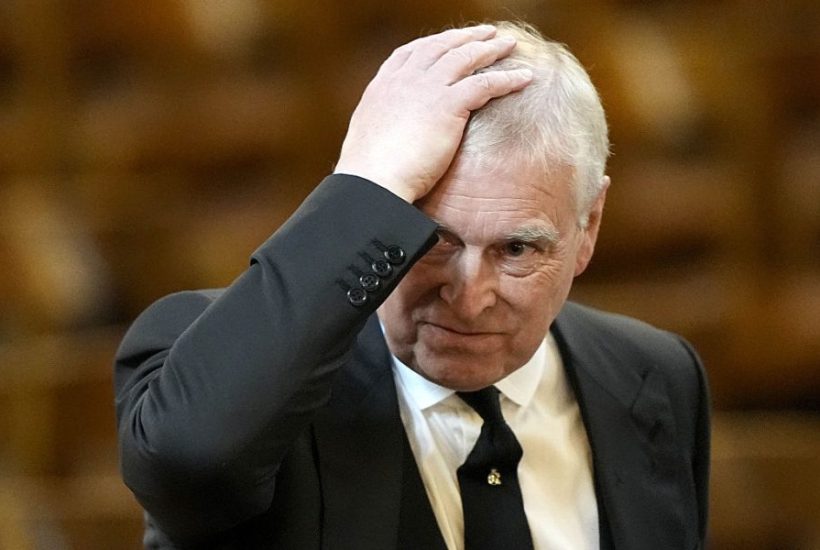
If you’ve ever dramatically broken up with an ex, only to find, to your miserable disbelief, that they keep popping up in the most inconvenient circumstances, you may feel a degree of sympathy with the royals as regards Andrew Mountbatten-Windsor. A few weeks after he was stripped of his titles and ordered to leave Royal Lodge, he may now be the Andrew formerly known as Prince, but he shows no signs of wishing to leave his Windsor grace-and-favour home. By the terms of his (remarkably generous) lease, he is entitled to twelve months’ notice before departing. As one of his few remaining friends told the Times, ‘It’s really rather sad, but if it’s a case of who will blink first, then Andrew is going to dig in. He ain’t going anywhere.’
If this was the only problem that the royals faced, it would be inconvenient but manageable. After all, worse things have happened at sea – or in Montecito. Yet the King and the other senior members of the Firm are ending their second annus horribilis in a row. This time, the reasons for it are neither health-related nor simply down to the various wrong ‘uns who have been expelled from the bosom of the royal family. Instead, it comes down to money: Andrew’s, in part, but also the workings of the wider crown estate, which are under scrutiny as never before.
There are a vast number of grace-and-favour residences that are owned or maintained by the King
In the case of the former Duke of York, it is a relatively straightforward situation. If he is expelled from Royal Lodge before the year is up, he is owed £488,321 in compensation for his lease being broken early. That would be a huge amount for most people, but it is a relatively trifling amount for an institution worth billions – and indeed it is less than a twentieth of the amount that his mother reportedly found to pay Virginia Giuffre off with.
If this was the only issue at hand, the money would undoubtedly be forthcoming. The royals, though, have fought back, claiming that the ‘dilapidated condition’ of the house meant that it would cost a greater amount to repair and restore it, which in turn would see the disgraced prince cast out without a penny. Job done.
It was, however, revealed last month that Andrew was not paying anything close to market rent for the property, and after making an initial payment of £1 million for the 30-room mansion in 2003, he was given a 75-year lease at a purely nominal rate. And it has since transpired that he is not alone in this regard.
The Duke and Duchess of Edinburgh inhabit Bagshot Park in Surrey and were offered a similar deal to Andrew; Prince Edward paid £5 million for a 150-year lease in 2007 and since then has paid a similar peppercorn rate. It is believed that the same is true of even minor royals, such as Princess Alexandra, who is supposedly paying £225 a month for Thatched House Lodge in Richmond Park: an amount so trifling that one must wonder why it’s even been levied.
There are a vast number of grace-and-favour residences that are owned or maintained by the King, via the crown estate, and it is looking increasingly likely that few, if any, have been charging anything like an appropriate rent to their well-heeled tenants. The Public Accounts Committee (PAC) has now opened an investigation into what precisely is going on. Its chairman, Sir Geoffrey Clifton-Brown, stated on Tuesday that:
Having reflected on what we have received, the information provided clearly forms the beginnings of a basis for an inquiry. We now await the conclusions the National Audit Office will draw from this information, and plan to hold an inquiry based on the resulting evidence base in the new year.
It is unlikely, based on previous evidence, that the royals will relish cooperating with such an inquiry. The Firm’s approach to anything financial or potentially embarrassing has been opaque at best and positively obstructive at worst. It has maintained its power and wealth not by explaining every detail of their activities, but instead by offering the British public an implicit deal. A member of the royal family will appear at major ceremonial and state functions, deliver a speech, smile, shake a few hands and wave. In return, they, and their financial circumstances, do not merit further investigation.
For decades, even centuries, this sense of noblesse oblige held true. Yet the Andrew debacle has had the unintended side-effect of blowing open the royal coffers and inviting scrutiny that many would prefer had never occurred. Even if no further scandal or illness occurs within the monarchy’s ranks, the PAC’s investigation will be another embarrassment for an increasingly beleaguered institution. Few would bet against 2026, on this evidence, becoming the third annus horribilis in a row before it has even begun.