A century ago, the Orkney poet George Mackay Brown was settling into his first term at Stromness Academy. His schooldays were to prove a dismal grind, but English lessons brought moments of magic. He was especially intrigued by poems – ballads, mostly – signed simply ‘Anon’. The name of the poet was lost – and perhaps there hadn’t been just one but a host of craftsmen in the making of each of these wonders. They were the creation of a tribe, the inheritance of a community, songs ‘seraphically free/ Of taint of personality’. Today, as publishers bust themselves to promote the cult of individual authors, it’s a thrilling, liberating notion.
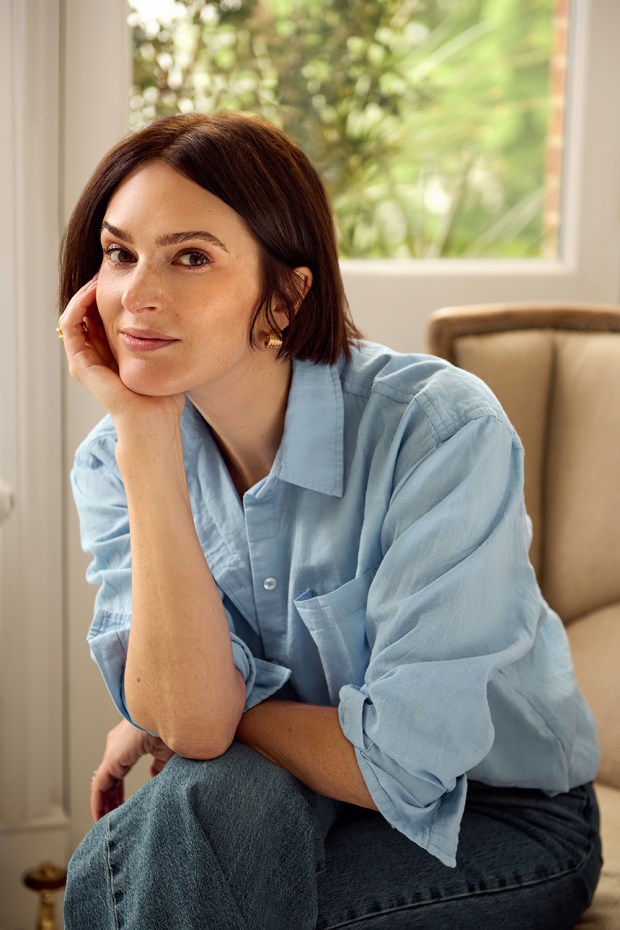
Amy Jeffs is an art historian, medievalist, artist and composer, whose Storyland: A New Mythology (2021) retold medieval tales of legend and landscape. In turning to ballads, she hopes to reacquaint us with old stories that ‘travel to us through a root system of real lives, with all their pains and predilections’ – stories that ‘provoke the kind of quiet, confident excitement felt in childhood, when something confirms magic to have been real all along’.
We may not today meet elves round every corner, but we are only too familiar with these stories’ big themes
She hopes to reignite interest in a literary form from which, she says, for the most part, we have ‘moved on’. She is probably right, though many of us have more ballads in our consciousness than we might think – ‘The Wraggle Taggle Gypsies’, ‘The Rime of the Ancient Mariner’, ‘The Ballad of Reading Gaol’. And poets such as Carol Ann Duffy and Simon Armitage are still working with the ballad form – as was Tony Harrison until his recent death.
Jeffs’s formula is simple. She has chosen ten ballads – all but one from the five-volume 19th-century ballad collection of Harvard Professor Francis James Child, ‘essentially unmatched in literary scholarship’. Some are well known, such as ‘Tam Lin’ and ‘Thomas the Rhymer’; some perhaps less so – ‘The Maid and the Palmer’, ‘The Lady Isabel and the Elf King’. She tells the story of each in simple, beautifully evocative prose: ‘Isabel… stepped forward, making a moorhen shriek in the reeds, and her shoes filled up with water and her weight made the black mud belch…’ Jeffs then moves on to offer a commentary aiming to place each ballad in its historical context and to bring it to life in the present. It’s not that the ballads are ‘relevant’, or, heaven forbid, ‘relatable’, but that they strike chords down the generations. We may not today meet witches, fairies and elves round every corner, but we are only too familiar with the big themes in these stories: unwanted pregnancy, wicked stepmothers, infanticide, murder, rape, abandonment, kidnap, racism.
Some of Jeffs’s commentaries work well. After writing up the ballad of ‘Lady Isabel and the Elf Knight’, she visits Edinburgh’s Arthur’s Seat with her father, and the Wells of Wearie, where lovers and witches gather, and turning a corner they encounter a stranger: ‘He smiled as he passed, but it was not a friendly smile. Then once he was behind us, he gave a long, low, loud wolf whistle full of wry menace.’ It’s a moment that feeds into the eeriness of the tale.
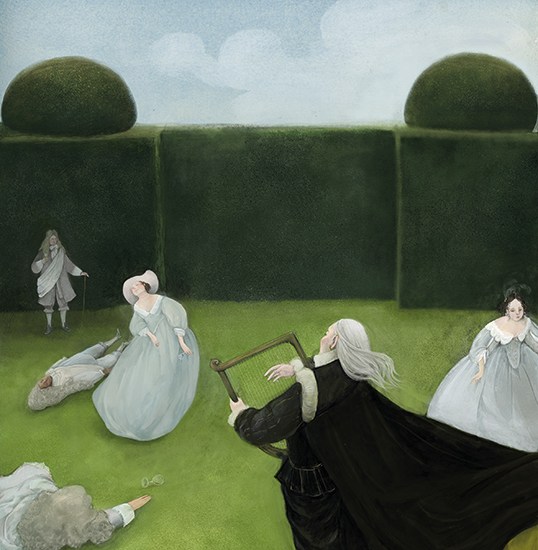
Old Songs aims to be ‘a manifesto for collective, multimedia stories’, so it is generously interspersed with deceptively gentle looking, actually rather sinister illustrations by Gwen Burns. At the end of the book, Jeffs offers Child’s verse texts for each of the ballads she has chosen, with delicious glossaries – gowany (daisy-covered), warsled (wrestled), drumlie (gloomy) etc.
Then there is singing. It is said that when Sir Walter Scott, hard at work on the Minstrelsy of the Scottish Border, showed Margaret Hogg, the mother of the Ettrick Shepherd James Hogg, the printed versions of the ballads she had sung him, she was appalled: ‘They were made for singin and no readin, but ye hae broken the charm now and they’ll never be sung mair.’ So it is good to know that, in the audiobook of Old Songs, the ballads will be sung, ‘to provide an immersive and beautiful listening experience’.
In May 1968, Mackay Brown travelled to Belfast to spend an evening in a pub with Seamus Heaney. In his cups, he sang the ballad of ‘The Queen’s Maries’:
Yestreen the Queen had four Maries,
The night she’ll hae but three;
There was Marie Seaton, and Marie Beaton,
And Marie Carmichael, and me.
‘It was,’ Heaney later wrote, ‘a chanting more than a singing, and more a haunting than a chanting.’ That sounds like the real deal.
Got something to add? Join the discussion and comment below.
You might disagree with half of it, but you’ll enjoy reading all of it. Try your first month for free, then just $2 a week for the remainder of your first year.