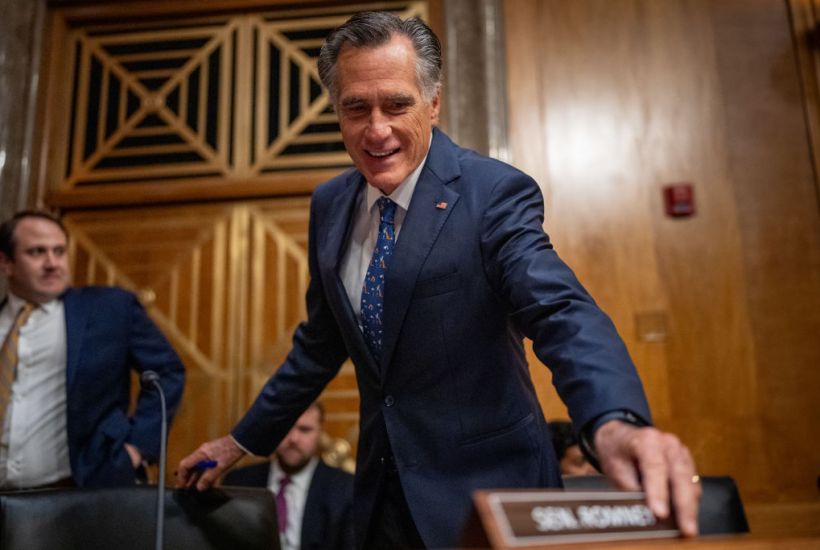
“On the tax front,” says Mitt Romney, “it’s time for rich people like me to pay more.”
It’s always slightly annoying for regular Americans when squillionaires announce that people like them ought to be contributing more to the Treasury. (Nobody’s stopping you from writing a big cheque, Mitt!)
But Romney’s intervention in today’s New York Times is noteworthy. It is the clearest sign yet that the pre-Trump Republican party, the party of Bain Capital, hyper-capitalism and asset-stripping, is adapting to a new political reality. And it’s now willing to go after the assets of the billionaires.
Romney’s logic is hard to refute. Social security and entitlements are bankrupting America. If, as the Congressional Budget Office expects, the combined balance of federal trusts funds is exhausted by 2034, benefits will have to be cut by about 23 percent. The US government will then have to find trillions of dollars from somewhere. So major entitlement reforms will therefore be inevitable, even if no leader wants to go through the political pain of hacking back generous programs which voters have become accustomed to benefitting from.
Social security costs $1.5 trillion a year; Medicare is roughly $1 trillion. Donald Trump can brag about the $200 billion his external revenue service (ie, his tariffs) has brought in. But this fiscal year the US annual budget deficit will be north of $1.5 trillion, again. One day the gods of the copybook headings will have their say.
Romney despises the current President, of course, and clearly enjoys pointing out that Trump and Elon Musk’s Department of Government Efficiency “took a slash-and-burn approach to budget cutting and failed spectacularly.” But he’s not wrong. “Only entitlement reform would make a meaningful difference,” he says, and everybody in Washington knows that is true.
What’s new, however, is that Romney is now pushing for more tax revenue and even making concessions to what might be called the politics of class envy. “I believe in free enterprise,” he says. “I believe all Americans should be able to strive for financial success,” he says. “But we have reached a point where any mix of solutions to our nation’s economic problems is going to involve the wealthiest Americans contributing more.”
“It would help us avoid the cliff ahead, and may tend to quiet some of the anger that will surely grow as unemployed college graduates see tax-advantaged multibillionaires sailing 300-foot yachts.”
Just a few years ago, any such talk would have been utterly anathema among the Republican elite. But now, Romney says, the fiscal crisis is so acute that he sees no other way out.
He proposes, among other things, removing capital gains tax breaks for estates valued at more than $100 million. And typically, he cites the potential inheritance of Elon Musk’s children as evidence of the unfairness — which gives you a whopping great big clue as to the real agenda.
The New York Times, the voice of Democratic America, and Mitt Romney do not team up purely from the goodness of their hearts. The Democrats are eager to force Trump into confronting entitlements so that his party suffers at the ballot in the mid-terms in November. And a figure such as Romney seems happy to help. In the coming months, the Democratic party is going to campaign against Republican party corruption and the Trump family’s intense coziness with billionaires. To offset these potent attacks, Trump will have to hope the American economy lives up to his hype in 2026.
But Trumpworld’s bigger concern about Romney’s argument today ought to be that, on the matter of America’s monstrous debts, he is right.