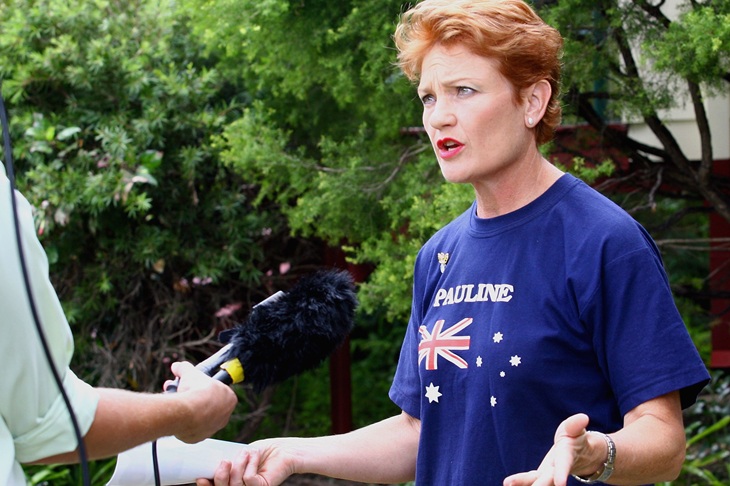
In a dramatic, defiant move, Senator Pauline Hanson entered the Australian Senate Chamber wearing a full black head covering known as a burqa. She did so after her proposal to ban full-face coverings was rejected.
Rather than labelling the performance as a ‘cheap stunt’, as many have indicated, this was a deliberate act of political theatre – a powerful symbolic protest rooted in her long-held convictions about security, integration, and Australian identity.
Hanson has brought much-needed publicity to a serious issue concerning Australia’s national security and future direction.
As terror crimes rise within Australia, it should not come as a shock to legacy media that our politicians (who handle matters of defence and crime), are making statements in political spaces … which is what Parliament is for.
Only a couple of days after Pauline’s burqa incident, I happened to run into her on the lawns of Parliament commemorating the men who died in suicides in Australia during an annual show of ‘men’s work boots’. She was pleasant to chat with, empathic, and sharp. Why doesn’t the media talk about that? They unjustly paint her as some racist, unhinged activist and completely forget that many migrant or ethnic types (including myself) see her as a bastion of freedom for this nation – a preserver of all that makes Australia worth migrating to.
She is concerned by the influx of mass migrants in a nation where infrastructure cannot keep up. I frankly agree with her. Many migrant families do.
I attended the March for Australia rally earlier this year in ACT and witnessed Pauline making a speech. We were all concerned by rising migrant crimes and poor vetting processes. I work a job where I deal with matters of persecution and know for a fact how swiftly countries can shift from supposedly ‘secular and democratic’ nations to violent Islamic regimes within a matter of years unless the government remains vigilant. This is why several European countries are now banning the burqa – which is a symbol of devout Muslim practice in some conservative versions of the culture.
Hanson has long argued that the burqa represents not only a potential national security risk but also a deeply entrenched form of patriarchal oppression held within the Islamic tradition. Having failed to secure leave from the Senate to introduce her ban on full face-coverings, she returned wearing one, declaring in effect: if you won’t debate the issue, I will show you what I mean.
This was not the first time Hanson used the burqa in Parliament. She first donned it in 2017 to highlight alleged links between full-face coverings and terrorism, yet at that time suffered no formal sanction. This protest, by contrast, drew a near-unanimous censure and landed her a seven-day suspension, indicating our times are changing and not for the better.
People should ask why senators are resorting to stunts like this to begin with.
Hanson insists her right to free speech was stifled. She argued that denying her the opportunity to introduce a private senators’ bill – and then punishing her for wearing the very garment she hoped to ban – was hypocritical.
‘There is no dress code on the floor of Parliament, yet I’m not allowed to wear it,’ she told reporters.
To many Australians, Hanson’s stunt was more than publicity-seeking. It was a raw reminder: the debate over the burqa is not just about religion, but about identity, security, and how we choose to live together as a nation. She framed her act as a defence of ‘Australian values,’ calling on fellow citizens to judge her at the ballot box, not in the chamber.
From a legal standpoint, a nationwide burqa ban in Australia would be enormously complicated.
Parliament’s refusal to allow Hanson to introduce her bill suggests that institutional support – especially across party lines – is lacking. Further, any such law would likely provoke constitutional, human rights, and religious freedom challenges.
The irony is that Pauline herself was banned from the Senate, which is fundamentally against the right to political communication and equality under the law. Not only was she banned, but her upcoming movie trailer screening of A Super Progressive Movie was cancelled at the last minute. It was set to take place at the Parliament House theatre and had to be moved to Dendy theatre at 9:15 pm on the same night, but this showing was so late, several people were unable to attend.
On the parliamentary front, Hanson’s critics argued her use of the burqa as a prop violated norms of decorum. The Senate President ordered her to remove it; when she refused, proceedings were suspended. Her suspension was not solely about the burqa, but about her defiance of Senate rules.
But in doing so, the Senate silenced her message in the very place where national debates should occur. Rather than engage with the substance – security concerns, cultural integration, and the rights of women – many in the chamber focused on rebuke and ritual censure.
Hanson’s campaign is not without precedent.
Across Europe, a growing number of democratic countries have enacted bans on full-face Islamic veils. Austria, France, Belgium, Denmark, the Netherlands, Portugal, Switzerland, Bulgaria and others now restrict burqas or niqabs in public spaces.
Italy, under Prime Minister Giorgia Meloni, has also recently proposed a national ban with fines ranging into the thousands. These bans are often justified on grounds of security, social cohesion, and equality.
In many of these countries, the number of women who actually wear full-face veils is very small. For example, in Switzerland, the burqa ban was applied even though only a few dozen women wear them. In the Netherlands, earlier bans covered public buildings rather than streets, and were based largely on security arguments.
These international precedents underscore that a free and open debate on the burqa is not alien to democratic societies. Hanson’s call to consider a similar path for Australia should not be dismissed as fringe – it echoes legitimate policy discussions underway in numerous countries overseas. She received tremendous support for the stunt, despite being dragged through the legacy media as some ‘unhinged’ activist.
The burqa’s origins are complex, rooted in cultural and religious Islamic traditions. While full-body coverings predate Islam in some regions, in modern political discourse the burqa has come to symbolise more than faith. To many critics – Hanson included – it is a symbol of female subjugation, a garment forced on women, not freely chosen. Christian Faith and Freedom Inc who advocates for the persecuted church worldwide has offered the following statement:
‘The burqa is a mobile prison that robs a woman of her identity, limits her vision and inhibits communication. It deprives her of the fullness she has as God’s creation. It is putting her under the authority of man.’
Not only is the burqa viewed as a sign of female oppression by many, but they open up security concerns. The anonymity afforded by a full-face covering can pose real risks: identity concealment, radicalisation, and possible exploitation by extremist actors. Hanson has repeatedly linked burqa-wearing to such risks, arguing that in public spaces, everyone should be identifiable for the sake of public safety.
Pauline Hanson’s burqa protest was not just theatrical – it was political. Her refusal to back down, even under threat of suspension, underscores her belief that this issue deserves serious consideration. Rather than condemning her, we should ask: Why is this conversation being suppressed in Parliament?
Hanson’s critics may see intolerance, but her supporters see courage. Either way, her protests force a question that many in political life would rather sideline: How do we deal with matters of national security and integrate deeply religious people into a society based on Australian customs?
If Australia is a genuine liberal democracy, the answer should not begin and end in censure – it should begin with a debate, and upholding the Constitutional right to free speech, which appears to be coming to a steep and tragic end as culture ‘progresses’ into a trajectory of foreign custom and crime.