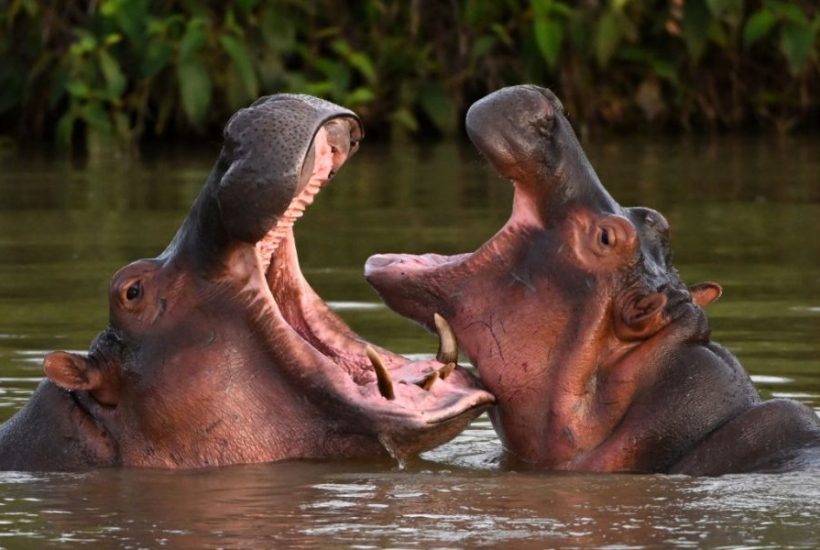
In Colombia’s enormous Magdalena River basin, an ecological anomaly has triggered an extraordinary debate among ecologists. Ought some invasive species – in this case hippos – be tolerated, or even welcomed, for the ecological role they play as proxies for prehistoric keystone species lost thousands of years ago?
In the early 1980s, infamous trafficker and kingpin Pablo Escobar smuggled four hippopotami – one male, three females – from an American zoo to his private menagerie at Hacienda Nápoles. Years later, on 2 December 1993, Escobar was shot dead by members of the Colombian national police’s search bloc in a shootout in Medellín. After his death, Escobar’s collection of exotic animals was dispersed to zoos around South America. The hippos, however, were deemed too large, too dangerous and too costly to relocate. They were set free and made their way down into the nearby Magdalena River, where they settled and began to breed.
Today, their descendants are thought to number over 200, roaming a 3,500 square miles of wilderness, roughly the size of America’s Yellowstone National Park, within a vast tropical river basin spanning 40,000 square miles. There they can be observed grazing riverbanks, wallowing in oxbow lakes, and reshaping wetlands in ways no South American native species has in several thousand years.
Hippos are true ecosystem engineers
At the outset, amid rising institutional alarm, environmental authorities declared Escobar’s hippos to be an invasive species and even a ‘biological pollutant’, calling for their immediate eradication. In 2009, a young male dubbed Pepe was shot by hunters sent out by local authorities. The mutilated hippo, draped over a tarp, made front pages. Colombians recoiled, protests erupted and a planned cull was suspended. The hippos, once symbols of narco excess, became popular heroes. Left alone, Escobar’s hippos didn’t just survive, they have thrived. Female hippos breed at three to four years old, producing a calf every 18 to 24 months. Population models now project 1,000 hippos by 2035.
In a landscape scarred by deforestation, gold mining and industrial cattle ranching, some ecologists have begun to observe that these African giants may be fulfilling a vital ecological role missing since South America’s catastrophic late-Pleistocene megafauna extinctions took place between 13,000 and 11,600 years ago. The continent experienced the most complete megafauna loss of any, losing forever giant ground sloths, sabre-toothed cats, giant armadillos, elephant-like creatures known as gomphotheres and a host of other species during a period that coincided with the widespread arrival and population growth of humans.
Could Escobar’s hippos represent Pleistocene rewilding in action? The species that performed the same ecological role as today’s hippos – the so-called ‘native analogue’ species – vanished 12,000 years ago: Neochoerus pinckneyi, a giant capybara weighing up to 400 kilograms. Like the hippo, it was semi-aquatic, grazed grasses, dug channels, and fertilised wetlands with dung. Its extinction left a vacancy in the role of ‘wetland architect’. Today’s hippos may have arrived by accident, but their role as an ecological proxy for the lost giant capybara in Colombia’s wetlands turns out to be amazingly precise. For this reason, a growing number of ecologists are now calling for the hippos to be welcomed for good.
Hippos are true ecosystem engineers. Their voracious nightly grazing reverses the choking of waterways by vegetation, and their trails on the banks and in the water create valuable aquatic corridors. Their wallowing creates open pools that serve as refuges for fish, caimans, and waterbirds during dry seasons. Most crucially, their dung acts as a slow-release fertiliser. Recent studies suggest that lakes with hippos had as much as 40 per cent higher algal productivity and 25 per cent greater microbial diversity than control sites. Fishermen are reporting better catches near hippo wallows. Ecologist Rafael Moreno describes the hippos as ‘the only large herbivores left to do the work that used to be done by many’.
Elsewhere in the world, similar stories are unfolding. In the American West, wild mustangs and burros, descendants of escaped Spanish horses and donkeys, were once targeted for eradication as ‘feral pests’. By the 1970s, the US Bureau of Land Management was rounding up tens of thousands of them for slaughter. Public outcry led to the 1971 Wild Free-Roaming Horses and Burros Act, which protected them on public lands. Today, ecologists increasingly appreciate their value. Mustangs control invasive cheatgrass, reduce wildfire fuel loads, and maintain grassland biodiversity. In Nevada’s Virgin Mountains, horse-grazed plots support a third more native plant species than ungrazed controls, as well as providing food for mountain lions, wolves, and even jaguars which are showing up across the Mexican border. An economic boon is underway too; wild horse tourism is worth approximately $50 million (£38 million) annually.
Australia’s feral camels offer another parallel. Brought in by the British in the 1840s for desert transport and freed into the wild with the arrival of mechanised alternatives, these camels now number more than a million in the Outback. An expensive cull was launched in 2010 amid fears of water depletion and habitat damage. But recent studies appear to tell a different story. Australia also lost most of its megafauna species with the arrival of humans, including large, soft-footed herbivores. Today, in the vast Simpson Desert, camels may be fostering vital lost natural processes. Camel wallows retain water three times longer than natural pans, creating micro-oases for birds, reptiles, and rare plants. Meanwhile, indigenous ranger programmes now earn upwards of $10 million (£7.5 million) yearly exporting camel meat and guiding eco-tours. The cull has slowed, and some ranger stations are advocating managed herds.
Colombia seems poised for the same pivot. Hacienda Nápoles, now a public theme park, draws 700,000 visitors annually, many of whom come to see the hippos. Local boat operators charge $15 (£11.25) for ‘hippo safaris’ on the Magdalena. Restaurants serve hipopótamo empanadas (a tongue-in-cheek nod). A 2023 economic impact study by the Antioquia Chamber of Commerce estimated that hippo-related tourism injects $22 million (£16.5 million) yearly into Puerto Triunfo and surrounding towns. Farmers, once fearful, now lease grazing lands to the park. ‘They bring jobs,’ one guide, María Elena Vargas, is quoted as saying. ‘Without them, we’d be back to cattle and cocaine.’
Enrique Ordoñez, a biologist at the Universidad Nacional de Colombia, calls the herd ‘a global conservation asset’. Another ecologist, Jonathan Shurin, whose National Geographic study tracks hippo impacts, found ‘no clear negative effects on native fish’ and ‘enhanced productivity’ in microbial food webs. Animal law expert Luis Domingo Gómez Maldonado argues for ethical non-lethal management: ‘It’s not about saving hippos on a whim, but giving them justice and giving the ecosystem a chance.’
Genetic rescue has the potential to transform a problem into an extraordinary ecological legacy
There is one just major issue: the hippos face a genetic crisis. Descended from just four founders (of which only one was male), they are suffering from a severe bottleneck. Without new blood, harmful mutations will undoubtedly accumulate. Natural selection may purge some of these, but not fast enough. Within 50 to 100 years, the population could collapse from immune failure, infertility, or a single pathogen.
The only fix is to bring in fresh blood, which seems an idea unlikely to garner the support of the scientific establishment or politicians. Nevertheless, a growing number of conservationists are indeed advocating for such a move. Five to 10 unrelated hippos from accredited zoos in South Africa, Europe, or North America would need to be imported, quarantined, tested for disease and then released into the Magdalena river. Within two generations, the inbreeding depression would vanish and adaptive potential would soar. Such a move would echo Florida’s 1995 rescue of its native panthers from a similar genetic plight. Eight cougars were imported from Texas, and the effects of inbreeding were quickly reversed.
The conservation movement is not known for its courage, nor for thinking much outside the box. Puritans will howl at the suggestion of adding new unrelated individuals to Colombia’s invasive hippo population. But the hippos are already there. Eradication appears to be practically impossible, logistically, financially, and politically. Sterilisation, the government’s current policy, is already seen to be ineffective. And the exporting of 60 such hippos (so far) to zoos in India, Mexico, and elsewhere is profoundly inhumane without making much of a dent in numbers. Genetic rescue, on the other hand, has the potential to transform a problem into an extraordinary ecological legacy.
Imagine Colombia with the world’s only wild hippo population outside of Africa. A living bridge between continents. A functioning, restored tropical ecosystem. Tourists flocking from Bogotá and beyond. A thriving fishing industry. Children learning about nature from the decks of boats. And with Africa’s hippos facing the destruction of their habitat, trophy hunting, poaching and drought, Colombia’s herd would be a safeguard for the species.
I know it sounds mad, but the accidental establishment of a population of African hippos on a major Colombian river system seems to me rather wonderful. An accident of history is transforming a damaged landscape for the better in magical and unpredictable ways. The giant capybara is gone. So too are the gomphotheres. But the hippos are here, grazing under ceiba trees, wallowing in sunlit lagoons, fertilising a river system that sustains millions of people. I can’t help but long for Colombia to make the decision not just to let them stay but to give them the genetic diversity they need to endure.