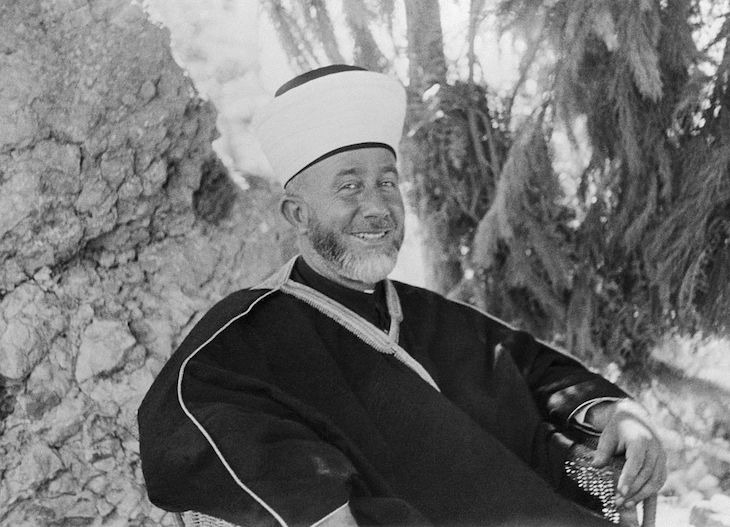
If the founding leader of the Palestinian national movement had been wanted for Nazi war crimes, you might assume this would figure in every modern debate about the Arab-Israeli conflict. Yet one of the darkest, most inconvenient facts of twentieth-century history has remained strangely peripheral: the intimate alliance between the Grand Mufti of Jerusalem, Haj Amin al-Husseini, and the Nazi regime.
The founding father of the Palestinian cause was an unapologetic Nazi collaborator who abetted an actual genocide
Many have seen the image of Husseini meeting with Adolf Hitler in Berlin in 1941. Yet few know what they discussed and what Husseini went on to do for the Third Reich. Fewer still understand how a man who lobbied for Jewish children to be sent to the gas chambers became a hero of the Palestinian cause.
The mufti did not formulate Hitler’s Final Solution, as Benjamin Netanyahu once falsely suggested. But that claim, and the swift debunking that followed, convinced many that Husseini’s Nazi connection was trivial. It was not. What he actually did was worse – and more revealing.
Born around 1895 into one of Jerusalem’s dominant clans, Husseini rose to prominence during the British Mandate. His opposition to Zionism was not political disagreement; it was a crusade. He stoked antisemitic unrest throughout the 1920s, including a deadly 1920 riot in Jerusalem. Rather than sideline him, Britain’s first High Commissioner of Palestine – Herbert Samuel, a Jew and a Zionist – pardoned him and, incredibly, appointed him Grand Mufti of Jerusalem. It was a decision that would haunt the region.
By 1922, Husseini controlled the Supreme Muslim Council as well, giving him utmost religious authority, political power and financial control over Muslim institutions. He used those platforms not to improve life for Arab Palestinians, but to consolidate power, intimidate rivals and inflame hatred. Husseini popularised The Protocols of the Elders of Zion in Arabic, and broadcast the lie that Jews intended to destroy Jerusalem’s Al-Aqsa Mosque. His incitement fuelled the 1929 Hebron massacre, which annihilated one of the world’s most ancient Jewish communities.
Still, the British hesitated to confront him. Only after the Arab Revolt escalated in 1937 did they finally move to arrest him. He fled into the welcoming arms of fascism.
After helping to instigate a Nazi-backed coup in Iraq and fleeing British pursuit yet again, Husseini arrived in Berlin in November 1941. Having declared Jihad against Allied powers, he met with Adolf Hitler. The mufti began by thanking the Fuhrer, telling him he was ‘admired by the entire Arab world’.
‘The Arabs were Germany’s natural friends because they had the same enemies,’ Husseini explained. ‘The English, the Jews and the Communists.’
He quickly became the Nazi regime’s leading Arab collaborator. From 1941 to 1945, he lived in luxury in a Berlin villa confiscated from a Jewish family. He led the Arab bureau of Joseph Goebbels’s Propaganda Ministry, broadcasting Nazi ideology to the Muslim world. With a staff of more than twenty and a monthly salary of roughly 50,000 reichsmarks, he earned more than many senior German officers. His value to the Reich was clear.
Historians note that Husseini pioneered a poisonous fusion of European racial antisemitism with Islamic religious motifs – a blend that still echoes today. His broadcasts called Jews ‘parasites’ who ‘suck the blood’ of nations. In 1944, he issued a chilling exhortation: ‘Kill the Jews wherever you find them. This pleases God, history, and religion.’
Heinrich Himmler, architect of the Final Solution, corresponded with Husseini warmly. In November 1943 – as extermination operations reached their peak – Himmler sent the mufti a letter praising their ‘joint struggle’ and wishing him ‘great victory.’ That year, Himmler informed Husseini that three million Jews had already been murdered in Nazi death camps. Germany, Husseini declared, had ‘resolved to find a definitive solution for the Jewish danger.’
 An Israeli delegate at the UN holds a picture of Haj Amin al-Husseini meeting Adolf Hitler (Getty Images)
Outside of his work with the Nazis, he laboured to ensure that Jewish refugees could not escape Europe for Palestine. In 1943, after learning that 4,000 Jewish children from Germany had reached Palestine, he demanded that Nazi officials block any further departures. In 1944, when Hungary approved the release of 900 Jewish children and 100 adults, he wrote to the Hungarian foreign minister urging him to send the Jews instead to ‘countries where they would be under active control, for example, in Poland.’ He knew precisely what ‘control’ meant in Poland.
Husseini also recruited thousands of Muslims into the S.S. and other Nazi units, particularly in Bosnia and Albania. These forces committed massacres not only against Jews and Serbs but also against Muslims who refused to collaborate.
The mufti also participated in Operation Atlas, a failed plot to establish a Nazi base in Palestine.
When the war ended, Husseini was indicted for war crimes by Yugoslavia and listed by the UN as a Nazi war criminal. Yet he escaped justice once again. Fleeing Germany on the day of its surrender, he was placed under house arrest in a villa outside Paris. Britain did not seek his extradition, and France preferred to curry favour with the Arab world. Sensing danger, he fled to Egypt in 1946 – in disguise, as always.
There, rather than disgrace, he found adulation. The Muslim Brotherhood hailed the arrival of ‘the Arab hero and symbol of jihad.’ The New York Times reported that although his actions were ‘sufficient cause for hanging in other countries,’ Husseini’s prestige ‘had only increased’ among Arabs. His villa in Alexandria was ‘the new shrine of political Islam.’
That is precisely why the story of Haj Amin al-Husseini still matters
In 1947, when the UN offered the Arabs and the Jews of Palestine two independent states, Husseini rejected partition and declared a holy war to wipe out the unborn Jewish state. Veterans of the Muslim S.S. units he had recruited in Europe joined the Arab assault, first against the Jews of Palestine, then against Israel.
During his years in Egypt, Husseini mentored his young cousin Yasser Arafat, who later succeeded him as leader of the Palestinian cause. When Husseini died in Beirut in 1974, Arafat attended his funeral. He later declared his ‘immense pride’ in having been his disciple. Leaders of the Palestinian Authority – including Mahmoud Abbas – still honour him.
The mufti’s own writings reveal no remorse. As historian Steven Wagner, who has studied Husseini’s personal archives, explained: ‘From his point of view, this was all justified. He was fighting for his country. To him, the Jews were aliens who didn’t belong in Palestine.’
That is precisely why the story of Haj Amin al-Husseini still matters. Not because he inspired the Holocaust, but because he willingly aided it – and because the foundational figure of the Palestinian national movement was a Nazi war criminal whose antisemitism left a lasting legacy.
Husseini’s legacy lives on not in the archives of historians but in the political culture he helped shape: the glorification of violence, the demonisation of Jews, and the century-long refusal to accept Jewish self-determination in the Jewish homeland.
It is impossible to fully understand this conflict without acknowledging the man who, more than any other leader, ensured that the Palestinian national movement would define itself not by building a nation, but by seeking to destroy one.
Many are reluctant to confront this history. Perhaps because it’s inconvenient. Perhaps because it complicates preferred narratives. But the truth remains: the founding father of the Palestinian cause was an unapologetic Nazi collaborator who abetted an actual genocide. And he remains, to this day, a celebrated hero of the movement he helped create.