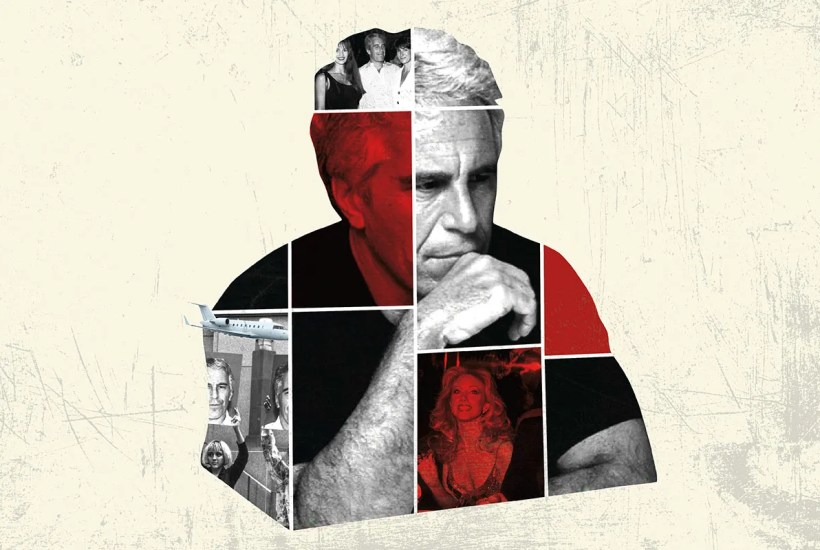
How do characters like Jeffrey Epstein come about, really? One way to find out is to read his emails, 20,000 of which were released by the House Oversight Committee in November. What they show us is that people like Epstein were a product of the second half of the 20th century, their existence more or less impossible outside this era and its conditions.
After World War Two it was decided that majoritarian democracy was too dangerous and had to be replaced by international law, human rights and expanded bureaucracies.
Epstein took this state of affairs for granted. In a 2016 email to the New York Times journalist Landon Thomas Jr., he talks blithely about the existence of what we would now call a “deep state”: “In politics the USA meant the white house. now there is pentagon. cia, state, and congress in addition, each feels empowered to act more independantly.” [sic]
As power became more diffuse, there were more people to bribe or blackmail, more points of entry into the Establishment for an ambitious power-seeker such as Epstein. The golden age of the “deep state” was also the golden age of the frontman and the dupe, controlled by high-level blackmail rings.
Yet none of this would have been possible without a tight control of information and an unusually incurious populace. Thanks to TV, you had both. Television meant that from around 1945 to 2000, the public’s entire view of reality was being curated by about three channels plus a few leading print outlets. At no point before or since has information been quite so centrally managed.
It was this media environment that made it uniquely possible for wire-pullers such as Epstein to operate in the shadows. As late as the mid-2010s, the legacy media could still quash some of the talk about him. ABC News famously pulled an interview with Virginia Giuffre after pressure from Buckingham Palace and, in 2016, the Trump chronicler Michael Wolff emailed a memo to Epstein to reassure him that the investigative journalist John Connolly “is known to have developed an obsession with Epstein, such that, his longtime employer, Vanity Fair, has refused to allow him to write about Epstein.”
Traditional media and traditional showbiz are a presiding force in these emails. There are endless attached press clippings about award ceremonies and red-carpet premieres, Hollywood tittle-tattle breathlessly relayed.
The internet is rarely mentioned, only as a vaguely menacing offstage presence that threatens to undo them all. From 2015 until his death in 2019, the world that gave rise to Epstein was clearly disintegrating. Social media made it much easier for ordinary people to discuss the misdeeds of the powerful. It also meant that a politician could now go over the heads of middlemen like Epstein and appeal directly to the people. By the 2010s there was already something old-fashioned and faintly vaudeville about him.
In his emails, Epstein tries to extricate himself with the old methods. Wolff suggests he should pen an “op-ed” in the Huffington Post and go on Charlie Rose. He engages the services of the slightly absurd grand dame Peggy Siegal, one of those boxy-suited socialite-PRs and hostesses who call you “darling.” She already seems to belong to a previous age, swooning over the “iconic Beverly Hills Hotel,” her “home away from home for 30 years of Oscar weekends.”
There are attempts to reach out to the new force of populism through Steve Bannon, but at some point Epstein appears to have recognized that his methods were obsolete. Whether or not we ever draw a line under the Epstein saga, it’s clear that the world which produced him has now gone the way of cable TV.
This article was originally published in The Spectator’s December 22, 2025 World edition.
The post How the ‘deep state’ enabled Epstein to operate appeared first on The Spectator World.