One of the crucial obstacles to a Ukraine peace deal appears to be Vladimir Putin’s demand for the remaining fifth of Donetsk region not in Russian hands. Kyiv not only resents the idea of surrendering hard-defended land, it also fears this could be use it as a springboard for future attacks deeper into Ukraine. One potential workaround under debate is apparently allowing Moscow to claim it, but also making it a demilitarised zone (DMZ) to ensure Russian troops stay out. But it’s not so cut and dried.
The notion of a DMZ may seem like an elegant way to square the circle of Putin’s demands and Ukraine’s concerns, but it’s all rather more complex than that
Yuri Ushakov, Putin’s senior foreign policy adviser and his main negotiator, recently asserted that any ceasefire can only follow the withdrawal of Ukrainian troops from Donetsk, but that ‘we can, in my opinion, discuss what will happen after that. Because it’s entirely possible that there won’t be any troops there, either Russian or Ukrainian. Yes, but there will be the National Guard, our police, everything necessary to maintain order and organise life.’
After all, this area contains the so-called ‘fortress cities’ of Kramatorsk, Slovyansk, Kostyantynivka and Druzhkivka, and a remaining total population estimated at around a quarter of a million. If they were to be handed over to Moscow, it is assumed that many of the inhabitants would leave and head west, but judging by what has happened elsewhere, others would not. They may not want or be able to abandon their homes and lives, may actually welcome Russian rule, or simply don’t care who controls them so long as the fighting stops.
Meanwhile, although it would be a long time before these cities experience the kind of wholesale reconstruction and remodelling witnessed in earlier combat zones such as Mariupol (which often goes hand in hand with an influx of Russian workers and settlers), there will be some investment to maintain basic services. As one Ukrainian official reluctantly acknowledged, ‘it’s not just that the [Russians] will want to look like enlightened imperialists, they also don’t want to be dealing with epidemics and starvation.’
Even if this is a DMZ that is properly monitored to ensure the Russians don’t move in troops, it will still need to be policed. Moscow is hardly going to be willing to let the existing Ukrainian police continue to do the job – even if many of them were willing to stay – and so will bring in its own law enforcers.
Russia’s law enforcement structure though is built around two main bodies: the regular police of the Ministry of Internal Affairs (MVD) and the National Guard, generally known as the Rosgvardiya. The latter was essentially carved out of the MVD in 2016. Although abuses are still common, the police had gone through a decade of gradual reform, symbolised by the replacement of the old Soviet term ‘militia’ and replacing it with ‘police’ in 2011. As regional commanders increasingly chafed at being used as political stormtroopers, Interior Minister Kolokoltsev quietly expressed their concerns to the Kremlin.
In response, he was cut off at the knees. Out of the blue, Putin announced that the most heavily-armed elements of the MVD would be hived off to a new force, under his former bodyguard General Viktor Zolotov. A man who an MVD official bitterly characterised to me as ‘Putin’s Doberman, now trying to walk on his hind legs,’ Zolotov was not going to have any such qualms.
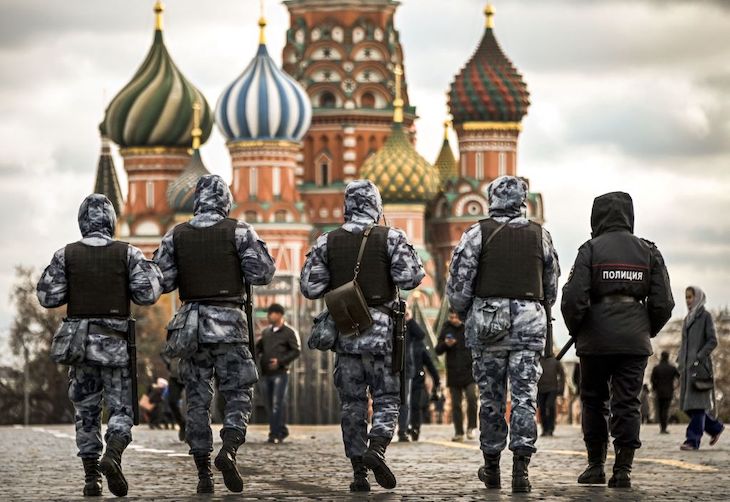
The Rosgvardiya has an establishment strength of some 180,000 officers (and as many within Okhrana, their private security arm). It comprises the heavily-armed rapid-response units known as SOBR, the OMON riot police, and the Interior Troops. The latter is a militarised force which includes units such as the 1st Separate Operational Designation Division (1 ODON), which has its own tanks, armoured vehicles and artillery. All these units took part in the initial invasion in 2022 (often taking heavy casualties) and continue to serve in Putin’s ‘special military operation,’ acquiring a brutal reputation for ‘pacification’ operations against real and suspected partisans in the occupied territories.
Allow the Rosgvardiya into a DMZ on the grounds that they are technically law enforcers rather than police, and Moscow can still mass an army there in all but name. 1 ODON alone is around 15,000 strong. Bar the Rosgvardiya and the Russians will claim, not wholly without reason, that without this heavily-armed back-up, their regular police will be unequal to the task of controlling cities still full of recalcitrant locals and Kyiv’s stay-behind special forces.
This is, in so many ways, a case study in the kinds of complexities trying to build peace in Ukraine entails, and the back-to-front nature of Trumpian diplomacy. Usually, the big public pronouncements follow months or years of painstaking detail work behind the scenes; now, people are scrambling to try and turn broad political statements into workable plans. The notion of a DMZ may have seemed like an elegant way to square the circle of Putin’s demands and Ukraine’s concerns, but it’s all rather more complex than that.