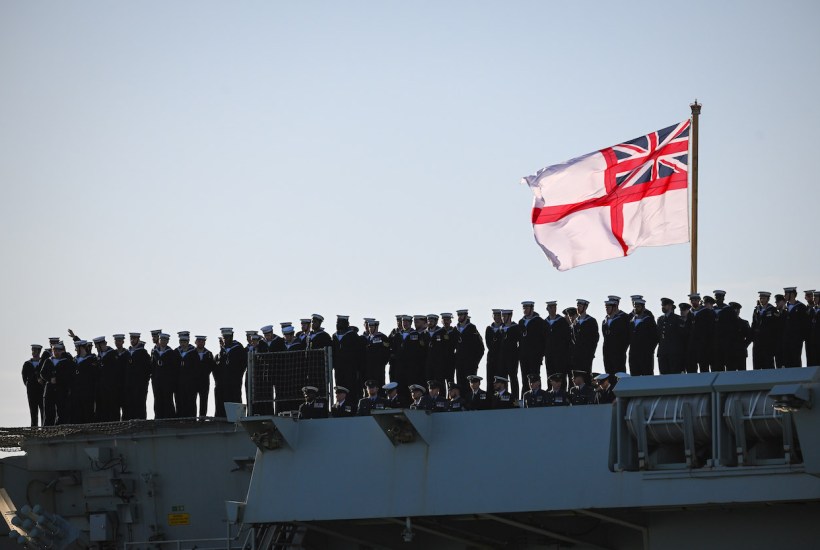
Huge crowds of locals, plus families and friends of the crew, greeted the return home of the nation’s flagship aircraft carrier, HMS Prince of Wales, last week. It was a fitting climax to a flawless, highly significant, eight-month, 40,000-nautical-mile deployment to the Far East. Sailors spoke about the emotion of their homecoming, pride in their hard work, and their desire for shore leave.
In November, the Ministry of Defence announced that Britain’s carrier strike capability had reached Full Operating Capability (FOC). This means we will have one carrier always available for operations with 24 advanced F-35 stealth jets embarked. The UK is alone in having its carrier committed to Nato at short notice. But Full does not mean Final.
It has taken almost 30 years to get to this point; Labour’s Strategic Defence Review recommended acquisition of two new aircraft carriers and next-generation jets in 1998. Decades of political indecision, real-term defence cuts, cost growth, construction delays, defect rectification, and, in the case of the jets, ‘short-termism, complacency and miscalculation’ followed. This delayed FOC by years.
It left the carriers at repeated risk of being scrapped, to the joy of some in the army and RAF and their media outriders. To their chagrin, this year’s Strategic Defence Review concluded the UK should retain and further evolve its carrier strike. The National Security Strategy reminded them that ‘control of the sea remained critical for Britain as an island nation’: for security at home, strength abroad and sovereign defence capabilities.
The multi-national carrier group operated alongside nine different aircraft carriers during its recent deployment. Jets were operated at a scale not seen since the Falklands War in 1982.
Of course, significant problems remain. We don’t have enough frigates or support ships to accompany the carrier, and it remains a scandal that our hugely expensive modern nuclear attack submarines are tied up in port due to mismanagement and a lack of available dry docks.
The ‘single biggest concern’ of Air Chief Marshal Sir Richard Knighton, the new Chief of Defence Staff, is the lack of long-range missiles to strike land targets from a safe distance. Presently the jets can only drop 500lb bombs. A ‘severe shortage of… engineers, cyber specialists, pilots and qualified flying instructors’ is reducing the number of available aircraft. Their range is also an issue.
None of these problems are insurmountable. Replacement support ships and frigates are being built. Alternative long-range missiles may soon be purchased to fill the gap until British missiles are fitted onto the aircraft. Engineers should investigate ways of getting more fuel airborne to refuel the jets.
We also need more stealth fighters. From an initial ambition of purchasing 138, the government is only committed to buying 62. A sustainable number is probably in the low seventies. This would allow the carriers to embark a maximum of 36 aircraft in extremis, the number they were designed for.
But the UK ambition is higher. The SDR said the current carrier capability in the future will need to have ‘crewed jets complemented by autonomous collaborative platforms and expendable, single‑use drones’.
The new First Sea Lord has accelerated timelines to test and field uncrewed drones by the end of the decade. New carrier-launched uncrewed drones may in the future enhance overall lethality by flying alongside crewed jets. Other drones could help improve detection of submarines, provide long-range airborne early warning, or deliver supplies and equipment between ships. An important step will be the launch of a ‘jet-powered collaborative drone’ demonstrator from a Queen Elizabeth-class carrier as soon as next year.
The priority for the next few of years will be operations
To improve, the armed forces need more money. The recent Budget had plenty on welfare, but little on warfare. A Defence Investment Plan to implement SDR recommendations appears to be running late due to difficulty in balancing the books. There are many other competing priorities. Procurement debacles such as Ajax don’t help.
The good news, insiders tell me, is that alignment between the Royal Navy and Royal Air Force is probably the best it has been for decades. Both services have a long and proud record of conceptual and technical innovation. Both want to squeeze out more from what they have.
A UK carrier group is unlikely to be headed out east for a while. The priority for the next few of years will be operations with the US Navy and others in the North Atlantic and Mediterranean, and testing new kit for demonstration during a Nato exercise to the ‘High North’ in 2027.
A distinguished diplomat said in 1908 that our ‘geographical situation on the ocean flank of Europe as an island State’ means our ‘existence and survival as an independent community are inseparably bound up with the possession of preponderant sea power’. Our carriers, alongside our nuclear weapons, will remain critical for our enduring security and prosperity and that of our allies.