There are decades when The Spectator is shorthand for a trait: sex (2000s), young fogeys (1980s), free trade (1900s). But I was surprised to find Henry James, a writer not given to shorthand, deploying the magazine’s name to give a sketch of Isabel Archer, the title character of his Portrait of a Lady: ‘She had had everything a girl could have: kindness, admiration, bonbons, bouquets, the sense of exclusion from none of the privileges of the world she lived in, abundant opportunity for dancing, plenty of new dresses, the London Spectator, the latest publications, the music of Gounod, the poetry of Browning, the prose of George Eliot.’
‘That half-page is sufficient to reassure me that the world goes on much as it always has’
In a way the list undermines the heroine by mixing the serious and the frivolous. James, writing as the 1880s broke, lumps Gounod in with bonbons and bouquets perhaps because the composer had spent years in London in the 1870s getting tangled up with the strange figure of Georgina Weldon and then trying to get untangled from her. A favourite subject of gossip, she was a soprano, spiritualist, serial libel plaintiff and energetic opponent of her estranged husband’s attempts to have her locked in an asylum.
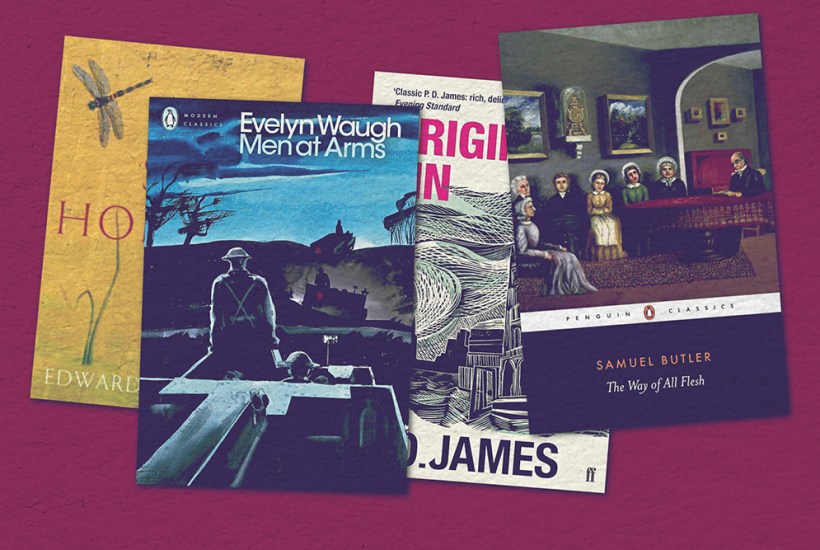
In Men at Arms (1952), Evelyn Waugh uses a similar novelistic technique of suggesting character by association. On Saturdays, Guy Crouchback, the hero, of a kind, remains in barracks when there is a general exodus: ‘It was holiday enough for Guy to change at his leisure, wear the same clothes all the afternoon, to smoke a cigar after luncheon, walk down the High Street to collect his weekly papers – The Spectator, the New Statesman, the Tablet – from the local newsagent, to read them drowsily over his own fire in his own room.’
Reading the New Statesman was no sign of foaming radicalism in Crouchback, even though the editor, Kingsley Martin, refused to publish dispatches from Barcelona by George Orwell because they criticised the Spanish Communist party. Crouchback read the Tablet, then of a rather conservative disposition, because he was a Catholic. The picture fits in with his conventional upper-middle-class way of life.
Forty years on, Robin Parker, a character in Edward St Aubyn’s Some Hope, enjoying an annoying railway journey, picks up his Spectator, which is characterised perhaps not entirely fairly as ‘a Perseus’s shield against the Medusa of modernity’. The author notes that it is a description of the magazine that Parker has used more than once.
In Samuel Butler’s The Way of All Flesh, written between 1873 and 1884, but not published till 1903, The Spectator fails to come up to scratch in another role – as a Dummies’ Guide to political conversation. In a scene set in 1848, the hero Ernest is taken by his father, Theobald, to meet the headmaster of his new school: ‘Dr Skinner and the other masters took in the Times among them, and Dr Skinner echoed the Times’s leaders. In those days there were no penny papers and Theobald only took in The Spectator – for he was at that time on the Whig side in politics; besides this he used to receive the Ecclesiastical Gazette once a month, but he saw no other papers, and was amazed at the ease and fluency with which Dr Skinner ran from subject to subject.’
The Spectator wasn’t good enough either for E.F. Benson. Before he ever moved to Rye and began writing Mapp and Lucia novels, he wrote a series of sketches called The Freaks of Mayfair. The Revd the Hon. J.S. Sandow, when not hobnobbing with his well-heeled parishioners, gives himself to literature: ‘This literary profession of his is no mere matter of a parish magazine, or of letters to the Guardian about the Eastward position, or The Spectator about early buttercups, but he publishes on his own account at least two volumes every year.’
The Guardian referred to is not the newspaper, which in those days was called the Manchester Guardian, but the Anglican weekly that ran from 1846 to 1951. C.S. Lewis published The Screwtape Letters in instalments there in 1941. The Spectator was lucky that the Revd and Hon. Mr Sandow did not succeed in visiting upon it the essays that filled his annual volumes, for Benson reveals they are of this pattern: ‘Mr Sandow tells you how he was walking across the Park one morning, when he observed two sparrows quarrelling over a piece of bread that some kind bystander had thrown them. This naturally gives rise to reflections as to the distressing manner in which ill-temper spoils our day.’
In the world of modern poetry, which if not exactly fiction can hardly be called factual, Ezra Pound, who had spent a pleasant few years in London, brought out a slim volume called Lustra in 1916. One poem, ‘Salutation the Second’, bids his songs: ‘Go! rejuvenate things!/ Rejuvenate even “The Spectator”.’ They are to: ‘Dance the dance of the phallus/ and tell anecdotes of Cybele!/ Speak of the indecorous conduct of the Gods!/ (Tell it to Mr Strachey.)’ Mr Strachey was not Lytton Strachey, whose Eminent Victorians was to be published two years later, but his cousin John St Loe Strachey, who had already been the respectable owner and editor of The Spectator for 18 years.
Pound had already found a place in T.S. Eliot’s life when the latter published Poems (1920), which included ‘Le Directeur’: ‘Le directeur/ Conservateur/ Du Spectateur.’ And so on. It’s a surreal little poem, more interested in sound than sense. If Pound reads like a translation into English, Eliot goes a step further with his distancing device.
Since then, The Spectator has more often been placed in fiction, in print or on screen, to make it seem to be the real world. A dummy Spectator may be glimpsed in the Netflix serial The Diplomat (2023), and a cover produced by the magazine’s staff appeared in Industry (2020), with artwork drawn specially for the programme by the brilliant Morten Morland.
Elizabeth Day in her new novel One of Us fictionalises The Spectator as the Witness, in which Edward Buller, as editor, had made an awkward remark about harems and Muslims, upon which the Witness offices were promptly firebombed. This must have been inspired by some comments that the late Auberon Waugh once made in the Times before he joined The Spectator about Mohammed. I won’t repeat them, but they provoked an angry mob to burn down the British Council building in Rawalpindi.
The deployment of The Spectator about which I feel most ambivalent was in P.D. James’s Original Sin (1994), in which a character declares: ‘I no longer bother with newspapers. The Spectator has a summary of the week’s main news. That half-page is sufficient to reassure me that the world goes on much as it always has.’ At that time, I used to write, as I still do, Portrait of the Week, and it feels funny to be part of a murder plot. But I wonder if James meant ‘assure’ rather than ‘reassure’. Too late to ask her now.
Got something to add? Join the discussion and comment below.
You might disagree with half of it, but you’ll enjoy reading all of it. Try your first month for free, then just $2 a week for the remainder of your first year.