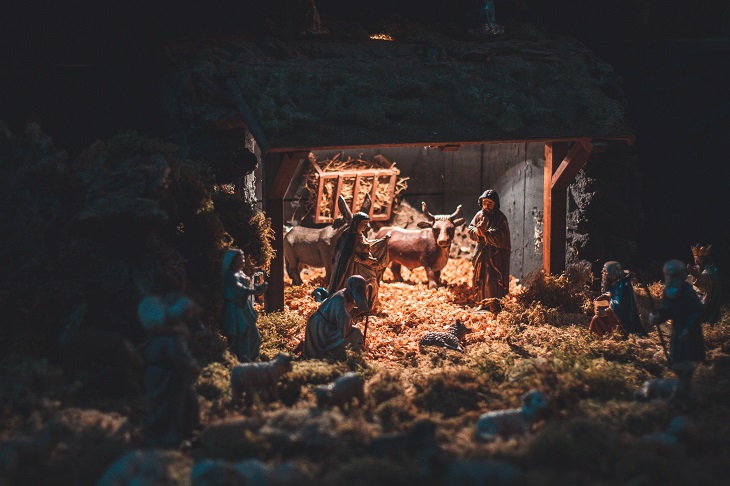
Here it is – Christmas again. And once again it can hold a lesson for us. For perhaps it really is worth contemplating what it means for a baby, said to be a king, to be born in the lowliest of circumstances.
If you choose to reflect in this way, you will be in good company. Many thinkers, beyond straight theologians, have considered this event. Of course, sometimes those reflections have resulted in us receiving some of the best-loved songs of our times – known as Christmas carols.
Even the atheist H G Wells, who wrote A Short History of the World, paused to consider this baby born into a very particular community. Even though he was not a personal believer in Jesus as the Christ, Wells said this about him:
The personal teaching of Jesus does seem to mark a new phase in the moral and spiritual life of our race… With Christianity, with the spreading teachings of Jesus, a new respect appears in the world for man as man.
A contemporary of Wells was the Christian GK Chesterton. He decided to also write a short history of the world, but in his history, he placed whom he thought to be the central character at the centre of the story. That person was Jesus, and Chesterton’s work (The Everlasting Man) comes to a climax in his chapter called The God in a Cave – for as best we can tell, that is what the manger was – a cave.
In one sense, Chesterton agreed with Wells – after that moment there could be no more slaves… Individuals became important, in a sense in which no instruments can be important. In another sense, Chesterton strongly disagreed with Wells – why? Because Chesterton believed that the basis of this deepening of respect of life was due to the Creator’s grace. Grace is when we continue to invite others into relationship, even when they don’t deserve it. The grace that Chesterton saw was that the Creator sent His Son to be born in a cave, which was the humblest of all places, and in a remote part of the Roman Empire!
Chesterton therefore concluded his reflection about the Birth in a Cave in this way:
It is rather something that surprises us from behind, from the hidden and personal part of our being… It is rather as if man found an inner room in the very heart of his own house, which he had never suspected, and seen a light from within.
Perhaps we too can consider afresh the Birth in the Cave this Christmas – in a way that surprises our hearts, even in ways that we do not suspect. May that again reinforce that universal respect is possible, if our hearts are right and our minds are clear.
Joy to the World!