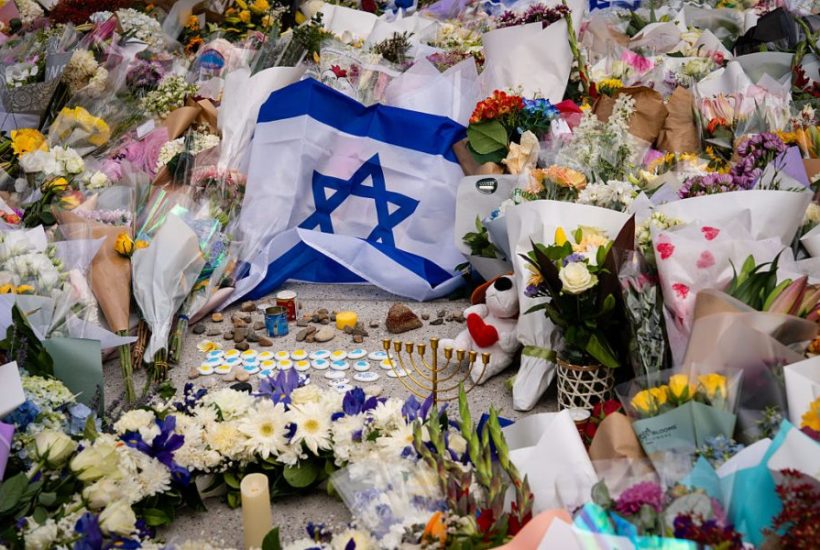
I knew two of the people murdered at Bondi Beach. That beach has always felt like Australia distilled: sun-bleached, open, and unserious in the best way. It is where the country goes to exhale. You don’t brace yourself at Bondi Beach. You assume the day will end the way it began.
My late father once thought that too. A Holocaust survivor, he arrived in Australia after the war with just a suitcase in his hand and a number on his arm. Australia took him in without interrogation of his past loyalties or beliefs, expecting only that whatever horrors he had fled would not be imported here. He honoured that bargain, worked hard, enjoyed financial success, and gave plenty back. As did so many others who came in those post-second world war waves. That bargain has now frayed. Bondi Beach was the proof.
We have a saying: she’ll be right. It means don’t panic, don’t overreact, things will work themselves out. As a national temperament, it has served us well. As an immigration philosophy, it has become an excuse for intellectual laziness. Bondi Beach is what happens when a country shrugs.
Sadly Bondi Beach is not just an Australian story. It is a test case
Australia likes to think of itself as the world’s most successful multicultural society – and for decades, it was. A former British penal colony with no aristocracy to speak of, Australia developed a deeply egalitarian civic identity. This was expressed through another Australian phrase – that everyone should have a fair go – which demanded mutual respect, tolerance and equal opportunity. Jews fleeing Europe, Greeks and Italians rebuilding shattered lives, Vietnamese escaping communism, and later Chinese migrants chasing opportunity; all were absorbed into a shared public culture that was unmistakably Australian within a generation. What made this work was a clear and unspoken contract: keep your culture, embrace your new home, and leave your old-world hatreds at the door.
The philosopher Karl Popper – himself a Jewish refugee who lost 16 relatives in the Holocaust – warned that unlimited tolerance leads to the extinction of tolerance itself. A society that tolerates the intolerant will eventually be destroyed by them. Popper wrote those words from exile in New Zealand while my father was a slave labourer in the Nazi concentraion camp Auschwitz.
Australia absorbed Popper’s insight instinctively. Multiculturalism here was never meant to be relativism. It was conditional. And it worked because the conditions were enforced socially, if not always formally. Despite a white Australian undercurrent of racism and parochialism, the country was tolerant and its new arrivals were even more tolerant. But more recently, they haven’t been.
The Bondi attackers were not foreigners fresh off a plane. They were Australian residents; one was a Muslim immigrant, and the other, his son, was born in Sydney and held citizenship. The police suspect that they trained with Isis-linked groups in the Philippines. Rather than an aberration divorced from broader trends, their act was the inevitable next step.
Since Hamas’s 7 October attacks against Israel in 2023, anti-Semitic incidents in Australia have surged dramatically. According to community security organisations, reported incidents have more than quadrupled, representing the steepest proportional increase in the English-speaking world. From the protests outside the Sydney Opera House, where people shouted ‘where’s the Jews’, to weekly pro-Palestinian protests that adopted anti-Semitic rhetoric, to vandalism and arson against schools and synagogues, we’ve seen a clear progression and escalation. And with each escalation, Australian Jews were shocked but not surprised.
In parallel with this, we have seen a shift in the threat environment. Australia’s own security services now say as much. Mike Burgess, the director general of the Australian Security Intelligence Organisation (ASIO), has identified anti-Semitism as his agency’s top priority ‘in terms of threats to life’. It is the first time a form of racism has ever been described that way by Australia’s domestic intelligence chief. Old-world hatred is no longer staying in the old world.
This year, Australia expelled Iran’s ambassador after ASIO traced a series of anti-Semitic attacks to what Burgess described as a ‘layer cake’ of Iranian state-backed direction, operating through criminal proxies on Australian soil. In plain language: a hostile Islamist regime is exploiting communities that Australia failed to integrate, turning them against the country that took them in. Even the Bondi Beach hero, Ahmed el Ahmed, who bravely disarmed one of the shooters, has been denounced as a ‘traitor’ by Arab media for saving fellow Australians who happened to be Jews. This is exactly the scenario Popper warned about: tolerance weaponised against itself.
None of this should have come as a surprise to law enforcement and security services; Australia has faced Islamist-inspired violence before. The 2014 Lindt Café siege in Sydney, carried out by a self-proclaimed Islamist extremist known to authorities, exposed failures of both intelligence coordination and political nerve. Subsequent attacks and disrupted plots followed familiar patterns: radicalisation within communities that existed alongside Australian society rather than inside it.
Each incident was treated as an exception – more ‘lone wolves’ – rather than a pattern. But the Jewish community knew better. We had seen that pattern before. And yet our government was barely able to name the problem, let alone address it.
When then-immigration minister Peter Dutton observed in 2016 that 22 of 33 terrorism charges involved second- or third-generation Lebanese-Muslim Australians, he was denounced as a racist. While the statistic was accurate, even then saying such things was unacceptable. That silence has had consequences.
Integration and assimilation must be understood as the price of entry
Australia today finds itself in the strange position of having overwhelming public support for multiculturalism (some 85 per cent of Australians consistently endorse it) while our leaders lack the political courage to define what multiculturalism requires. This is not a country teeming with bigots. The problem is not public sentiment; it is elite taboo.
Since the attack, I’ve received dozens of messages of support, most from non-Jewish friends and associates. Many call themselves ‘the silent majority’ and wonder how they can help. But our leaders have confused moral seriousness with moral panic, and in doing so, abandoned the very principles that made multiculturalism viable in the first place.
Australia once understood this intuitively. Immigrants were welcomed because Australia believed rightly that its civic culture was strong enough to absorb newcomers who wanted to join it. That confidence has been replaced by a brittle moralism that treats any discussion of integration as an act of hostility.
But integration and assimilation must be understood as the price of entry. Enforcing the social contract is more powerful than any rush to new laws or authoritarian impulses. It requires the courage to use the tools we already have: enforcing laws against those who advocate violence, prosecuting incitement consistently, revoking visas for non-citizens who import sectarian hatred, and ceasing to pretend that every failure of integration is merely a misunderstanding.
Other Western democracies should be paying close attention. Australia was long held up as proof that mass immigration and multiculturalism could coexist. Bondi Beach suggests that model works only if you enforce its terms.
The people I knew who died at Bondi Beach were ordinary Australians, going about their lives in a place that symbolised openness and ease. They deserved better than ‘she’ll be right’. So did my father, who believed Australia had learnt the lessons Europe refused to learn in time. So does Australia now. And so, increasingly, do the other democracies watching us, because sadly Bondi Beach is not just an Australian story. It is a test case. One we can still pass, if we choose to stop shrugging.