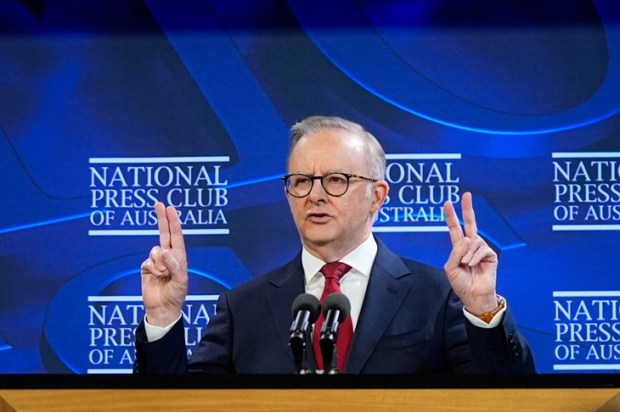
The referendum revealed a troubling pattern in the Prime Minister’s language.
Whenever Anthony Albanese speaks from genuine conviction, his words stop describing reality and start pressuring the listener. What should persuade instead coerces. It exposes the machinery of what I call the culturally engineered robot, a rhetorical system that enforces obedience while dissolving responsibility. It is a mode of speech that replaces reasoning with soft coercion and shifts responsibility from the speaker to the listener.
The Albanese myth is built around the image of the quiet man of conviction. After decades in the parliamentary trenches, he was meant to be the authentic contrast to the performative politician. Direct. Principled. Trustworthy. But a forensic reading of his rhetoric, especially when his moral certainty is activated, reveals a deeper problem.
When discussing budgets, infrastructure or the clear condemnation of antisemitism, his language is functional and restrained. It behaves proportionately because belief is secondary. When he condemned antisemitism in Parliament, his words were plain, proportionate, and free of pressure. When belief becomes primary, the structure collapses. His moral passion shortcuts argument. Clarity gives way to pressure. Conviction becomes the catalyst that triggers denial of cost, denial of risk and denial of dissent.
The Voice campaign exposed this most clearly in his repeated use of the word modest. A constitutional change is never modest. It alters the legal machinery of the Commonwealth. It introduces risk by definition. To call it modest was not description but sedation. The word shrank the scale of the decision and disarmed scrutiny. His certainty, instead of producing clarity, produced concealment.
The second reflex appears whenever resistance rises. He appeals to what he calls common sense. This was his defence of the redesigned Stage 3 tax cuts. Breaking an election promise was re-framed as simple relief, obvious to anyone thinking clearly. When a policy cannot withstand evidence or logic, common sense becomes a device to impose deference. It claims the high ground without earning it. The public, not the policy, becomes the implied problem.
The final reflex is the injunction to be part of the solution. Albanese uses this across domains including the recognition of a Palestinian state, the housing crisis, and major economic settings. The structure is always the same. A politically risky decision is framed as a moral task that citizens must complete. Responsibility for outcomes shifts from the decision maker to the public who must now deliver the success. It is one of the quietest but most consequential rhetorical displacements in modern politics.
These reflexes betray the authentic image he wants to project. They are not the language of conviction but the language of avoidance. The irony is that this drift weakens the very policies he cares about most. Voters instinctively resist the pressure because, under scrutiny, the language reveals itself as a mechanism designed to suppress disagreement and dissolve accountability.
If Albanese wishes to lead through conviction, he will have to reclaim clarity.
Conviction does not require coercion. Authority does not require the denial of risk. Politics cannot be repaired while its language is engineered to secure compliance rather than invite judgment.
Australians can accept disagreement.
What they will not accept is being told that compliance is common sense.
The Voice campaign proved that clearly.