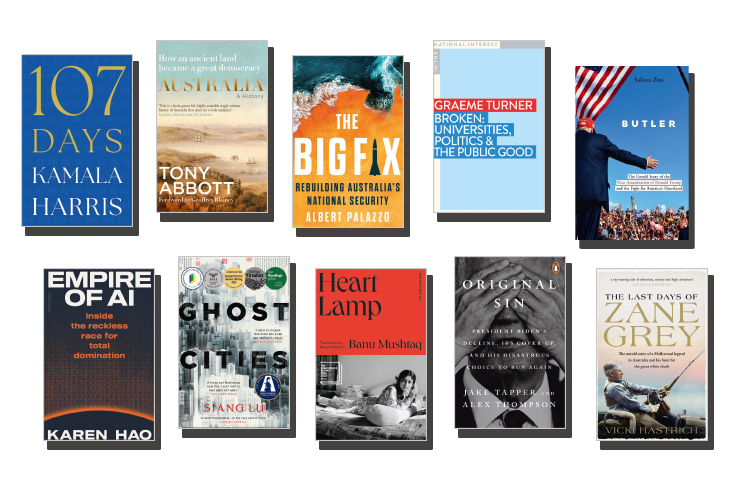
Books about Australia’s past can easily turn into battlefields, and many commentators expected Tony Abbott’s Australia: A History (HarperCollins, $35) to be an exercise in aggressive whitewashing. In fact, it is a remarkably even-handed piece of work. Certainly, Abbott disdains the black-armband view of history and recounts the many positive aspects of the country’s culture and people. But he is entirely ready to call a spade a shovel, as in the sections about the violent conflicts between the first white settlers and the indigenous tribes. Far from the ‘convict dumping ground’ myth, he argues that Australia was settled as a dynamic frontier. He applauds the steady expansion of social and political rights, even when the reforms came from the non-conservative side. Australia has generally been a very good place to live, work and raise a family. We have always been an ingenious, forthright people, he says, and will probably continue to be. In short, the book shows Abbott to be optimistic but realistic, proud without being pompous. A companion television series is available to stream at SkyNews.com.au.
They just don’t make them like this anymore, if The Last Days of Zane Grey (Allen & Unwin, $35) by Vicki Hastrich is to be believed. In the 1930s Grey found fame (after an abortive career as a dentist) as the swashbuckling writer of a stream of Wild West novels, and several of his books were turned into Hollywood movies. He also made lengthy excursions to Australia, partly due to a semi-secret romance with an Australian poet called Lola Gornall and partly due to his obsession with game fishing. He even tried – not successfully – to make a movie about a killer shark on the Great Barrier Reef. The emotional climax of this rambunctious life was a protracted battle with a monstrous great white shark in the waters near Port Lincoln. Hastrich obviously loves telling this story, mixing personal snippets with Grey’s larger-than-life adventures, and even readers with no interest in game fishing or cowboy novels will find this book hard to put down.
Graeme Turner, an emeritus professor who has been an adviser on tertiary education to a long list of governments, reviews and industry bodies, has no good news to share in Broken: Universities, Politics and the Public Good (Monash University Publishing, $20). A parade of attempts to reform the sector has created a system which pleases no one, from underpaid casual academics to administrators who seem to be stuck in a maze of uncertain objectives. Turner unpacks all this, pointing to the over-dependence on international students, the soaring cost of many courses, and the breakdown of the research grant system. He also discusses the plight of regional universities, an issue often neglected. He acknowledges that a major increase in government funding is unlikely, and he instead offers proposals to use existing funds more strategically. These would be very difficult to implement, given the number of entrenched parties involved. Nevertheless, Turner has done much to show the extent of the rot and to explain how we got to here.
Albert Palazzo was Director of War Studies for the Australian Army before moving into academia, so he has been thinking about defence policy for a long time. In The Big Fix: Rebuilding Australia’s National Security (Melbourne University Press, $18) he takes a deep dive into the issues, proposing a posture he calls ‘the strategic defensive’. This would include reducing dependence on foreign allies, including the Aukus agreement. There should be more emphasis on drones and a stealth-based strike capability. Submarines, he says, are becoming outdated, and he suggests that the army should move towards a mainly part-time reservist force. He describes China as the most likely geopolitical threat but then he veers to the left to nominate climate change as the more serious concern. Why, one must ask, is this in a book on defence strategy? The distraction is a pity, because some of Palazzo’s ideas about force structure and new-gen technologies are worth serious consideration.
Australians love their sport, and some sporting grounds have the feel of secular temples. Great Sporting Sites: Australia (Gelding Street Press, $40) draws on the expertise of several respected writers who between them cover sports ranging from football to tennis, and golf to surfing. The collection is held together by editor Glen Humphries as the contributors delve into the history and pivotal events of each site. Flemington Racecourse, Constitution Dock, Mount Panorama, the MCG (of course) and a host of others are covered. This is a handsome book with plenty of photographs, backed up by tales of triumphs, defeats, and colourful characters.
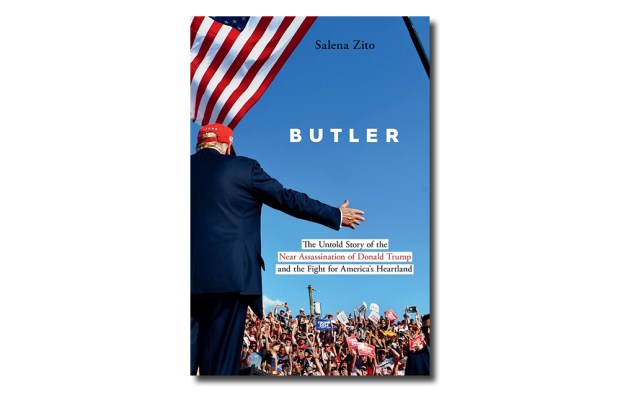
Even by the turbulent standards of American politics the attempted murder of Donald Trump at a campaign rally was remarkable. A veteran journalist, Salena Zito has been a close observer of Trump for years and was only a few metres from him when the bullets began to fly. In Butler: The Untold Story of the Near Assassination of Donald Trump and the Fight for America’s Heartland (Hachette, $50), she tracks through the mechanics of the near-fatal assassination attempt, marvelling at the unlikely sequence of coincidences that allowed Trump to dodge the bullet. She uses the event to examine the level of polarisation that the US has reached, to the point that some of Trump’s enemies lamented that the gunman missed. She believes that Trump’s rise points to a fundamental realignment in American politics, although she adds the caveat that it might be too early to know for sure. Interestingly, it was Zito who first said that Trump’s supporters took him seriously but not literally, while his opponents did the opposite.
A sense of deadpan humour underpins Ghost Cities (University of Queensland Press, $35), winner of the 2025 Miles Franklin Award. Siang Lu, a Chinese-Malaysian-Australian author, collected scores of rejection slips for the manuscript before his novel The Whitewash won a Queensland Literary Award in 2022, which made publishers take another look at Ghost Cities. It is not an easy book to categorise, although Lu is interested in China’s empty skyscrapers in apparently random locations as a reflection of the immigrant experience of being a stranger in a strange land. The tone is one of dark satire, with some parts reminiscent of Joseph Heller’s Catch-22. It tells the story of Xiang Lu, a translator living in Sydney, who is fired from the Chinese consulate when his employers discover that he cannot speak Mandarin. Through a series of increasingly absurd connections Xiang Lu’s deception goes viral on social media in China, which turns out to be a very mixed blessing. It adds up to a package which is weird but thoroughly enjoyable.
Heart Lamp (Penguin, $50) by Banu Mushtaq won the International Booker Prize for the year, and it was a controversial choice. This is the first time a collection of short stories has won, and it was written in the obscure Kannada language, used by a traditional Muslim community in southern India. Some of her stories appear to be drawn from Mushtaq’s experience of living in a society defined by misogyny and caste, while others are based on close observations of personal relationships and social hierarchy. Many of the stories are heart-rendingly painful but it is hard to dispute their authenticity. However, there are flashes of humour and striking imagery to leaven the grimness, and Mushtaq is good at springing surprises on readers. Heart Lamp is not an easy book but those who are willing to accept the challenge will find much to respect and admire. The book includes a useful and informative note from translator Deepa Bhasthi.
Karen Hao, a senior journalist specialising in technology issues, has penned a disturbing account of the rise of artificial intelligence in Empire of AI: Inside the Reckless Race for Total Domination (Allen Lane, $55). She puts a magnifying glass on Open-AI, the company behind ChatGPT, and its messianic boss Sam Altman. The company started as a non-profit aiming to balance progress and safety but the latter was gradually pushed into the background. Instead, OpenAI began to rush along the highway of emerging AI tech with little thought about where it was leading. Hao readily acknowledges that AI can be a great benefit but she notes that it comes with sinister downsides. She also examines the amount of resources, especially power, that advanced AI systems require. Then there is the army of underpaid workers who have to ‘feed’ massive volumes of data into the insatiable AI maw. At 450 pages the book is a dense read but Hao makes her points with clarity and solid research, keeping the hyperbole and jargon to a minimum.
On the general subject of AI, several US newspapers, including the prestigious Philadelphia Inquirer, published a list of fifteen ‘summer reading’ books in 2025. The list provided a summary and recommendation of each book. The problem was that ten of the books did not exist, although the authors were real. The list was generated by an AI system operated by a content syndicator called King Features. Fortunately, no great damage was done, although the newspapers looked very foolish.
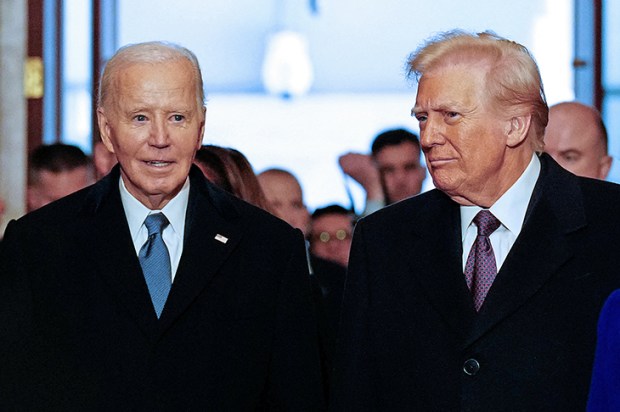
This reviewer’s annual Trees Are Dying For This (TADFT) competition for the year’s most unnecessary book saw a strong contender in Original Sin: President Biden’s Decline, Its Cover-Up, and His Disastrous Choice to Run Again (Penguin, $32.00) by a pair of left-wing journalists, Jake Tapper and Alex Thompson. The irony is that the authors actively participated in the Democrat scheme to present Biden as mentally sharp and physically fit, in the face of a mountain of evidence to the contrary. The turning point was the campaign debate, when Biden looked lost, confused and feeble. Tapper and Thompson quickly transferred their allegiance to Harris, pretending that everything that they had said for years had not happened. The level of chutzpah and hypocrisy is astonishing. Tapper and Thompson blame Biden’s handlers for manipulating them, although it is not difficult to manipulate people who happily participate in the process. They describe Biden’s decision to run as the original sin, as it ensured a Trump victory. This book raises a key question: how dumb do they think people are?
Original Sin was an impressive attempt at prize-winning silliness but it was pipped by 107 Days (Simon & Schuster, $50), Kamala Harris’ account of her 2024 presidential campaign. She insists that she lost because she did not have enough time to establish herself. However, this steps around the inconvenient truth that she had been Vice President for nearly four years. She has plenty of other excuses, such as Tim Walz as her running mate and a media that was not totally on her side. However, to any fair-minded observer her campaign looked like a series of unforced errors, from the decision to not have any policies to her word-salad incoherence. Her inability to name anything that she would have done differently to Biden was particularly disastrous. Maybe her aim in 107 Days is to prepare the ground for a 2028 run, which would undoubtedly be entertaining. Snaps to you for winning the TADFT award, Kamala, and try not to be burdened by the past that has gone before, as well as the significance of the passage of time in terms of… something or other.
Got something to add? Join the discussion and comment below.
Derek Parker is a freelance writer and reviewer.
You might disagree with half of it, but you’ll enjoy reading all of it. Try your first month for free, then just $2 a week for the remainder of your first year.