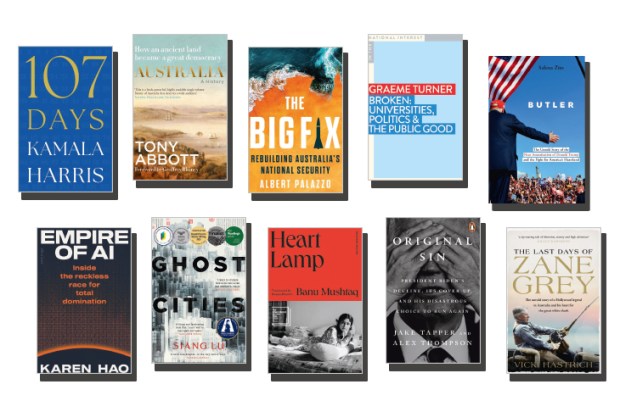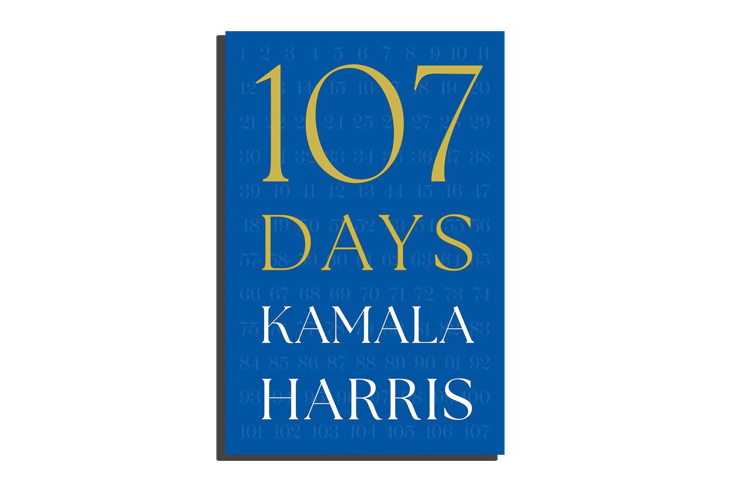
We owe the ghostwriter of this book a debt of gratitude. A novelist called Geraldine Brooks is cited as a ‘collaborator’, so presumably it was her job to rephrase the word salads and twisted language that characterised Harris’ campaign for president in 2024. Good work, Geraldine, although few people who wade through 107 Days will conclude that Harris did, after all, deserve to win. She emerges as an oddly unfocused figure, wandering through the narrative without much purpose, except to explain how the drubbing was mostly the fault of others. Most politicians can play a good game of blame-shifting but with Harris it seems to be her only notable talent.
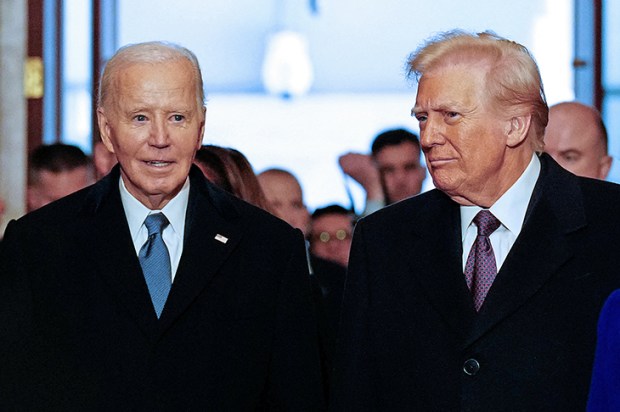
As she recounts it, Joe Biden bears most of the responsibility. She equivocates about whether he was capable of running a plausible campaign and then, if elected, whether he could continue to serve as president. But she is adamant that the key reason for her loss was that by the time Biden finally decided to go she did not have enough time to introduce herself to the national electorate.
There is considerable sleight-of-hand here. She steps around the point that she had been Vice President for nearly four years and that, as she constantly told us during the campaign, she had a solid record as a senator and a prosecutor. In fact, in the book she cannot seem to decide whether she was a well-known Washington performer or a mystery girl from Oakland.
This fuzziness came to the fore when she was asked on the far-left program The View about what she would have done differently than Biden. Her staff had prepared responses to a question like this but Harris went blank, and replied that she could not think of anything. With the wisdom of hindsight, she now says: ‘I had no idea I’d just pulled the pin on a hand grenade.’ The Trump campaign, of course, had a wonderful time with the comment.
To be fair, a VP who is running for president is in a difficult position. If you criticise the boss you look disloyal and if you toe the line you look like a lackey. But in this case the real problem was that Harris believed that the Biden administration had been remarkably successful and was broadly popular, so there was no need to move away from the established model. A few of her staff tried to break through the fog of delusion but it was an uphill task.
The air of unreality was reinforced by the decision of the campaign planners to avoid policy proposals and instead go with ‘the vibe’. It played well with the hard-core base but the broad middle of the electorate saw it as merely vacuous. Harris’ peak in the polls was at the time of the convention that anointed her.
After that it was a slow slide downwards. The problem was not that she was unknown. It was that she was known, and disliked. Her inability to complete a sentence without drifting into vague, circular repetition became a killing joke.
Harris, naturally, accepts none of this, and instead blames the media for not being completely on her side. This becomes merely silly after a while, as anyone who watched the campaign would have seen that much of the coverage was not just co-operative but fawning. Harris sometimes slides into conspiracy theory territory in this section of the book, and displays her remarkable sense of entitlement. She simply could not believe that Trump might win. After all, she was… her.
One area where she admits to error is the selection of Minnesota governor Tim Walz as her running mate. He was actually her third choice, after Pete Buttigieg and Pennsylvania governor Josh Shapiro, but they both came with problems. As it turned out, nearly anyone would have been better than ‘Tampon Tim’. Harris recalls yelling at the television screen during the Walz/Vance debate, when Walz looked like, well, an idiot.
She has surprisingly little to say about Trump, aside from reheated insults and Democrat talking points. Some of her staff warned her that he was a formidable candidate with the wind at his back. But she was carried away by her own strategy of only appearing before adoring crowds and limiting media contact to journalists who could be counted on to engage in creative editing. Certainly, breaking out of a sycophantic campaign bubble is difficult but it seems that Harris did not even know that she was in one.
When the count on election night started and the numbers began to stack up against her, her response was incredulity. She says she was terrified at the prospect of another Trump term but it sounds hollow and sour. The surprise, after reading this book, is that she did not lose by a greater margin, given that much of what she said was unintelligible and her campaign strategy was fundamentally flawed.
She does not say so in the book but it is hard to escape the feeling that 107 Days was written to lay the groundwork for another shot. The message is: I would have won if Joe had not delayed, if the media had been more supportive, if my colleagues had been more reliable, and so on and so on. Beyond this, the book does not seem to have a point. Are there Democrats who are masochistic enough to re-live the humiliation of losing to their most hated enemy? Probably, although not many of them. Harris would probably insist that she is simply setting the record straight. If you say so, Kamala… but who cares?
Got something to add? Join the discussion and comment below.
You might disagree with half of it, but you’ll enjoy reading all of it. Try your first month for free, then just $2 a week for the remainder of your first year.