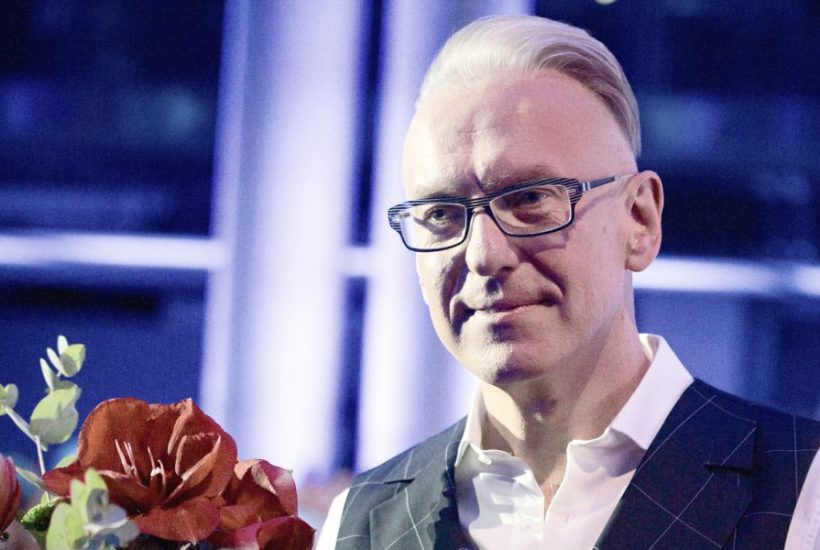
I’ve been a fan of Mariusz Szczygiel, the Polish author, investigative journalist and TV presenter, since reading his book Gottland: Mostly True Stories from Half of Czechoslovakia some ten years ago. Gottland – a series of 20th century Czech histories without the boring bits – was a knockout, winning the 2009 European Book Prize and giving an unexpected jolt to those who expected the usual stodgy travelogue on Central Europe. Victor Sebestyen described it in these pages as ‘one of the funniest books I have read – and one of the shrewdest.’
If all this sounds sombre, it’s anything but. Not There, translated once again by Lloyd-Jones, is full of weird variety and bounce
Gottland’s tales were ruthlessly well chosen. Szczygiel told us of the ups and downs of the Bata shoe factory; the rise and fall of filmstar Lída Baarová, Goebbels’s disgraced Czech mistress; the 20-year state ban on Marta Kubišová, the sixties pop singer reduced to chopping up chickens in a food-processing plant, and who dreamed, as she walked round Prague, that a balcony or flowerpot might fall helpfully onto her head.
The stories were pared down and racy, told in the present tense and with the simplest of language – ‘intelligent’ people, Szczygiel writes, ‘know they must use short, plain words’ – and seemed to zip along like thumbnail-thrillers. ‘Even if I present a banal topic in my non-fiction,’ Szczygiel told me a critic said of him, ‘it sounds like a crime story, where I’m the detective.’ Translated with brio by Antonia Lloyd-Jones, Gottland – if not exactly history rewritten for the Guy Ritchie era – certainly recognised that generation’s rhythms and its need for dynamism.
Twelve years have passed since Gottland appeared in English – until finally a second book, Not There, was published here earlier this month: ‘A collection of essays about loss, grief, and absence,’ says the blurb. Szczygiel’s life partner – who once suggested the idea to him – died suddenly, ‘and three years after his death I began to write this book…a way of completing my mourning for him.’ Not wanting to write it in the first person, he explored different forms of loss: ‘I decided to find other people’s (true) stories through which I could talk about myself.’
If all this sounds sombre, it’s anything but. Not There, translated once again by Lloyd-Jones, is full of weird variety and bounce. We get stories of a woman hunting in a library for books from her childhood, saving one of them just in time from the library’s ruthless ‘clearance’ procedures: ‘You see, my dear,’ the librarian coos at the rescued novel, ‘You’ve escaped selection, you’re going to go on living.’
He meets a woman, Ewa, who’s kept an exhaustively detailed balance sheet, since childhood, of the ‘successes, failures and stresses’ she has racked up: ‘Take a look: so far, I’ve got 504 successes, 17 failures and 93 stresses. This is the Excel table of my life.’
Sometimes his subjects embrace the decay. One artist he meets (a kind of 3D Polish Banksy) deliberately creates public sculptures with the briefest of shelf lives – almost sure, within a few hours, to be taken down by the authorities or smashed up by an angry passerby. Amidst this are Szczygiel’s fears of misremembering, a kind of loss in itself. ‘All we ever get is the feeble report of memory,’ he quotes his countryman Czeslaw Milosz: ‘Everything that has passed away is available to us only in the double recast to which the mind once subjected it, and to which it subjects it now.’
So Szczygiel takes pains to preserve tiny things for us: a snatch of dialogue overheard on the metro, or a conversation with a completely random stranger about the Czech national character. A son puts his elderly father’s portrait on the internet, racking up 1,752 likes and 105 comments, delighting the old man: ‘So now I’m in the history of the world, am I?’ Czech history – which still seems to obsess Szczygiel – is told through the prism of a single poem, or the history of a Prague house, the Loos-designed Villa Müller – ‘a star among villas’ – through whose exquisite Modernist rooms and stairways history seems to rampage. ‘We never remember the whole, just details,’ he explains. ‘I’m sure the detail is where the whole of something is reflected.’
Alongside this goes a panic – understandable in one bereaved – of certain memories vanishing forever. The poet Josef Brodsky laments the emptying-out of his late parents’ flat: ‘Their bodies, clothes, telephone, keys and furniture had gone and would never be recovered, just as if a bomb had fallen on their room… a bomb of time, which even destroys memory.’ Meanwhile, a grieving lover goes half insane trying to remember the name of an Icelandic band his dead partner liked, finally recalling it with anguish: ‘One day I’ll forget! One thousand per cent, I’ll forget the name of that band… That’s what I’m afraid of. That’s the very thing.’
Over it all, linger the words of Szczygiel’s father: ‘Some things should be fixed in the mind, son. Then a person might dream about them… When he’s lost his sight entirely.’ Not There brings home to us that our best bet for remembering is, as with Szczygiel’s writing, to rid ourselves of pointless clutter and let our empathy do the rest. ‘I’ve always wanted to find books left behind by someone who marked the quotes that mattered to them,’ he writes characteristically, ‘and on that basis create a portrait of them.’
At another moment, Szczygiel goes to a Budapest junk shop and, finding a bin of old used postcards, selects one blindly and prints the sender’s words for us here, allowing the unknown Janos H., from Dunakeszi to live again, along with his 1965 bout of flu: ‘There was one day when I felt all right, but most of the time I’ve been very ill. I think the Devil’s waiting for my skin.’
‘So, here in this book,’ writes Szczygiel jauntily, ‘we’ve saved one postcard, perhaps more than just that.’ One can only agree with him: whole multitudes are saved in Not There from the ‘bomb of time’.