Each year on November 7, we remember the Victims of Communism to acknowledge those who have suffered and died at the hands of communist regimes, and to stand with those who fight for freedom today.
The Victims of Communism Memorial Day is dedicated to educating new generations about the ideology, history, and legacy of communism.
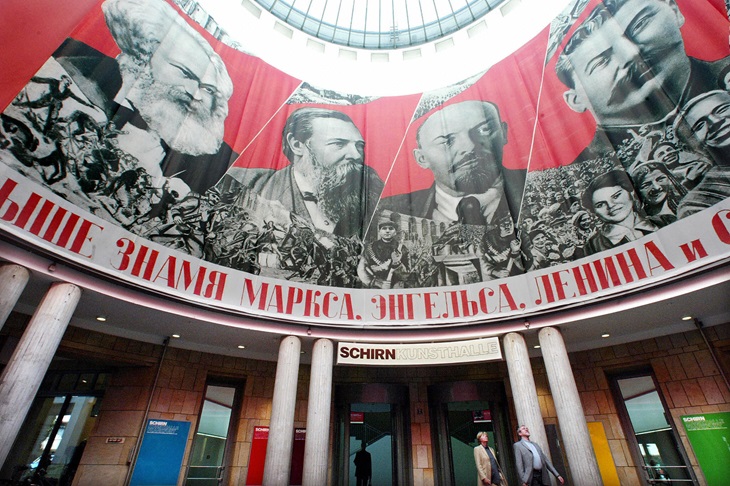
It started with Karl Marx and Friedrich Engels, co-authors of The Communist Manifesto in 1848. Their ideas would go on to inspire Lenin, Stalin, Mao Zedong, Pol Pot, and Castro, whose revolutions and the 40 or so communist states they created, would drench the 20th Century in blood and cause the deaths of more than 100 million people and the oppression of over two billion more.
Communism is not just an economic theory; it is an ideology built on deception.
Without exception, wherever communism takes root, freedoms die. It offers an appealing narrative to the unwitting of a re-engineered utopian society that guarantees equality for everyone. However, all evidence demonstrates the opposite; these regimes suppress freedoms of speech, religion, and peaceful assembly. They immediately curtail the role of media and of the mechanisms that ensure free and fair elections – communism will never allow itself to be openly judged by those it rules.
The evidence is unequivocal. Communism promises equality but achieves universal poverty.
Communism first took root with the unwitting acceptance of radical ideology and enforced conformity; citizens who learned to censor themselves, journalists who repeated the Party line, teachers who taught ideology as fact, and neighbours who stopped speaking their minds.
In Russia, before Stalin’s terror and the mass executions of the 1930s, it was made possible by the manipulation of language and the suppression of free speech. Censorship was institutionalised through Glavlit (General Directorate for the Protection of State Secrets in the Press), and the Pravda press that served as a propaganda organ rather than a source of factual reporting. Writers and scientists were forced into ideological conformity, and language itself was reshaped to reflect Party dogma. As Solzhenitsyn later observed, ‘The lie became not just a moral failing but a mode of survival.’
In China, before the Cultural Revolution, Mao’s Communist Party spent years indoctrinating citizens, controlling the press, and silencing intellectuals. Mao’s brief ‘Hundred Flowers Movement’ invited citizens to voice criticisms, only to use those criticisms to identify and punish intellectuals. More than half a million teachers, writers, and scholars were persecuted or sent to labour camps. This terrified others into silence and taught society that independent thought was dangerous. Universities became ideological training grounds, not places of free inquiry. By the time the Red Guards unleashed chaos, society had already accepted that free expression was dangerous.
In Eastern Europe, after the second world war, when communist regimes were installed in countries like Czechoslovakia and Hungary, the first moves were not executions but takeovers of media, schools, unions, and speech. Schools were nationalised, curriculum and textbooks were rewritten, teachers seen as ‘bourgeois’ were dismissed. Violence followed once opposition had been muted.
Once established, the communist weapon of control may not always be a gun; often it is sustained by silence – the suppression of dissent and truth.
Freedom does not vanish with a bang. It disappears in whispers. When people are afraid to speak their minds, when comedians self-censor, when academics are sacked for incorrectness, and when ordinary citizens hesitate to voice common-sense opinions, a nation has already taken the first steps down a very dangerous path.
Australia is not and must never become a communist nation, and we would be foolish to take our freedom for granted. As a nation we are largely unaware of the true nature and history of communism. Our educational institutions have failed to teach the most important lessons of the 20th Century to a new generation. Free speech, once a sacred pillar of our democracy, is being squeezed by cultural intimidation, online mobs, and legislation that treats informed dissent as a crime. Honest debate is being replaced by slogans, and moral courage by fear of cancellation.
Australia’s prosperity rests on the foundations of liberty, fairness, personal responsibility, enterprise, and the rule of law. These are not automatic or eternal. They must be defended, especially in the small things, and especially when it’s uncomfortable. A free society is not just one where we can speak; it’s one where we can disagree and where truth can stand against fashion, conscience against coercion.
Remembering the horrors of communism is how we keep our bearings in a world that increasingly confuses compassion with control.
Our task as Australians is simple but sacred:
To remember what happens when people stop valuing freedom.
To teach the next generation that comfort is no substitute for courage.
To ensure that the silence that enables tyranny never finds a home here.
Because freedom, once lost, is rarely won back. And forgetting is the first step to losing it.
Colleen Harkin is the Director of the Institute of Public Affairs’ Schools Program