The Israeli hostages recently freed from Gaza have begun to speak, and among the new revelations is that some were subjected to sexual assault and degradation, including male hostages. They describe being stripped, groped, violated, and threatened at gunpoint. The scale and cruelty of what they endured should have triggered sustained, front-page attention in the UK, not least on the BBC. But it has not.
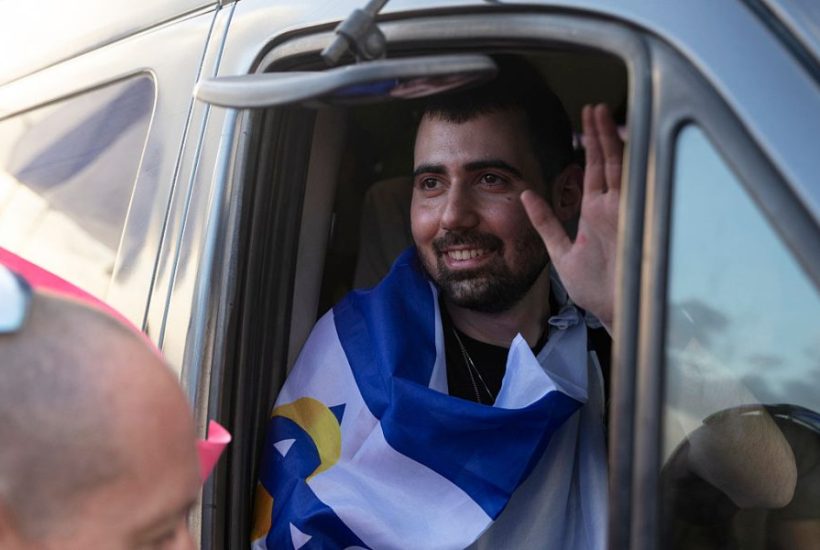
The testimonies began surfacing in recent weeks. Rom Braslavsky, seized by Palestinian Islamic Jihad while recovering the bodies of murdered women at the Nova music festival, described being stripped naked and left that way for days. ‘They took all my clothes. Underwear too. Everything. They tied me up from my… while I was completely naked. I was torn apart, starving, naked. I said to God: take me out of this already.’ His captivity lasted 738 days. ‘It was sexual violence, and its main purpose was to humiliate me,’ he said. ‘The goal was to crush my dignity. And that’s exactly what he did.’
Guy Gilboa Dalal, 22, was abducted by Hamas with a friend after escaping gunfire at Nova. He was tied, blindfolded, beaten, and later taken into a guard’s room. ‘I was on a chair with my eyes covered,’ he said, as his sadistic torturer asked him: ‘You haven’t seen girls in a long time, right? Want to watch porn? Want me and you to make a porn film?… He touched me all over my body… kissed my neck, kissed my back.’ A gun was pressed to his head, a knife to his throat. ‘He said that if I told anyone, he would kill me.’ Days later, the same guard assaulted him again. ‘He pulled down my trousers… stood behind me and rubbed his genitals on my anus for some minutes.’ Guy stood frozen. ‘I was terrified this would become something regular, worse each time – more violent, more invasive.’
Guards stripped men and left them exposed. Others were molested and sexually assaulted while blindfolded
Israel has now confirmed that roughly half of the returned hostages reported some form of sexual abuse. The methods include forced nudity, sexualised torture, coercive touching, and threats of rape. Both women and men were targeted. The full extent of this abuse has only recently started coming to light.
The abuse did not end with Rom and Guy. Omer Wenkert, another hostage, was forced onto all fours and ordered to bark like a dog while a guard kicked him and threw Guy onto his back. Rom, stripped naked, described being immobilised and whipped, with his head bound so tightly with stones that, he said, ‘there was hardly blood flowing to my brain… Pain I had never known.’ He was later beaten with iron rods, punched repeatedly, and whipped while restrained. One night, he broke a mug on his own head to try to end the suffering. ‘I bled a lot… I wanted the blood to keep flowing until I collapsed.’ That self-harm, that yearning for escape through injury, marks just how complete the torment became.
Ori Megidish, the IDF observer rescued three weeks after her abduction, only spoke in more detail a year and half later about the chillingly abusive treatment she experienced during her captivity. ‘I felt that the boss, the one in charge, wasn’t looking at me the way a normal person looks,’ she said. ‘I tell him that I have a boyfriend, but that only gives him legitimacy to ask sexual questions. He starts coming closer and touching; I tell him I don’t want that. I can’t resist him the way I should.’ After her return, she spoke of the psychological fallout. ‘It took time until I told my boyfriend… there’s always that thought of “what if I had done this or that”, and God knows what would have happened if I had stayed in that flat any longer.’
The initial reports of sexual violence in 2023 focused heavily, and rightly, on the case of Amit Sosana, the Israeli lawyer abducted from Kfar Aza. Her testimony described being chained by the ankle in an unnatural position, repeatedly beaten, and sexually assaulted under threat of a gun. Some UK outlets covered her case with seriousness. The UN’s March 2024 report, which found ‘clear and convincing information’ of rape and sexual torture by Hamas, was also reported.
But the more recent testimonies, especially those involving male victims, have received barely a fraction of the attention. There is no shortage of coverage of Gaza in Britain. Yet the accounts of hostages like Guy and Rom – clear, detailed, profoundly disturbing – have been mostly limited to shorter reports or ignored altogether. The most explicit reporting still comes from Israeli and American outlets.
It is not only a failure of news judgement. It reflects a deeper reluctance to confront the ideological structures behind this kind of violence.
Sexual assault, including against men, is not an accidental by-product of jihadist terrorism. It has been used deliberately, again and again, across groups and decades, as a method of control, punishment, and annihilation of dignity. Isis abducted, raped, and traded Yazidi women through formalised systems of slavery, justified in theological pamphlets. Fighters were taught that enslaving non-Muslim women was a religious duty and a military reward. The group’s propaganda equated concubinage with piety. Sexual violence was not hidden, but proclaimed.
What happened to men in Isis prisons followed the same logic. Detainees were stripped, penetrated with objects, forced into sexual acts with others, or sexually assaulted during interrogation. Guards claimed that this was not for their pleasure, but to dominate and destroy. They called it punishment. While Islam forbids homosexual acts, the perpetrators simply declared their actions were not sex. That rhetorical shift allowed them to proceed with impunity. The Taliban, Al-Qaeda in Iraq, and Algeria’s GIA all followed similar patterns. Male-on-male sexual violence became a weapon: legalised internally through redefinition, deployed systematically to crush resistance.
Hamas and Palestinian Islamic Jihad are no different. The details are now emerging. Guards stripped men and left them exposed. Others were molested and sexually assaulted while blindfolded.
Captivity in Gaza was a theatre of cruelty. Some were blindfolded for weeks at a time, plunged into sensory darkness so total they feared for their vision. ‘They blindfolded me with thick cloth. Total darkness. I could not see anything. I was afraid it would damage my eyes,’ Rom said. Later they covered his ears too. ‘Without seeing or hearing, something inside me broke.’ He was denied sleep, denied food, denied the ability even to urinate. Amit Sosana, suspected of being a soldier, was suspended from sticks ‘like a chicken on a grill’ and beaten on the soles of her feet. Guy, weak from hunger, spoke of blacking out from standing. ‘You can’t move without pain, can’t stand up without dizziness… It’s slowly dying.’ One was told to dig his own grave. Another was made to kneel for hours until his legs swelled. What emerges is not just a record of torture, but a deliberate system of psychological collapse.
They know what it means to be at the mercy of Palestinian terrorists. They saw ‘Palestine’ from within
The men and women who gave these testimonies did so with a clarity and courage that defy description. The shame that so often silences victims of sexual abuse was not enough to silence them. They chose to speak, to testify. They did not let what was done to them define them. They were degraded, tortured, and stripped of every protection, yet still they stood up to say: this is what happened. In Israel, they are now seen as a kind of moral vanguard – witnesses not only to their own suffering, but to the true face of the enemy. They were inside Gaza. They know what it means to be at the mercy of Palestinian terrorists. They have seen ‘Palestine’ from within. And they came back to tell the world.
Their voices now fill the Israeli public sphere. It is time they were heard properly beyond it. Theirs are not the narratives of generals or politicians, shaped by ideology or ambition. They are the stark, lived reports of those who endured what no human should. Against that, the sentimental dispatches of dewy-eyed BBC journalists or the shallow sloganising of campus activists peacocking in keffiyehs and facemasks are weightless. The hostages speak with a different kind of authority, earned in blood, silence, and unimaginable suffering. They are telling us something essential. Somehow they have found within them the courage to tell us just what the enemy is like. The question is whether we have the courage to listen.