There is a story that has barely been told – a story sitting there, waiting to blow open into national consciousness if any politician, farmer or farm organisation is willing to say it plainly. It starts with a small, obscure line buried inside New South Wales’ biodiversity and vegetation laws. A line that explains why farmers in the Central West, North West and the Monaro now live under some of the most intrusive land-use restrictions in the developed world. The law says, in effect, that everything depends on what your place looked like on 1 January 1990. That date – unknown to most MPs, never taken to an election, never properly justified by any minister, and never honestly explained to farmers – now determines whether a paddock can be managed like a farm or must instead be treated like a quasi-national park.
The public has been encouraged to think that the NSW vegetation regime is all about ‘protecting biodiversity’. But that 1990 line in the sand has far less to do with ecology than we have been led to believe. It has far more to do with Australia’s climate-treaty obligations – and with twenty-five years of bureaucrats quietly embedding international carbon-accounting rules into state law while publicly pretending the purpose was environmental. It is one of the more astonishing pieces of technocratic sleight-of-hand in modern Australian politics: a climate policy disguised as an environmental one, enforced by regulatory ambush, and by criminalising normal, necessary land management on private property.
The origins go back to the 1990s, when the Howard government negotiated the ‘Australia Clause’ under the Kyoto Protocol. It allowed Australia to set its emissions baseline using 1990 land-clearing levels. Smart diplomacy at the time – or so everyone thought. What nobody foresaw was how Commonwealth and NSW officials would seize on that baseline and quietly turn it into the organising principle of the entire NSW vegetation-law system. Through the 1997 legislation, then the 2003 native vegetation reforms, and later through the 2013 Local Land Services Act and its 2016 amendments, the 1990 baseline hardened into the fulcrum upon which farmers’ rights would turn.
The public story was biodiversity. The real story was carbon accounting. And the method was cynical. If the Commonwealth had imposed these limits directly, it might have triggered a constitutional requirement to pay just terms compensation. But if state law could be engineered to deliver the Commonwealth’s carbon outcomes, Canberra would get the climate credits and farmers would wear the cost. And that is exactly what happened.
Decades on, the consequences have been severe. In the North West, country that requires broad-scale control of woody weeds and thickening scrub has been effectively paralysed by laws treating any post-1990 regrowth – however useless – as a carbon asset that cannot be touched. Millions of acres are now locked up, unmanaged, and overrun with pigs, dogs and other pests.
In the Central West, productive paddocks are being slowly strangled by regrowth while farmers are told to buy offsets for areas they want to crop, or apply for permits just to manage their land the way previous generations did as a matter of course. Everywhere, turning previously uncropped land into cropping country, even where it is clear country, is counted as a carbon-emitting ‘land-use change’. This has everything to do with the 1990 Kyoto/Paris accounting rules and almost nothing to do with ecology. So ordinary farming activity is choked in service of the national net zero reporting system.
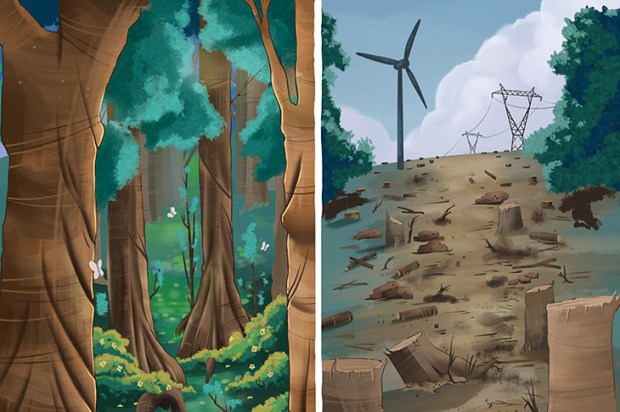
Even where biodiversity is the underlying rationale, the regulation – devised behind a desk in Canberra or Macquarie Street – ruins it. On the Monaro, the absurdity is impossible to miss. Serrated tussock and African lovegrass – two of the most destructive invasive weeds in Australia – are spreading across open country. These weeds require broadscale, coordinated, landscape-level control. Yet Monaro graziers are forced into treating vast acreages by hand with a backpack, spraying individual plants so as not to disturb any native grasses, because native grasslands are treated as protected vegetation that must remain untouched. It is too costly for many to manage the weeds like a park ranger, so they are left unmanaged and spread like wildfire. The weed monoculture crisis is now almost irreversible on the Monaro and has been entirely bureaucrat led.
It is hard to overstate the dishonesty here. A system sold as ‘biodiversity protection’ is achieving the opposite: collapsing landscapes, exploding fuel loads, declining native species and exhausted farmers who are blamed for problems they are legally prevented from fixing. Science is not driving the policy; carbon spreadsheets lacking real world understanding are. And the people who best understand the land and are best placed to fix it – farmers – have been lectured, criminalised and regulated into inaction.
No one should pretend this is simply a Labor project. Governments of both colours have implemented, inherited, accepted and expanded the machinery. Many ministers barely understood what their departments were doing under the surface. Farmers who tried to raise the issue with MPs were met with whispers: ‘We can’t control the bureaucrats.’ The deeper problem is cultural – a political class increasingly comfortable governing by technocratic deception, burying major policy choices in dense regulation, and allowing unelected officials to re-write property rights behind closed doors. Every serious policymaker knows that regulation carried out for one purpose under the cloak of another eventually unravels, and that is what has happened here.
Farmers are not asking for a licence to wreck the land. They see themselves as custodians – many for generations. They are asking for rules grounded in principles of proportionality, ecological reality, constitutional honesty and plain truth. If Australia wants private land to shoulder the load of international climate commitments, politicians should be upfront about it. And taxpayers should compensate the families whose land is being used to deliver those commitments.
The green numbers in Australia’s treaty reports are not abstractions. They sit on real title deeds, owned by real families who feed this country and much of the world. It is time the nation understood the price those families are being forced to pay – and demanded something better than a slow, quiet, technocratic Kyoto protocol inspired land grab carried out under the cover of biodiversity.
Got something to add? Join the discussion and comment below.
You might disagree with half of it, but you’ll enjoy reading all of it. Try your first month for free, then just $2 a week for the remainder of your first year.