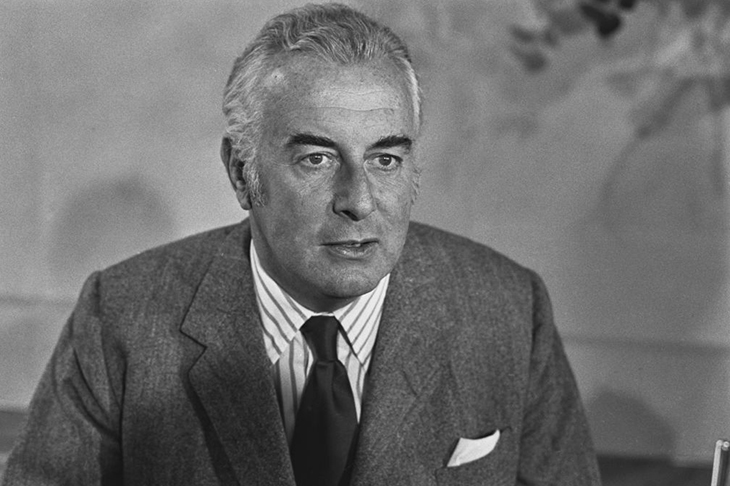
Next Tuesday will mark the 50th anniversary of the occasion on which governor-general Sir John Kerr legitimately employed a power, granted him by the constitution, to resolve an intractable political impasse and secure to the Crown properly appropriated funds that it needed to carry on the business of government.
For that Sir John has been mercilessly pilloried up to and beyond the grave.
Let me make one point very clearly right at the start. Sir John Kerr did not deliver us from a grossly incompetent government. The people of Australia did that. Sir John Kerr simply gave them the opportunity to do so. And more importantly, that was a by-product of – not the motivation for – his decision.
I had anticipated that this anniversary would see a renewed attack on Sir John. What I didn’t anticipate was a three-pronged assault – a new biography of Whitlam, a Sky News Australia documentary and a day-long spectacular organised by the Museum of Australian Democracy and live-streamed from Old Parliament House. The latter, chaired by Barrie Cassidy, will include such partisan players as journalists Paul Kelly and Troy Bramston and academic Professor Jenny Hocking, all fierce Kerr antagonists. And most of the participants are Labor-aligned. So, you can imagine the sound and fury that will engulf the parliamentary triangle on this otherwise sacred day.
In 2022, I wrote a book, Villain or Victim (Connor Court), as a response to the most vitriolic attack ever mounted against Sir John Kerr – a 2013 book titled The Dismissal: In the Queens Name – by Kelly and Bramston. A work that can best be described as tabloid history.
Inspector Javert never pursued Jean Valjean with half the obsession that Paul Kelly and his minion Troy ‘Ahab’ Bramston have brought to the task of ‘maintaining the rage’ against Sir John. It seems any amount of damning evidence against Kerr is never enough. So, Bramston has opened another line of attack under the cover of a new biography of Whitlam. In it, he reveals that the great man, far from being the arrogant so-and-so we have always thought him to be, was actually shy, diffident and naive – just ripe for exploitation by an unscrupulous schemer like Kerr. You couldn’t make this stuff up.
The new book includes this gem: ‘…Mr Keating said he would have rejected being dismissed. “I would have arrested Kerr,” Mr Keating insisted. I would have said: “You are abusing a kingly power that was never yours to abuse. So therefore, you’re seeking to illegally dismiss the government of Australia, which I regard as a criminal act, and I’m ordering the police to arrest you.”’
That a former prime minister could utter this asinine comment is extraordinary. That Bramston could stoop to use it in his book is just pitiful. It’s like taking your granddaughter’s crayon drawing of Peppa Pig off the fridge, framing it and hanging it in the lounge room.
Even if you were a Whitlam supporter, the ‘rage’, and its latest manifestation at Old Parliament House, is out of all proportion to what actually happened.
Kelly and Bramston go out of their way to imply that the thought of dismissing Whitlam dominated Kerr’s thinking and that he was planning it from an early stage.
Throughout their book they refer repeatedly to Kerr’s ‘dismissal project’. Most people will remember that, in an attempt to bypass the Senate which had blocked supply, Whitlam proposed a scheme to borrow money from the banks to tide him over until the Senate either backed down and approved supply, or a more favourable Senate emerged as a result of a half-Senate election. As long as he persisted in that course his dismissal was inevitable. Whitlam brought it upon himself. I believe it’s possible he even engineered it. Or at the very least he acquiesced in it when, at the last minute, he declined to back down and advise a double dissolution. Had he done so, Sir John Kerr undoubtedly would not have withdrawn his commission.
Kelly and Bramston have created a complex tapestry of misrepresentation and innuendo designed to impugn Sir John’s motivations and character. A prominent theme in their narrative is that Sir John should have warned Whitlam he risked dismissal and his failure to do so constitutes an ambush.
It’s a complex issue so I will make just two points. Whitlam was well aware that he risked dismissal because he joked publicly about it on at least three occasions. He just didn’t believe Kerr would have the courage to do it. And, for his part, Sir John feared that if he made explicit a threat that he knew Whitlam was quite well aware of, he might provoke Whitlam into advising the Queen to replace him. That would have dragged the monarchy into a local political dispute and Kerr would have walked through broken glass to avoid that.
But when it came down to the final crunch, as Kelly and Bramston themselves have stated in their book, no governor-general could have accepted Whitlam’s advice, as late as 11 November, for a half-Senate election.
Kerr antagonists characterise what transpired in 1975 as one of the most damaging and controversial events in Australian politics. It was certainly controversial at the time but only remains so now because Kelly and co. have worked assiduously to keep it so. But it was by no means a damaging event. Yes, political tensions were raised for a few months. But the vast majority of Australians moved on from it years ago. And it was not a constitutional crisis. The constitution worked as it should. A prime minister who was unable to get supply from parliament and was planning to bypass that obstacle by unconstitutional means, had his commission as prime minister withdrawn. His successor obtained supply and promptly advised an election. What could be more democratic than that?
Let me ask you to ponder these questions. Suppose Sir John Kerr found himself, under the same circumstances, having to withdraw the commission of prime minister John Gorton denied supply by a joint Labor/DLP Senate motion – as Whitlam attempted to do in 1970, with the express intention of bringing the government down. Would he have suffered the same fate? Would our democracy and institutions have been pushed to breaking point? Would Kelly and Bramston be manning the barricades to defend our democracy fifty years on when everyone else has gone home? No-brainer, right?
The burning question that will complete the extravaganza on Tuesday is ‘Could the dismissal happen again?’ The answer is that, of course, it could. The power to withdraw the commission of a minister is explicit in the constitution, there is a well-documented precedent from as little as fifty years ago and, tellingly, there has been no attempt since then to remove this power from the constitution. If this were the cataclysmic event that Kerr antagonists proclaim, why has there not been a single attempt to eradicate or constrain those offensive reserve powers? One of the reasons, I suspect, is that those that would like to see the reserve powers removed are fearful that a referendum on this matter would fail, as a result of which the powers would be strengthened. That is why they have embarked on this campaign to discredit the reserve powers – and intimidate successive governors-general from using them – by association with the odious, ambitious and duplicitous Kerr. Select your own trifecta of character flaws – Kerr had them all apparently.
Yes, 1975 could happen again, but only if the governor-general understands both his rights and his duty and has the courage to act accordingly.
Got something to add? Join the discussion and comment below.
You might disagree with half of it, but you’ll enjoy reading all of it. Try your first month for free, then just $2 a week for the remainder of your first year.