You will be pleased to know that we finally ditched our old television set that was stuck on ABC Channel 2. It was that or the nuthouse for me. There’s only so much a grumpy old woman can take.
The ABC news mornings, Afternoon Briefing, the nightly news service, 7.30, Insiders – as far as I’m concerned, these programs now don’t exist. So that’s the good news.
But because I am an early waker, I am wont to switch on the radio next to my bed. I used to listen to Red Symons, who sadly got the sack. It’s now Radio National. I know, I know. I really need to get out of the habit. There is just so much good material in podcast land that I have no excuse apart, perhaps, from knowing thine enemy.
The chatty Sally Sara comes on at 5.30 a.m. She regularly reminds us that she comes from regional South Australia. I think this may be some sort of excuse for her mistakes, naivety and relentless bias. But I’m not sure.
So, one day last week, I decided to jot down some of the segments to demonstrate just how slanted these hours of talk really are. The first thing to observe is the half-hourly news segments themselves. The coverage ranges from the trivial and local to important worldwide events. There is little rhyme or reason to most of them.
Last week, one news item – OK, ‘news’ – was about a proposal to ban the use of animal fur in Victoria. Evidently, ‘bad people’ have been passing cat fur off as something else. We even heard from a Greens party parliamentarian about the bill.
Given what is happening around the world and even in the nation, it’s inconceivable that this item would make the top one thousand most important items. Which simpleton in the newsroom thought that this was even fit for inclusion?
The broader point is that if you are relying on the ABC radio for updates on the important news events of the day, think again.
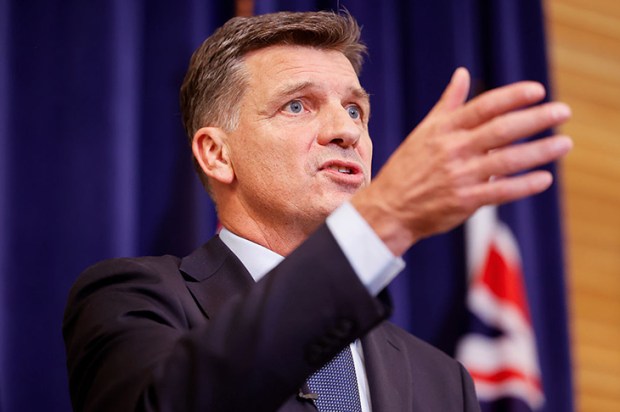
One of the first topics up for discussion on this day was between Sara and Mel Clarke, who heads up the ABC Parliament House bureau. The topic was the Liberal party’s decision to ditch net zero. Mel thinks she knows a thing or two about a lot of things: from energy to foreign policy, from education to US politics.
Now what would have been appropriate is a presentation from Clarke about the contents of the Liberal party decision – there were several parts – and perhaps some discussion about the voting numbers. But instead, she lurched into an opinionated and ill-informed exposition of why the Liberal party’s new policy won’t work.
And given the ABC’s full-throttled support for net zero and Labor’s associated meddlesome policy suite, her conclusion is that the Liberal policy position is a highway to failure, both practically and electorally.
She clearly doesn’t understand the difference between news and commentary, but it’s also clear she doesn’t care. Indeed, her bosses probably reward her for this robust denunciation of any alternative to net zero. Gosh, isn’t it misinformation querying the case for net zero, according to the ABC manual?
Now you might ask why I didn’t switch channels then and there. ABC Classic is not bad, although a great deal of annoying chat must be tolerated even there. But having decided to make this morning my case-study, I pressed on.
We then had some public health academic – all Speccie readers know the sort – prattling on about the tragic lack of progress with health labelling of foods. What is with these interfering, cheerless ‘experts’ whose main aim in life is to restrict individual freedom in costly ways?
Evidently, the real problem is that the labelling is voluntary and that not enough food producers have gotten on board. Of course, the whole thing is piffle. In the UK, a tub of fruit yoghurt has the same health rating – very bad – as a box of Maltesers. By the way, it’s probably OK to eat 50 grams of butter in a day; it’s just not such a good idea to eat 1,000 grams.
Of course, the solution to this problem according to the academic whose name I immediately forgot is to make health labelling of food MANDATORY. And there is no time to waste. Sara simply groaned a few times during the interview – in obvious agreement.
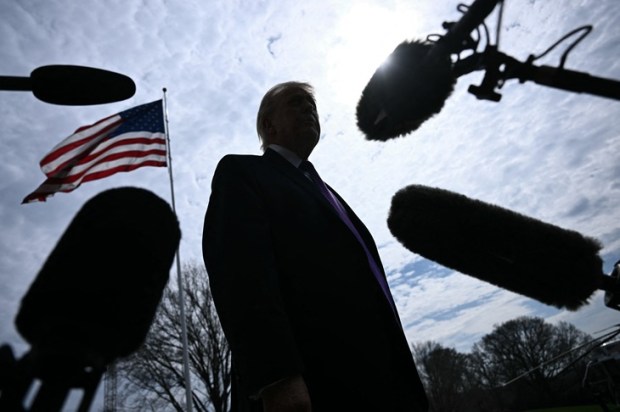
But the ‘highlight’ of the morning was the discussion of the doctoring of President’s Trump 6 January speech in the BBC Panorama program. The person invited to discuss this topic had worked for the BBC – almost all humanities graduates in the UK seem to have worked for the BBC at some stage – but is doing something else now. He was fiercely pro-BBC which was the principal reason he was invited on the program, no doubt.
His first assertion was that Britons don’t like Donald Trump, so who really cares? No evidence offered, but no push back from Sara either. The next point was that the selective editing of the speech was no big thing, and it didn’t change the only interpretation that can be given to that day – that Donald Trump wanted to take over the Congress by force and destroy American democracy.
Again, no objection from Sara, although she may have had a slightly different view on the editing of the speech. But who knows?
His final point was that the BBC is one of the most important cultural institutions in the world. Any complaints made about its performance are trivial, are made by far-right/conservative forces to destroy the BBC and should be dismissed. Complete agreement from our Sal, there.
There was only so much I could take. Having been warned that B1 (Chris Bowen) and that complete nobody from South Australia, Senator Andrew McLachlan, were coming up in the next hour or so, I hit the off button. A cup of tea beckoned.
In fact, the selection of McLachlan is a classic case of bias. He is a non-entity who has never achieved anything politically. But he is pro net zero and a Liberal. This is just the perfect candidate for an ABC program.
A bit like an Israeli citizen who hates Israel. A bit like someone who thinks being a woman is a social construct. A bit like someone who believes in the climate emergency. These types are regularly on ABC programs. Is it possible to have fervent Democrat E.J. Dionne on the ABC even more? As an expert on American politics, listeners must understand.
The question I keep asking myself: is the ABC really any better than the BBC? The selection of interviewees is clearly biased. And for anyone who does agree to be interviewed but doesn’t take the ABC position on a topic, expect rudeness, interruptions and argumentation. By contrast, those who are on board with the ABC line are given carte blanche to make the case with only effusive thanks at the end.
‘Thank you for your time, Minister.’ ‘It’s a pleasure, Sally.’ Says it all.
Got something to add? Join the discussion and comment below.
You might disagree with half of it, but you’ll enjoy reading all of it. Try your first month for free, then just $2 a week for the remainder of your first year.