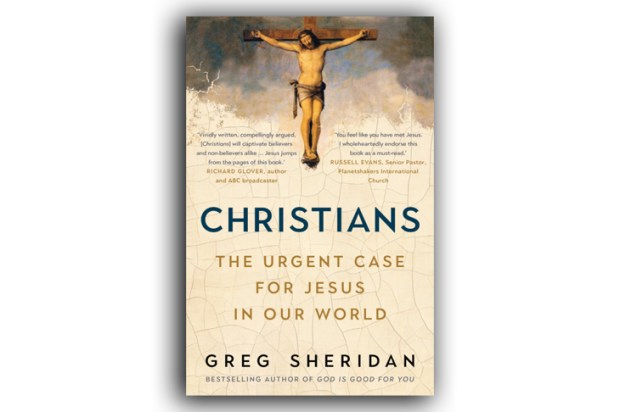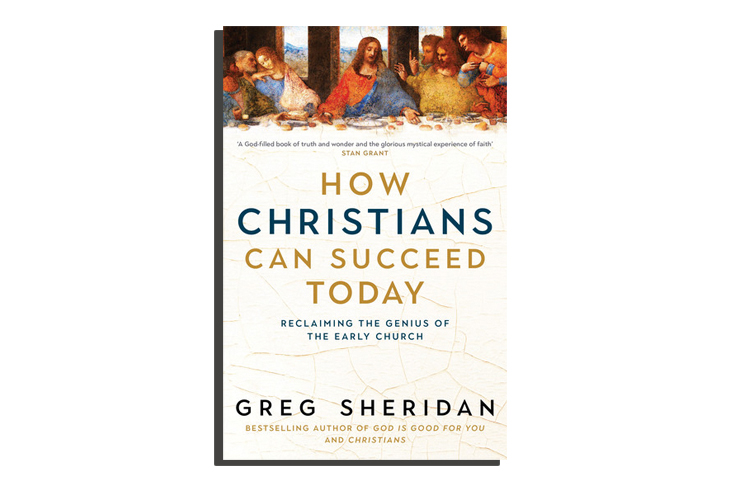
This is Greg Sheridan’s third volume of Christian apologetics. The first, Christians, was the case for Christian faith. The second, God is Good for You, was an exploration of the character and personality of Jesus. This latest work is essentially a call to arms directed to individual Christians and the wider Church. Don’t be discouraged, Sheridan is telling today’s Christians. At least in the post-Christian West, these are dispiriting times for people of faith. Still, they’re not nearly as harsh as those experienced by the early Christians, whose example amazed and eventually converted the Roman world. If this generation of Christians can manage even a fraction of the same inspiration, Sheridan assures us, wonders may yet be worked.
I think Sheridan is right. Just as the Reformation and counter-Reformation revitalised Christianity in early modern Europe, and just as Wesleyanism and the Oxford Movement revitalised Christianity in late-18th and early-19th century Britain, this generation can create the revival of faith that Western Civilisation sorely needs. And that may even be starting, in the nascent return to religious practice evident among young men in particular. But no one should pretend that it’s going to be effortless or without its own crop of modern martyrs.
‘We shall this day light such a candle by God’s grace, in England, as I trust shall never be put out.’ Such was the encouragement that Hugh Latimer gave to his fellow Anglican bishop, Nicholas Ridley, as they were burnt at the stake in Oxford as part of Queen Mary’s attempted Catholic restoration. Although the penalties for individual Christian witness in the West are these days much less sanguinary, they’re hardly insignificant: public obloquy, cancellation, dismissal, and false accusation being by no means unknown. Think Israel Folau, Andrew Thorburn, and the disdain extended to some public figures who take their faith seriously, such as Scott Morrison. The persecution of the late Cardinal Pell doesn’t feature here – perhaps because Sheridan didn’t want the book to become part of the extensive and highly polarised Pell literature – but he’s the supreme contemporary example of someone targeted for being a serious Christian.
Sheridan’s intention is less to dwell on Christians’ contemporary trials, whether it be the social disdain experienced in the post-Christian-becoming-anti-Christian West, or the actual pogroms that Christians endure in other parts of the world, such as the Middle East, Burma and sub-Saharan Africa. Rather, it’s to explore how Christian witness moved the Roman world and to highlight key exemplars of contemporary Christian witness in the hope that more might follow.
As Sheridan explains, ‘ancient culture was working overwhelmingly against Christian beliefs and values’ with only a few exceptions such as ‘some elements of Greek philosophy… which reflected something of the natural law and some elements of paganism (that) contained the sense that there was wonder in the world’. To the Romans, he says, Christianity was ‘a pernicious superstition’; to the Greeks, ‘obvious foolishness’; to Jews, ‘heretical’. But because Christians tended to have more wholesome lives than their pagan neighbours, this novel and demanding faith spread person-by-person throughout the Roman world and beyond, despite intermittent savage persecution. For instance, rather than practise infanticide, the early Christians rescued abandoned babies; rather than enforce a rigid patriarchy, the early Church insisted that men and women had equal rights within the home; and rather than shunning plague victims, Christians strove to help them, courageous in the face of a death that they believed was more a transition than an extinction. By the time of Theodosius, who made Christianity the official religion, perhaps 60 per cent of the empire’s people were already Christian.
Of course, it’s easier to change the religion of someone who’s already religious (as the ancients were) than to argue in to faith the irreligious folk of today. It’s a series of pen portraits of heroic modern-day Christians that forms this book’s luminous heart. Sheridan dubs these radiant individuals ‘contemporary early Christians’ because he thinks they have a proven ability to persuade by inspirational example.
Some of them are well known: Mike Pence, for instance, Donald Trump’s vice president, who did his duty on 6 January 2021, in having the US senate ratify the election his boss said was ‘stolen’; Niall Ferguson, the best-selling historian, who’s thought himself back to faith; Marilynn Robinson, whose novel Gilead, Sheridan regards as one of the deepest modern explorations of personal faith; and Dallas Jenkins, whose TV series, The Chosen, dramatising incidents of the Gospel, has been a global phenomenon.
There’s Danny and Leila Abdallah, three of whose children were killed by a drugged driver, who descended into a dark place before finding peace through forgiveness, and founding the i4Give Foundation. Danny visited the killer in prison, who has subsequently himself had a religious conversion, and says, ‘forgiveness is a gift you give yourself…. People look at us, even if they don’t believe, (and) their souls get pierced. It’s one per cent us, embracing God’s love, and it’s 99 per cent God’.
Another moving story is Jess Echeverry’s, who helps street people in Los Angeles. Jess was herself homeless for much of her teens, and only pulled herself out of prostitution, drugs and suicide attempts, when she was pregnant for the third time, and desperate to give her baby a better life. After marrying a faithful Catholic, she had a mystical experience of the presence of Jesus. Later, she heard his voice telling her to go back to the streets to serve the homeless. The service she and her husband now run is not explicitly Christian or outwardly religious but prayer keeps it going. As she says, ‘My work is inspired by the love of Jesus. Even if for a moment I help homeless people feel their dignity… These are his children. They direct their thanks to me but really it’s Jesus. They deserve to meet him and know what it means to be loved by him.’
Then there’s Mark Varughese, who left a successful legal career in Perth to found Kingdomcity, a Pentecostal church now active across 15 countries, after several personal encounters with God. This is how he explains one: ‘It was the most strange but life-giving experience… It was like someone turned the tap on… I was on the floor. I could feel this, like waves of liquid… I was mumbling. I didn’t want to be too loud because I didn’t want to be embarrassed. At the same time, it was so overwhelming. I didn’t want it to stop. If God chooses to make me look like a fool for a few minutes but I get him in exchange it’s worth it.’
There’d be few readers who wouldn’t find an individual to relate to amongst the personal stories that Sheridan gives us: all of them people whose contemporary lives have been transformed by faith and who have gone on to help and inspire numerous others. Who would have thought that a lay journalist would turn out to be one of Christianity’s best public advocates? Sheridan is becoming a Chesterton for our time.
Got something to add? Join the discussion and comment below.
You might disagree with half of it, but you’ll enjoy reading all of it. Try your first month for free, then just $2 a week for the remainder of your first year.