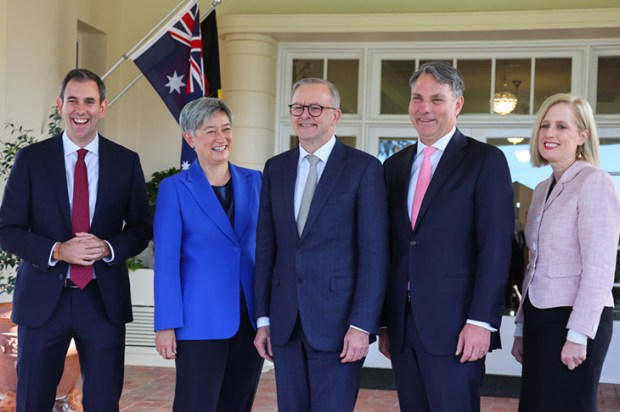
The Commonwealth stands mere weeks away from breaching the $1 trillion debt threshold, a milestone so staggering it would have been inconceivable just two decades ago. Yet Jim Chalmers, Treasurer and self-styled fiscal custodian, insists with a straight face that he has ‘paid down’ the Morrison government’s debt, despite inheriting $855 billion and adding close to $150 billion since. To call this sleight of hand ‘creative accounting’ would be too generous; it is a blend of economic ignorance and rhetorical deception. It is the fiscal equivalent of a gambler borrowing more money while insisting he is ‘winning’ because he has paid off an earlier loan.
Australia’s fiscal history makes this reversal even more shocking. In 2007, the Commonwealth effectively carried no net debt and enjoyed one of the strongest balance sheets in the world. The nation was regarded internationally as a model of discipline and prudence, with resources to weather any storm. Today, after waves of political mismanagement, reckless spending, and short-termism, Australia finds itself financially vulnerable and teetering on calamity.
Meanwhile, the cost of servicing this mountainous debt load consumes an ever greater share of public resources. The fastest-growing item in the federal budget is not the NDIS, as many assume, but interest payments on government borrowings; rising at more than double the NDIS’s already unsustainable pace. This means taxpayers are now funding the privilege of past excess rather than the promise of future opportunity.
Worse, interest payment spending comes on top of already excess spending, which is destroying wealth creation by the private sector while driving the increasing debt. Interest payments crowd out spending on health, education, defence and infrastructure thus weakening the economy, which then reduces revenue, causing still more borrowing. It is an unforgiving spiral that no amount of political spin can disguise. Every dollar spent on interest is a dollar denied to hospitals, schools and roads. And unlike infrastructure, which if well directed generates productivity and future returns, interest payments are dead money, merely a transfer from taxpayers to bondholders
Australia’s transformation from fiscal exemplar to debt-laden cautionary tale is among the most dramatic in modern global economic history. And yet, when challenged, political leaders fall back on the tired refrain that, ‘Australia’s debt is manageable by international standards.’ Such comparisons are both lazy and dangerous. Pointing to Italy or Greece as benchmarks ignores that Australia’s economy is smaller, more trade-exposed, and far less diversified.
Unlike the United States or China, Australia does not possess vast domestic markets to cushion external shocks. Our prosperity rests precariously on a handful of commodities – iron ore, coal, natural gas, agriculture – many of which are under siege from government policies designed to constrain or eliminate them altogether. This is not just imprudent; it is a form of national self-harm.
Debt accumulation paired with deliberate sabotage of our export base creates a vicious feedback loop. As revenue streams weaken, debt servicing becomes more burdensome, forcing either higher borrowing or higher taxes – often both.
Delusionists claim that the Future Fund will act as a buffer, but this is perhaps the greatest misconception of all. It is small in comparison with the trillion dollars in debt. And as the global financial crisis showed, asset values collapse precisely when liquidity is most needed. To rely on volatile and illiquid investment pools to underwrite fiscal security is to build a house on quicksand while congratulating yourself on its earthquake resistance. History shows that when the storm comes, paper wealth evaporates like morning mist. A government that believes otherwise has learned nothing from history.
The problem is not confined to Canberra. Add in roughly $600 billion of state and territory borrowings, and combined government debt approaches $60,000 for every Australian, or nearly a quarter of a million dollars for an average household.
Victoria, Tasmania and the ACT, in particular, have turned fiscal irresponsibility into an art form, coupling bloated spending with punitive taxation and endless borrowing. Their inevitable financial crises will trigger Commonwealth bail-outs, adding billions more to national debt and creating cascading liabilities across every tier of government. The problem is systemic and contagious.
Once one jurisdiction falters, the pressure on the Commonwealth multiplies, and the cycle of borrowing accelerates.
Australia’s prized AAA credit rating now hangs by a thread. Very few nations retain this badge of fiscal strength and losing it would inflict swift and painful consequences. Higher borrowing costs would ripple across governments, banks, households and businesses. States would pay premium rates for their already bloated debts. Banks, facing increased funding costs, would pass them on to mortgage-holders and small businesses. A downgrade at the sovereign level would cascade through the entire financial system with devastating effect. The illusion that Australia can drift along without consequences is precisely that, an illusion. Bond markets are patient until suddenly they are not.
The most troubling feature of all is that the trajectory shows no sign of reversing. Only Western Australia maintains fiscal discipline; everywhere else, deficits stretch indefinitely into the future.
Instead of genuine structural reform, governments lean on bracket creep, an insidious inflation tax that silently strips households of disposable income. This cynical reliance on stealth taxation hides the true weakness of public finances while intensifying cost-of-living pressures for working families. Politicians congratulate themselves on ‘record revenues’ while families quietly suffocate under invisible tax hikes.
The illusion of current stability has seduced policymakers into thinking that Australia’s fiscal buffers are unbreakable. But buffers erode, debt compounds, and opportunities squandered do not return.
For fifteen years, Australia has drifted toward dependency, lulled by prosperity and distracted by ideology. The path narrows with each passing budget, and the longer reform is postponed, the harsher the reckoning will be. Ernest Hemingway’s line about bankruptcy – ‘slowly, then all at once’ – captures the Australia’s trajectory with chilling accuracy. What now appears to be a slow drift could, without reform, become a catastrophic crash.
The moment of reckoning may not arrive tomorrow or next year, but it will come, and when it does, it will define the nation’s economic future for generations. The question is whether Australia will act while choice remains or wait until crisis leaves no choice at all.
Got something to add? Join the discussion and comment below.
Dimitri Burshtein is a Senior Director at Eminence Advisory. Peter Swan AO is professor of finance at the UNSW-Sydney Business School.
You might disagree with half of it, but you’ll enjoy reading all of it. Try your first month for free, then just $2 a week for the remainder of your first year.