What are we to make of dramatic classics and classics of music and dance? That very distinguished actor Bille Brown said of the Australian theatre director Simon Stone’s adaptation of The Wild Duck – the one in the glass box – that it was very fine but that he missed the trolls.
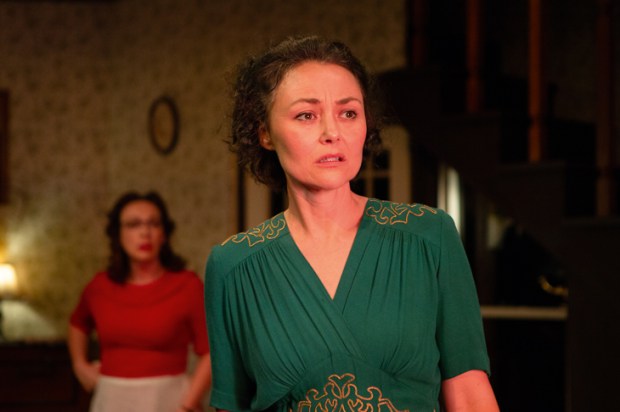
Last month, Stone’s ‘version’ of The Lady from the Sea opened in London with Alicia Vikander as the woman who tortures herself and her husband with the distinct possibility that she’ll leave him for the long-ago lover to whom she feels she has given her soul so that she imagines she must embrace perdition.
Simon Stone is an auteur of the theatre and he constantly writes along with his original even though they sometimes end up with the same lines. He did a Medea at BAM in New York with Rose Byrne who has the born comedian’s ability to capture the terrible crystal of tragedy. And it will be fascinating to see what Andrew Lincoln and Vikander make of this play with its great depth of disturbance, its apprehension of dead children exchanging eyes with a fatal lover.
The Lady from the Sea is a staggering piece of theatre and the spirit of the trolls – and perhaps some prefiguration of Freud – are mighty in this colossal black ocean of a play.
Shaw was fascinated by Ibsen. James Joyce taught himself enough Norwegian to write a letter to him. He is one of the towering prophets of the modern theatre and we have everything to learn from him. So, God bless Simon Stone and all who sail with him in whatever stormy and contradictory sea.
Suzie Miller has made a brilliant career for herself by exhibiting the histrionic glitter and impassioned reality of the dramas that transpire in the courtroom and the shattering emotional realities that take place in the shadowland of private life. The National Theatre Live broadcast of Prima Facie was a galvanising success with Jodie Comer in a devastating performance as a young barrister who finds the scales of justice pointing any way but hers.
In cinemas this week we have the original London version of her new play, Inter Alia, with Rosamund Pike. She plays a tough-minded feminist Crown Court judge who despises the condescension of the old establishment barristers who appear before her. She is willing to sentence a young man to seven years even though she hears the cry of despair that comes from his mother. She’s a tough customer and the gender bias that favours the assailant in cases of alleged sexual assault fills her with rage and contempt.
The acting in this NT Live transcription is ‘big’ especially when Rosamund Pike in the early scenes of self-confident bravura struts her stuff. Then something happens which confounds all of Pike’s righteous and tough assumptions which the audience has been encouraged to acquiesce in even if they know there is a glassiness in her sense of predestined rectitude.
Inter Alia literally means among other things and in the context of this piece of riveting theatre it plays – somersaultingly – with the limitations of considering the law as ‘the true embodiment of everything that’s excellent’.
Or does it? Suzie Miller plays with the supreme difficulty of behaving truthfully when heartbreaking personal predicaments and emotional contradictions intervene. Rosamund Pike’s performance grows in magnitude as she attempts to anatomise the looming horror of what her heart tells her, thud by shuddering thud, and the sheer difficulty of forging some semblance of integrity in a world that has hardly begun to fathom Pascal’s dictum that the heart has reasons that the reason knows not of.
Justin Martin directs Inter Alia brilliantly and populates the stage with all manner of conjured-up friends and long-ago children as well as the very real figures of her husband and son. The action of Inter Alia is such a ballet stage and such a battlefield (all at once) that we gasp at the congregation of formal beauty and intimate horror that we’re confronted with.
All this is a long way from Snoop Dogg at the AFL Grand Final on Saturday. He strolled with a sauntering elegance and it was a cheering thing that he included ‘Gin and Juice’, his finest song, in his medley of hits to the delight of the Geelong Cats and the Brisbane Lions and the world at large. Who would have guessed that on the night before he was at Brunswick’s Tempo Rubato listening to Melbourne pianist Tristan Lee play Schubert and Brahms? The world of music has many mansions and Snoop Dogg clearly has a head and heart for every variety of it.
Of course if you wanted music that outstared the stars there was the Melbourne Symphony Orchestra concert that culminated in Mozart’s Great Mass in C minor which is one of the most towering pieces of music ever written, a soaring musical mountain range that audaciously leaves out parts of the liturgy of the Mass to make room for the implicit representation of human love – leaving spaces for what Mozart does not wish to have asserted.
It dates from 1782-83 and was the first major piece of sacred music Mozart had written for a decade. Of course the missing bits speak volumes. The upshot is weird because it personalises the excisions – as if they were a private language to his wife Constanze – and it also shows Mozart reanimating the counterpoint of not only Handel but the stupendous restraint of Bach. But the Great Mass is the most mysterious kind of extroverted privacy.
The MSO’s Kyrie had all the depth and grandeur in the world with the chorus solemn yet not weighed down and Siobhan Stagg inhabited the ‘line of beauty’ with seraphic effect and later the coloratura of Samantha Clark was crystal clear, like a memory of the long-ago ecstasies of childhood, and then in their duet – during the ‘Dominie Deus’ – Stagg and Clark had just the right interplay and incandescent rapport.
Conductor Nicholas Carter’s integration of the whole work was masterful and the interplay of choir and orchestra deepened the palpable sense not so much of enchantment as of something that actually came across as revelation.
The sense of coming home to one of the pinnacles of music is part of the paradox of a cultural nationalism that embraces the world. It tallies with a sense of theatre, like Simon Stone’s, that can encompass Ibsen.
Got something to add? Join the discussion and comment below.
You might disagree with half of it, but you’ll enjoy reading all of it. Try your first month for free, then just $2 a week for the remainder of your first year.