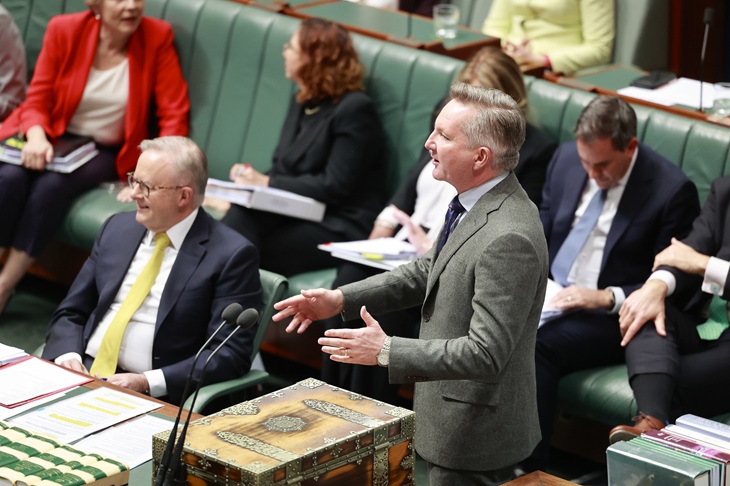
No one should be surprised by Minister Chris Bowen’s latest article in The Australian. He has made it abundantly clear that he will not budge from an almost singular obsession with wind, solar, and batteries, and any technology that does not fit that view, particularly nuclear power, is dismissed out of hand. The result is not bold policymaking but a narrowing of Australia’s strategic choices at the very time we need maximum flexibility.
His rhetoric is familiar: renewables are cheaper, renewables are faster, and Australia is already on the right track.
What Bowen skips entirely is how energy works in the real world, not in glossy speeches. Land must be cleared, communities push back, workers are scarce, transmission gets delayed, costs keep rising, and the sun still sets every night. When politics demands a victory narrative, reality becomes an inconvenience, so he pretends it’s not there.
His aversion to nuclear power, a proven technology that already keeps the lights on in dozens of advanced economies, is completely misplaced. Bowen bases his ‘too slow, too expensive’ argument almost entirely on the GenCost report, treating it like the final word. But that report assumes the very first reactor we ever built will cost the same as every reactor after it — a modelling shortcut no sensible energy economist would take seriously. It’s like judging the future price of smartphones based on the very first Nokia brick.
In reality, nuclear is delivering on exactly the metrics Bowen claims to care about: reliability, emissions control, and system value. The World Nuclear Association reports that the global average capacity factor for reactors reached 81.5 per cent in 2023, meaning nuclear plants ran at full power more than four-fifths of the year.
The International Energy Agency confirms that nuclear already supplies around 20 per cent of electricity in advanced economies, and over 65 per cent in France, one of the world’s cleanest grids. The WNA also notes nuclear power helped avoid 2.1 billion tonnes of CO₂ in 2023 alone, more than the annual emissions of almost every nation aside from China, India and the USA.
These are not footnotes to the transition; they are the backbone of advanced low-carbon, reliable systems. If nuclear can perform at this scale globally, then the question for Australia becomes: why dismiss it before even trying?
Let’s talk about the nuclear advantages Bowen pretends don’t exist.
First: uranium. Australia produces around 8 per cent of the world’s uranium, and holds roughly 30 per cent of global reserves, the largest on Earth. We earned over AU$1.19 billion from uranium exports last year.
But here’s the absurd part: we ship uranium to countries that turn it into clean, reliable electricity… while we refuse to use it ourselves. It’s like running the best bakery in town, and deciding we’re only allowed to sell flour, not bake bread.
We dig up the uranium, send it overseas, watch others convert and enrich it into fuel, and then admire them for having cheaper, cleaner power. Every stage of the fuel cycle that actually creates value — conversion, enrichment, fuel fabrication — happens somewhere else. We take the smallest slice of the pie, then celebrate it as a feast.
If any other country had our resources, they’d be using them to strengthen national security, industrial capacity, and energy affordability. But under our current policy, Australia is stuck playing miner and spectator, while everyone else collects the winnings.
Second: geopolitical common sense. In a world racing toward clean, reliable, locally-controlled power, countries with nuclear capabilities are powering their industries, securing their supply chains and actually staying switched on. Meanwhile, right in our region, Rosatom and Indonesia are advancing plans for small modular reactors and floating nuclear plants, marking a major strategic shift in Southeast Asia’s energy landscape.
And there are real implications of being a bystander. Being outside the nuclear build-up means Australia misses out on high-value manufacturing jobs, export-income streams, and the power of sovereign capability. It means our critical minerals sector remains raw export-focused rather than integrated into fuel-cycle value chains. It means when the region builds its nuclear infrastructure, the decisions about reactors, fuel services, and maintenance will be made by others, with Australia buying their output, paying higher prices and ceding long-term strategic control.
Third: affordability, the real kind. Bowen loves to repeat that wind and solar are the ‘cheapest’. Sure — per unit of energy, in perfect conditions, on a spreadsheet. But once you try to run a whole country this way, the bill gets a lot bigger.
Why? Because when the sun goes down and the wind quits, you still need:
- backup power
- massive batteries
- new transmission lines running through farms and forests
- expensive tech to keep the grid stable
So that ‘cheap and cheerful’ price tag starts to blow out fast once renewables hit around 50-60 per cent of the system, something even the CSIRO flags.
Meanwhile, transmission lines across regional Australia are already causing delays, protests and environmental concerns. And the materials needed for solar and batteries like lithium, graphite, cobalt, and rare earths don’t magically appear without mining, emissions and geopolitical risk.
Put simply: Renewables are great, until you try to run everything on them. Then the hidden costs show up.
To illustrate the global turn towards nuclear, the Canadian province of Ontario recently approved construction of a 300 MW SMR unit, the first of four at its Darlington site, scheduled by 2030. Its officials expect that four SMRs will deliver 1.2 GW, power roughly 300,000 homes and form the first new generation of reactors among the G7. That project underlines that advanced economies are not treating nuclear as ancillary; they treat it as strategic. Canada’s regulatory authority recently issued a licence to construct for the first unit in April 2025.
Our major allies are all accelerating their nuclear programmes: the United States through the Inflation Reduction Act; the United Kingdom through large-scale reactor builds and SMRs; South Korea and Japan are repositioning around nuclear. And China is commissioning reactors faster than any nation in history.
Even the World Bank, long seen as nuclear-cautious, has acknowledged nuclear’s role in climate and energy security, opening avenues for financing in emerging economies.
In that context, Australia stands out as the only advanced economy planning to try to achieve decarbonisation without a credible firm zero-carbon backup.
We all share the same decarbonisation goal. What we do not share is the luxury of faith in one technological path, and certainly not the luxury of ignoring deeply strategic national assets. If Australia truly has nothing to gain from nuclear, then lifting the ban would simply confirm the Minister’s wisdom. No harm done.
But if nuclear delivers where weather cannot, then lifting the ban protects households, industry and national resilience. As Sir Humphrey might gently suggest, there is no better way to prove one’s conviction than to remove all obstacles to its validation.