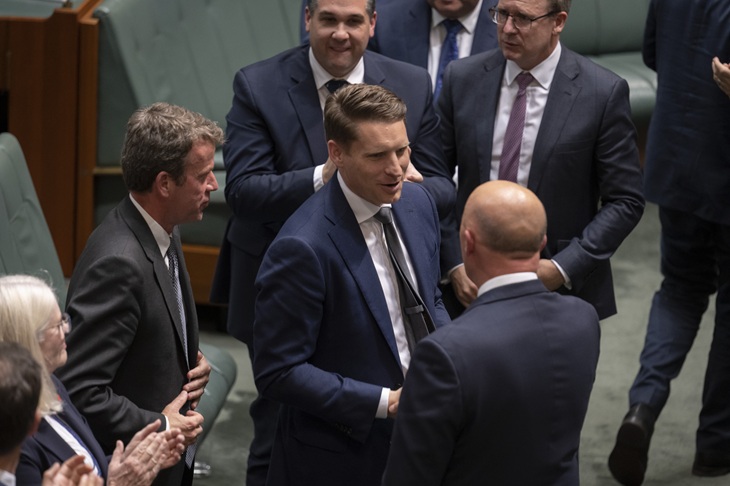
Andrew Hastie’s resignation from the Liberal Party’s frontbench marks a pivotal moment in the party’s internal struggle between its conservative base and moderates.
Once propelled into the spotlight alongside Scott Morrison during the pandemic, Hastie’s departure from the Liberal ‘limelight’ underscores deepening divisions within the Coalition as it grapples with defining its identity and policy direction.
A source who has interned with Hastie’s office, offered the following statement:
‘It is indisputable that Andrew is genuinely committed to preserving the national security of this country. Although the pandemic crushed the nation’s view of several Liberal politicians, trust is being gained back when people see members of parliament take a proper conservative stand to preserve Australia’s freedom and integrity. I’m not surprised Andrew has finally had enough and has put the country first, before the Liberal party.’
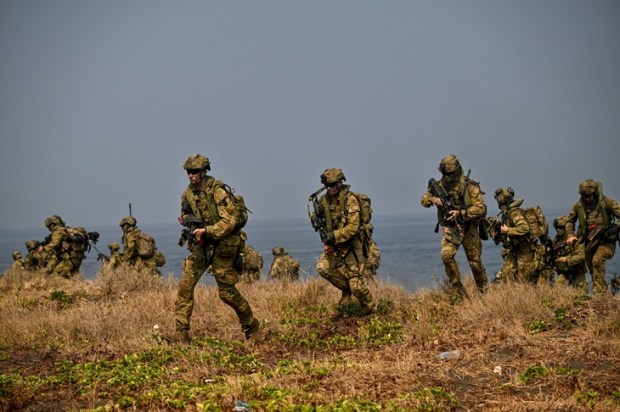
Hastie’s ascent to the frontbench came during a period of national crisis. Appointed as Shadow Minister for Home Affairs in May 2025, he was expected to bring a disciplined, security-focused perspective to the role. His background as a former Special Air Service Regiment (SAS) officer, with deployments to Afghanistan and the Middle East, lent him credibility on national security matters and foreign policy. His military experience shaped his hawkish stance on China, emphasising the need for a robust defence posture and clear-eyed foreign policy.
However, Hastie’s tenure was marked by increasing tensions over policy disagreements of late, particularly concerning immigration and climate change. He advocated for a significant reduction in immigration levels, arguing that high migration was leading to housing shortages and making Australians feel like ‘strangers in their own home’. This position resonated with many in the party’s conservative wing but clashed with the broader party’s more moderate stance. The recent ‘March for Australia’ indicates that tens of thousands of citizens align with Hastie’s very logical view to curb migration so that there are enough houses, proper infrastructure and facilities available to maintain the current population.
According to the 2021 census, there is an average of 2.5 people living in each Aussie household. The number of people per house has been on the decline since 1961, where the average number of people per house was 3.6. According to ABS data, Australia has 11 million homes. We have a population of 27 million people, meaning house availability is hitting breaking point, as Australia opens wide the doors to upwards of 739,000 immigrants per year. Suggesting Australia needs to drastically change its immigration intake to remain a viable and comfortable place to live, is somehow causing divisions within Australia’s ‘conservative’ party – which indicates something is going wrong in our departments which are supposed to govern constitutionally, according to the principles of ‘peace and order’.
On the overdone ‘climate catastrophe’, Hastie was unequivocal. He threatened to resign if the party maintained its commitment to achieving Net Zero emissions by 2050, labelling the target as economically damaging and out of step with global realities. His criticism extended to what he perceived as hypocrisy among major polluters like China and India, who are not adhering to similar commitments.
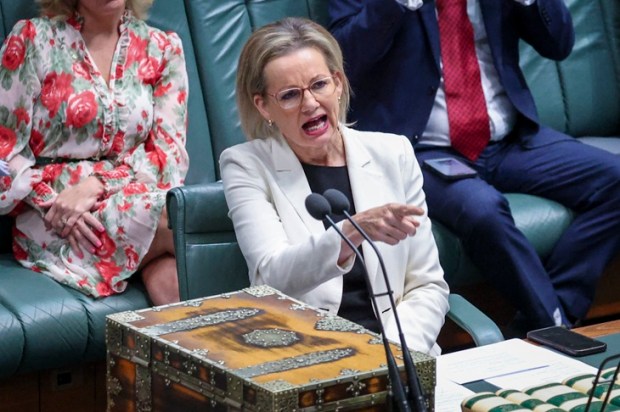
These positions placed him at odds with Opposition Leader Sussan Ley, who emphasized the importance of unity and broadening the party’s appeal. Although it appears to be important to preserve the party’s unity, what is arguably more important is the unity of the country at large – and its national security. On the Net Zero issue, several politicians are sceptical of renewables because they pose a threat to Australia’s energy security.
In his resignation statement, Hastie invoked the Westminster principle of Cabinet Solidarity, expressing respect for Ley’s leadership but asserting his inability to remain silent on issues of national importance. His departure has sparked speculation about his future within the party, with some viewing him as a potential leader for a more conservative faction, with eventual Prime Minister capabilities.
Hastie’s resignation indicates a broader dilemma beginning to expose the internal politics of the Liberal Party.
The party must navigate the delicate balance between appealing to its traditional conservative base while attracting a broader electorate – and balance votes with integrity on key issues that will have a drastic effect on the nation long term.
Hastie’s departure may embolden the conservative wing, leading to a more pronounced ideological divide within the party. Either that, or people will start asking the moderates to wake up and stop pushing out all the party’s best politicians – many of whom profess the Christian faith.
Senator Jacinta Nampijinpa Price has been another strong voice ‘sidelined’ by Ley. Being sidelined for being ‘too conservative’ is starting to become very common.
As the Coalition prepares for the 2028 election, the challenge will be to reconcile these internal divisions and present a unified front. Hastie’s exit serves as a stark reminder of the complexities involved in maintaining party cohesion while addressing the diverse concerns of the Australian electorate.
His exit demonstrates that strong Liberal politicians have had enough of the ‘wokefied’ nonsense destroying the very fabric of Menzian politics.