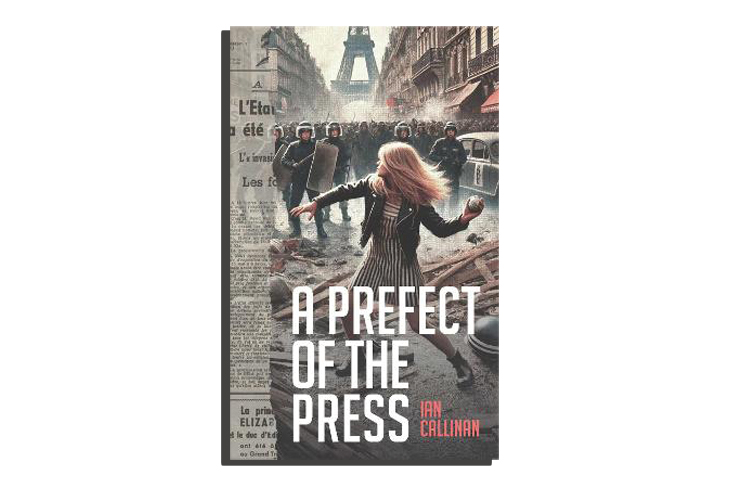
For a Justice of the High Court of Australia – even a retired one – publication in any genre is a perilous venture. Before being relegated to gather dust on the unreachable top shelves of professional libraries, a monograph devoted to an abstruse field of the law may attract graciously lukewarm notices in the few legal journals which do not insist upon academic ‘peer review’. But anything intended for the popular market is doomed to be critiqued, if at all, only by academics who have a bone to pick with the author, and somehow manage to extricate from the author’s fictitious inventions a psychoanalysis which serves only to confirm the reviewer’s preconceptions regarding the author’s troglodytic social and political opinions.
Thus, when Sir Samuel Griffith’s English translation of Dante Alighieri’s La Divina Commedia – replicating the original hendecasyllabic metre – was published the most generous accolade appeared in the Bulletin, which grudgingly pronounced that, ‘No harm can come from a perusal of Sir Samuel Griffith’s attempt.’ The English publication Bookfellow sniffed that, ‘Unfortunately the poetry of Dante has escaped almost entirely from Sir Samuel’s industrious fingers.’ Griffith was gratified when, after presenting a copy to Sir Julian Salomons, leader of the Sydney Bar, he was asked to inscribe the flyleaf as a gift, until Salomons explained that ‘I should not like anyone to think that I had borrowed the book, even less should I like anyone to think that I had bought it.’
Yet, at the risk of betraying these malevolent precedents, it must immediately be conceded that A Prefect of the Press is actually a jolly good read. The eleventh of Callinan’s published novels (he has also written six stage plays), it rivals his third, The Missing Masterpiece, as arguably the best yet. Both have this in common: adherence to Mark Twain’s advice to ‘write what you know’.
Callinan has long been one of Queensland’s most discriminating art collectors, and, prior to his elevation to the judiciary, served as Chairman of Trustees of the Queensland Art Gallery: hence, The Missing Masterpiece sardonically exposed the elite world of public art galleries and private collectors. Likewise, not only was Callinan something of a specialist in defamation cases when at the Bar, often either suing or defending the major organs of the legacy media (including his appearance for Channel 9, successfully defending what was then the longest civil jury trial in Australian legal history); not only was he, albeit briefly, a director of the ABC. In addition, his only son, Rory, is himself a distinguished investigative journalist, reporting for such renowned news outlets as Time magazine, SBS and the Guardian. So it is unsurprising that A Prefect of the Press addresses the tension between the lofty ambitions of the journalistic profession and the shameless compromises required of the working journalist.
There is one regrettable flaw in Callinan’s novel: the publisher’s editor, if such a person exists, deserves to be shot. One suspects, however, that any proof-reading was done electronically, since most of the (very numerous) typographical errors are real words which appear to be homophones for the words which the author intended, such as ‘court marshalled’ for ‘court martialled’, being a sure sign of electronic editing. In any event, those familiar with Callinan’s literary output will feel confident that the fault does not lie with him, since a number of his personal idiosyncrasies (legitimate, if somewhat archaic) have survived the spell-checker’s mauling, such as the spellings ‘connexion’ and ‘gaol’, and the expression ‘an hotel’.
Maybe Callinan even foresaw this typographical misadventure, when he attributed to one character – the editor of a London tabloid – an example of a sanctimonious literary review, containing the remarks, ‘Neither the prologue nor the endnote, not surprisingly, names its editor. It is understandable that any editor would not wish to associate his name in print, with this handsome and expensively bound volume which has a spelling mistake on every other page and commits solecisms with the same regularity as cart horses fouled the Edwardian streets of this once fair city.’
Callinan’s greatest achievement, however, is the evocation of Brisbane life in the sixth and seventh decades of the last century. Novels set in Brisbane are rare: aside from a few works by David Malouf, Nick Earls, Trent Dalton et al. it is difficult to think of any work of fiction – either literary or popular – which has been set firmly in Brisbane since Steele Rudd (Arthur Hoey Davis) published his semi-autobiographical work, The Miserable Clerk, in 1924.
For the reader who lived through the relevant decades, even as a child, there can be some fun in identifying the local institutions (many now long gone) and local personalities (most now long deceased) to which Callinan has judiciously attached pseudonyms. Some of them are obvious, like the Sunday Express (described as ‘a weekly scandal sheet’), which could only have been inspired by the inaptly named Sunday Truth; and ‘the Palladian Club’, which could only be a simulacrum of the Royal Queensland Golf Club. But the public figures are harder to pin down. Only one character is instantly recognisable: the barrister Timothy O’Leary, surely modelled on the late Dan Casey.
Amongst many other wry observations, Callinan (through the mouth of yet another fictional tabloid journalist) offers this advice about writing literary reviews: ‘Well there’s a technique. Read the last chapter first. Usually that’ll give you a good idea what the book is about. Start on the basis that all authors are prolix. After the last chapter, read the first. Then all you’ve got to do is dip into the odd page or so in between. Always make some reference to material in the middle of the book. If you’re really stuck and up against a deadline, just write about the author. They’re usually as vain as they are prolix, so there’s always quite a lot about them inside the back cover or the dust jacket.’
Regrettably, the present review was undertaken without the benefit of such sage advice, which appears more than halfway through the text, by which point one was inevitably ‘hooked’ to know how the story would play out. In any event, it seems unlikely that the suggested technique would work, either for this book or for this author. And, to be frank, this reviewer is more than gratified to have imbibed Callinan’s prose, refreshingly elegant if poorly type-set, from cover to cover.
Got something to add? Join the discussion and comment below.
You might disagree with half of it, but you’ll enjoy reading all of it. Try your first month for free, then just $2 a week for the remainder of your first year.