Check out this diagram. This is Venezuela’s GDP over time. It tells a sad and devastating story.
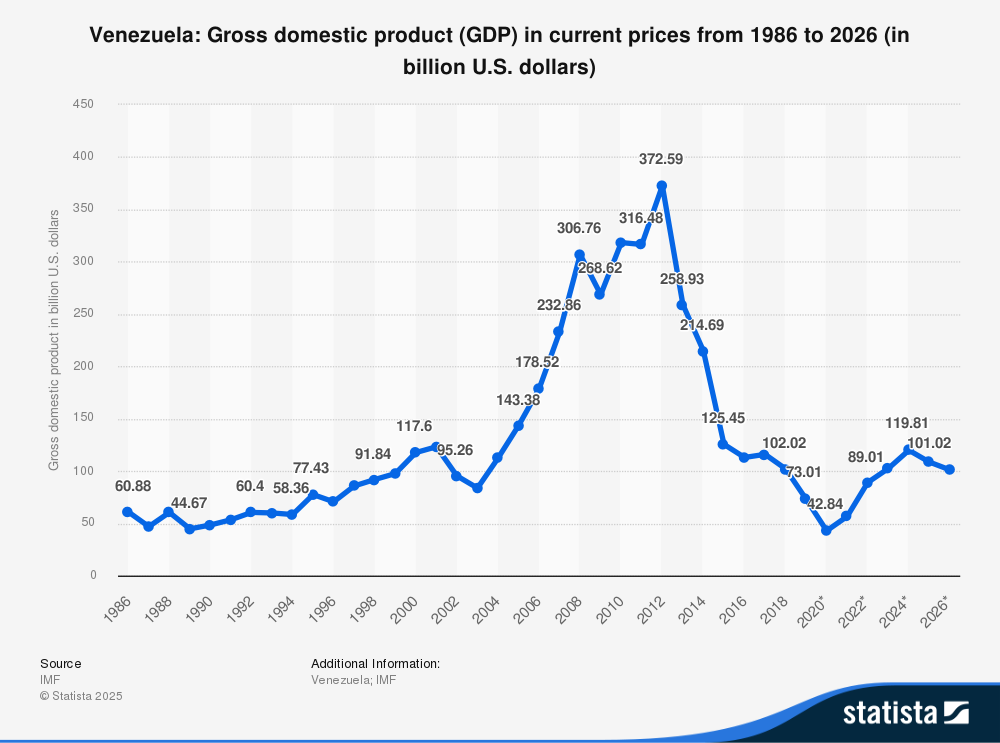
From a peak of US$372.59 billion in 2012, Venezuela’s economy belly-flopped to just US$42.84 billion by 2020 – an 88 per cent nosedive that qualifies as one of the most spectacular peacetime economic implosions in modern history. For Australians watching global trends, it’s a cautionary tale of how quickly a wealthy democracy can morph into a case study for ‘what not to do’.
The unravelling kicked off with Hugo Chávez, elected in 1998 on a platform of feel-good redistribution and sticking it to ‘the elites’. ELECTED!!!
At first, his so-called ‘Bolivarian Revolution’ looked like it might be onto something – poverty dropped from 61 per cent to 34 per cent between 2003-13, and income distribution briefly became the fairest in Latin America. Of course, all this glitter was built on a foundation about as sturdy as a Treasury budget projection.
Then came the economic genius moves. Price controls in 2003 froze staple food prices and essentially outlawed private imports. Because nothing screams ‘sustainable policy’ like banning supply while keeping demand constant. Add in currency controls and you get a system where subsidised dollars fuelled a cottage industry of currency speculators while ordinary Venezuelans queued for toilet paper.
But wait, there’s more. Chávez’s nationalisation binge made Oprah look restrained: you get expropriation, you get expropriation, everybody gets expropriation!
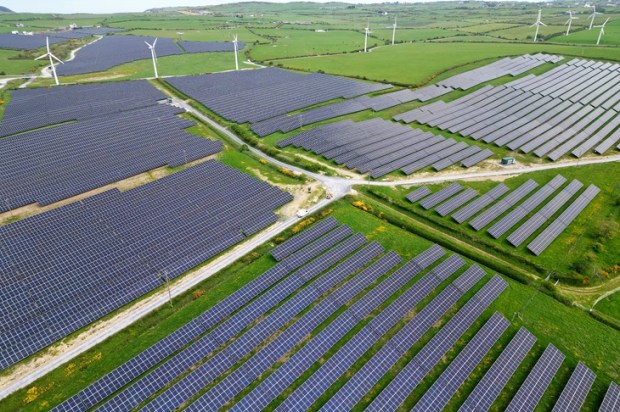
Over a thousand firms and millions of hectares were seized, often announced on live TV with all the subtlety of a game show reveal. And not to build poles and wires to renewable energy sites.
Shockingly, putting steel plants, cement companies, and telecom networks in the hands of political cronies didn’t lead to peak efficiency.
Their own version of A Future Made in Venezuela.
Meanwhile, the central bank became a glorified money printer, churning out currency to paper over massive fiscal deficits during the oil boom. Rather than saving for the inevitable rainy day, Venezuela blew the lot like a lottery winner at a casino, racking up over $100 billion in debt. Unlike Australia’s $1 trillion.
Cue the oil crash of 2014, and suddenly the emperor had no clothes.
And here’s the kicker: Venezuela has the largest proven oil reserves on the planet – yes, more than Saudi Arabia – but thanks to decades of corruption, mismanagement, and driving foreign expertise out the door, it can’t even extract and refine enough to keep the lights on.
Imagine sitting on a mountain of coal, sorry, gold and still managing to go bankrupt – Venezuela did exactly that.
The uncomfortable part? Echoes of this playbook show up in Australian debates.
Calls for price controls, government takeovers, and spend-like-there’s-no-tomorrow deficits sound hauntingly familiar. Toss in some class-warfare sloganeering and you’ve got déjà vu with a Southern Cross.
And then there’s the climate policy circus: as Minister Bowen helpfully reminds us, ‘the costs of doing nothing are higher’. Which would be reassuring, if the ‘something’ wasn’t a central plan with a price tag that makes Venezuela’s spending look like loose change. Apparently, the road to salvation is paved with gold-plated subsidies and energy bills you’ll need a second mortgage to cover.
Yes, Australia has sturdier democratic institutions, an independent judiciary, and a media that still bites back. But Venezuela reminds us how fast those guardrails can be bulldozed when politicians peddle silver-bullet solutions and hollow out institutions while chanting about ‘the people’. Spoiler alert: it doesn’t end well.
The human fallout? Beyond tragic. Over 7.7 million Venezuelans have fled – one of the largest refugee crises on the planet – while those stuck inside grapple with hyperinflation, food shortages, and the slow-motion collapse of basic services.
Flamingo frittata and pigeon pasta on the menu.
So, next time a politician promises to ‘fix everything’ with a mix of government control, central planning, and populist swagger, take a look at Venezuela’s GDP chart. It’s a reminder that the road from $372 billion to $42 billion doesn’t start with chaos – it starts with applause, an election, and a government promising that the state knows best, and a congenitally incompetent opposition.
This was first published on Substack