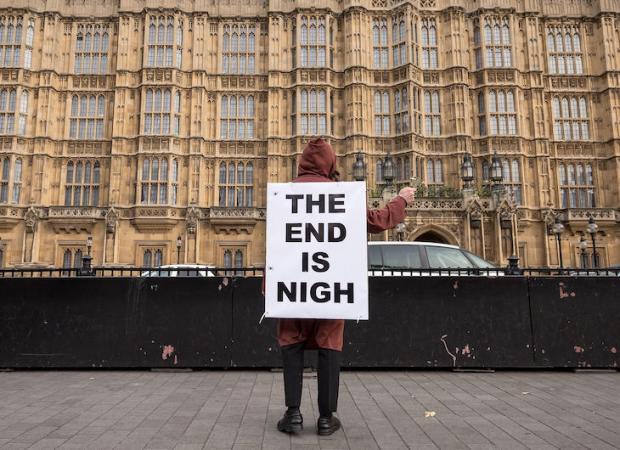
I am writing this in the bar of a cheap hotel. As I type, I notice a man running down the road with a box of chocolate and cartons of cigarettes. His trousers fall, and he hits the ground, spilling the goods all over the street. As he tries to leave, an elderly African woman hits him with her shopping bag. ‘Welcome to London,’ the bartender says with a smile as he hands me my beer. I’ve been here for a week and have generally avoided the typical tourist experiences of being ignored, overcharged, mugged and molested on the Tube. I’m here to be culturally enriched, and hopefully not stabbed.
A couple of nights ago, I visited the Tate Modern. I’m no fan of conceptual art – another medium that has been ideologically captured. Normally, applying the prefix ‘modern’ to anything makes me break out in hives. To my surprise, the five floors housed a small collection of paintings by Wyndham Lewis, Max Ernst, Kandinsky and Miró as part of its general display. The queue was long and stretched around the corner. We had already been waiting outside for an hour when a collective groan filled the air. Bags were being checked under new rules, and anyone found with liquids had them confiscated. Security personnel were patting down visitors in the lobby. So I sat outside and drank two litres of water. Bad idea. Within minutes of entering, I had to find a toilet. Initially, I was tempted to use the one on display by Marcel Duchamp, but I remembered the man who sat on a priceless ‘Van Gogh chair’ and destroyed it. Eventually, I found a toilet in a room with rocks topped with pineapples meant to highlight climate change.
In October 2022, two Just Stop Oil activists entered the National Gallery and threw soup on Van Gogh’s Sunflowers painting. The pair were arrested on suspicion of causing criminal damage and later jailed for their attention-seeking stunt. Politically motivated cultural vandalism undermines the implicit structure of trust that underpins many social arrangements and events. When activists engage in this sort of protest, galleries and museums are more likely to isolate their cultural items from the public. Paintings and artefacts that once seen up close will eventually become distant sights, behind thick perspex glass with a security guard lurking a few feet away.
It’s a microcosm of modern Britain. The institutions that served as the framework holding this country together have collapsed. Marriage rates are declining, the church is mostly ignored, and fertility rates have reached an all-time low. Our collective retreat from these institutions has dramatically weakened us, both as individuals and as a nation. As a result, we have grown increasingly selfish and materialistic. Without a shared moral value system, the concept of civic responsibility dies. A walk down a typical British high street reveals the absence of the common good in public life. The pavement is littered and bus shelters vandalised – windows smashed and tagged with graffiti. Food is now security-tagged and chained to the wall, while expensive products are kept behind glass cabinets. A low-trust society frequently results in a zero-sum game. Because of the rampant surge in shoplifting, British consumers now pay a 10p ‘crime tax’ on each transaction to offset the costs of theft and security. When items are stolen, retailers must raise their prices or close entirely. Contrary to popular belief, poverty doesn’t cause crime; rather, crime causes poverty.
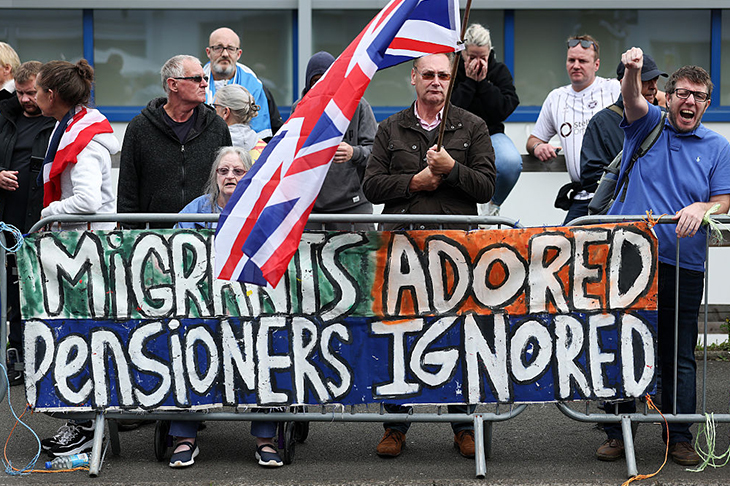
The Labour government’s route to Downing Street rests on preference falsification. As any political science student will tell you, power will always look to enlarge itself. Power, as Bertrand de Jouvenel wrote, ‘lives for its own sake and for its fruits.’ Keir Starmer attempted to appeal to disillusioned Conservative voters fed up with the party’s abysmal record on immigration. In reality, there is little difference between the two parties. During the last six years of Conservative rule, over 150,000 undocumented migrants crossed the English Channel. The BBC reported that 36,816 migrants entered Britain via this route in 2024. 50,000 have arrived since Labour won the election last July.This has sparked public outrage, with taxpayers forced to spend billions of pounds to house migrants in hotels while they await asylum decisions. Instead of being deported, asylum seekers are free to roam the streets. A recent protest erupted in Epping when a migrant was found guilty of sexually assaulting a 14-year-old girl.
The failure of Labour and the Conservatives, commonly known as the ‘uni-party,’ has resulted in a growing public disdain for politics. According to a recent report by More In Common, 87 per cent of Brits have little or no trust in politicians. Another survey revealed widespread dissatisfaction with the mainstream political parties. 45 per cent of people never trusted the government to prioritise the nation’s interests, regardless of which party was in power. This figure has doubled in four years.
Brits have complained about the number of people entering the country for years; ninety percent of constituencies want immigration reduced. We are witnessing a preference cascade as the British public now realises that this thirty-year experiment with multiculturalism has been a deliberate act of sabotage. After only five months in office, an Ipsos Mori poll found that Keir Starmer was the most unpopular prime minister in forty years.
Our governing elites, in their collective arrogance, bought into the idea that diversity is a strength. The electorate had no say on the issue; we were never asked. They arrogate to themselves the power to change the law arbitrarily – elaborate hate-speech statutes exist to stop the electorate from questioning this fashionable shibboleth. The consequences of decades of uncontrolled immigration are obvious: crime, terrorism, grooming gangs, religious courts, forced marriage and honour killings. The ballot box was the revealed preference: the fledgling Reform party returned four MPs to Westminster.
It wasn’t all bad. During an impromptu walk, I stumbled across the grave of William Blake. ‘What is now proved was once only imagined.’
Got something to add? Join the discussion and comment below.
You might disagree with half of it, but you’ll enjoy reading all of it. Try your first month for free, then just $2 a week for the remainder of your first year.