Last week the global national conservative conference was held in Washington DC.
While poorly understood in Australia this movement, or ‘NatCon’ as it is commonly referred to, is increasingly recognised as the intellectual heart and governing ideology of the Trump Administration.
To the best of my knowledge, I was the only Australian there for the full three days.
This is odd. Given its importance you would have thought that representatives from our corporates or at least someone from the Aussie embassy would have rocked along. It might have been useful if you were, say, trying to arrange a substantive meeting with the US President or engage with key people in the administration, many of whom were in attendance.
The key takeaways from the gathering – the first one since Trump retook power – is not only how intellectually sophisticated, resolute, and energetic the new movement is but also how at odds much of their thinking is from the current bipartisan political consensus in Canberra.
To be sure, there is much that the traditional Australian centre-right would cheer.
For example, Assistant Attorney-General Harmeet Dhillon, who is responsible for enforcement of Federal civil rights laws in the United States, gave a cracking speech where she outlined how she is taking an axe to DEI practices in Ivy League universities and corporate America.
She is also an underappreciated foe of discredited gender ideology. Under her direction criminal prosecutions of doctors and others who have been involved in mutilating minors in the name of ‘gender affirming care’ are on their way.
Australian institutions and individuals engaging with the United States would be well advised to drop their gender pronouns from their LinkedIn profiles going forward.
There was much else to celebrate with respect to the attitude to energy development where our incessant debate about ‘Net Zero’ seem like an odd out-of-date parochial obsession. The world’s biggest economy has completely moved on and is again building coal-fired power stations.
There is also a push to hold those accountable for the disastrous Covid-era policies, led by the heroic Jay Bhattacharya, now head of the National Institutes for Health. It was remarkable how often Americans of all walks of life mentioned how shocked they were by the authoritarian response in Australia during the Covid-era and how much it had damaged our reputation as formerly easy-going people in the mode of Crocodile Dundee.
Another pro-tip for those doing business in the American Republic: hold off any effusive praise for matinée idols of yesteryear like state premiers, health bureaucrats, and similar identities or risk a very chilly response.
However, the ‘new right’ in Washington also differ in significant ways from the Howard era.
This is clear in foreign policy. Tony Abbott, who is in many ways representative of such legacy thinking, recently wrote:
‘How many Britons or Australians or Americans would readily put themselves at risk for the safety of others, especially since their leaders have given up explaining that if freedom is diminished anywhere, it’s diminished everywhere.’
With respect, this is the language and mindset of the age of George W Bush and Tony Blair.
It is hard to overstate the quiet contempt this attitude is held in, especially by many key members of the Trump Administration. From Vice President JD Vance to Director of National Intelligence Tulsi Gabbard to United States Trade Representative Jamieson Greer all served in Iraq. The suggestion that they, or young people more generally, would not fight for their country or when vital interests are threatened, is incorrect if not gratuitously insulting.
What this new generation is absolute resolute about is that the reckless and flawed foreign policy of the post-Cold War world which saw America (and often Australia) get involved in numerous pointless ‘forever wars’ and interventions of dubious benefit – from Somalia to Serbia, Syria to Libya, to Iraq and Afghanistan – must come to an end.
While each current or future dispute much be handled on a case-by-case basis, this is the lens through which they will be viewed.
There is a clear generational divide here. Dr James Orr, a key British figure intellectually in the NatCon movement, recently criticised ‘the fervour with which many conservatives of a certain age follow the slightest twists in the Ukrainian conflict’ but that there was now a desperate need to end ‘Ukraine on the Brain’ and to focus on putting ‘Kent before Kyiv’.
Such an attitude is not ‘appeasement’ or ‘isolationism’ but is one which has a healthy scepticism about grand democratising projects, the limits of American power, and those who want to cast every intractable ethnic conflict in Churchillian terms.
Another area of major difference is trade policy.
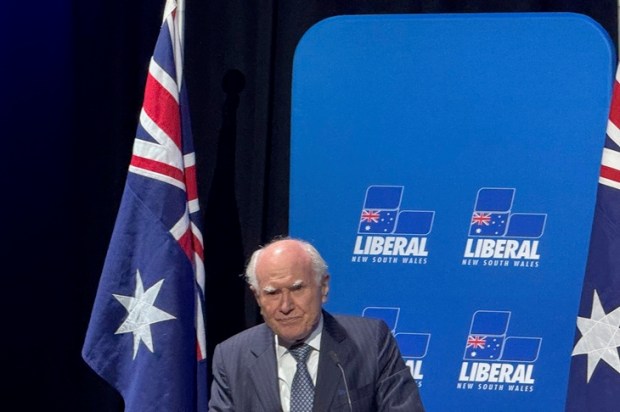
John Howard stated recently that Donald Trump is ‘not a real conservative’ because of he believes in tariffs. With respect, this is simply historically and philosophically inaccurate – and he would flunk any academic essay for saying so.
The US Trade Representative spent much of his speech at the conference explaining not only why ‘free trade’ has been so harmful to America’s national interest but also how it runs contrary to what the Republican Party of Abraham Lincoln traditionally believed in.
These are arguments you will almost never hear from the mainstream right in Australia.
But open-borders trade is of relatively recent origin and runs contrary to the beliefs on which the Liberal Party was formed. Menzies, it is often forgotten, was in favour of tariffs even on British goods to protect our workers and build up our nation’s own industrial capacity. He would have considered it patently absurd that the political party he established still supports a trade agreement that allows 100 per cent of Chinese-manufactured goods to enter Australia duty free.
Finally, there is immigration.
Not only has there been a dramatic crackdown on illegal immigration crossing the border. But there has been a focus on reducing legal immigration so much so that America seems set to experience a period of net negative migration – something we can only dream of here in Australia.
In the Howard era, there was an oft-repeated line that because the government was able to control illegal immigration Australians welcomed higher levels of legal immigration. If that was ever actually true, it is not true now – as recent protests across our capital cities illustrate. It is certainly not the direction national conservatives are committed to in the United States.
Beyond the reduction in numbers there is also a deeper reassessment of what it means to be a citizen of a nation. ‘America is not just an idea,’ as JD Vance famously said. ‘It is a group of people with a shared history and a common future. In short, a nation.’
By contrast, our centre-right still like to talk about ‘Australian values’ as the key to what holds us together. But a nation is more than an ideology, a bundle of liberal axioms, or a corporate values statement.
A Frenchman is different to an Italian even though, today, they share a commitment to the ‘values’ of democracy and freedom of speech. Benito Mussolini, Antonio Gramsci, and most of the Catholic popes were all still Italian even though they ideologically believed in very different things.
Immigrants can form part of the nation, but this needs to be done slowly and very careful not in the grossly irresponsible way it has been done over the last 30+ years.
The focus going forward in the US will be designing policies that reforge them as a common people. No longer will they be content to simply be a bunch of different ethnicities that share a geographic area.
Among the many people at the conference, I had breakfast with well-known academic Patrick Deneen the author of Why Liberalism Failed. The point he wanted to emphasise is that properly understood national conservatism is not new. It is just an updated version of the conservatism of Benjamin Disraeli: sceptical of free trade, wary of liberal internationalism, and corrosive influence of Gladstonian liberalism more generally and focused, above all, on policies which bind a nation together as a common people.
This is the key lesson out of Washington. It is what our own political class in Australia needs to understand if we intend, like our American counterparts, to become one nation once again.
Dan Ryan is the Executive Director of the National Conservative Institute of Australia