It’s bizarre the level of sheer wastage in Ian Michael’s production of Troy. Yes, there’s a bit of hieratic glamour in that soaring pile of cream-coloured steps, but to what purpose? It’s an old adage of criticism that it is better to present rather than refer but Tom Wright’s homage to the great tragic epic of our culture is all whispered reference to the obvious. Someone says the way to get Achilles back into the action is to kill the thing he loves i.e. Patroclus (Lyndon Watts). Everything operates as a footnote to a pre-existent drama and we’re left yawning even when the production whips up a storm to conjure the horrors of the Middle East. There’s sound, there’s fury but nothing much is signified beyond a nominal effort to bring the archetypes together.
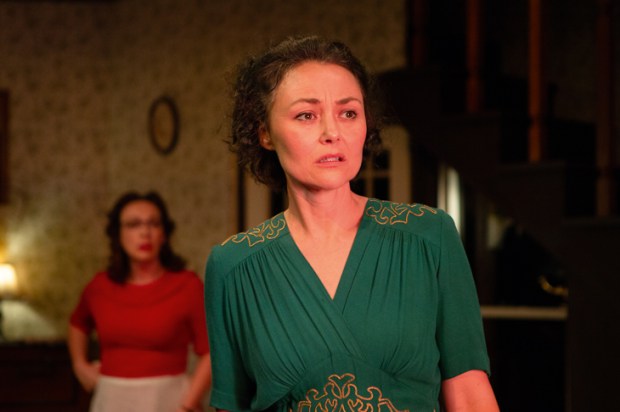
We know Elizabeth Blackmore is Cassandra because she’s the one who knows what’s going to happen and when Geraldine Hakewill’s Clytemnestra starts getting busy with a sword we know, if we’ve ever paid attention to these things, that this is the wife of Agamemnon taking her revenge for the sacrifice of his daughter, Iphigenia (Ciline Ajobong) but it comes across as a gesture in a story no one is centrally engaged with.
There are occasional susurrations of acting from Mark Leonard Winter as Agamemnon but the overall effect is obliviousness to the tragedy of war and its centrality to whatever belief in our culture we retain. ‘Such was the funeral of Hector, tamer of horses’ is one of the great lines in our literature but Troy is largely deaf and dumb. It’s sad to think that all this comes across as a humourless comic book story but it does.
The diction in which the half-baked incidents are evoked is clear in a flat-vowelled high school kind of way but the clarity hardly justifies itself in the face of a script as reductive and throwaway as this. The heavenward soaring of voices and bodies amounts to very little. Anyone would get immeasurably more from glancing at any translation of Homer’s text for a couple of hours. They would get still more from Christopher Logue’s meta-Homer War Music, an hour or so of which was dramatised back in 1961 with Vanessa Redgrave in ravishing vocal form and Alan Dobie (Andrei in the 1972 BBC War and Peace opposite the Pierre of Anthony Hopkins) as the voice of Achilles. And, yes, they would get more from the Brad Pitt film or indeed from Roger Lancelyn Green’s Tales of the Greek Heroes.
Fidelity is an ambiguous thing but it’s at least worth considering with what is by common consent the greatest dramatic poem and the greatest war story in our culture (if The Odyssey is as great it’s in a way that follows a different, much less concentrated, method).
But what are we to make of fidelity in the case of The 39 Steps? Twenty-odd years ago Maria Aitken revisited her original London production here to ravishing effect. She played John Cleese’s wife in A Fish Called Wanda and she knows everything about rapid-fire comedy and managed to make Marcus Graham look like the most able leading man on earth.
The 39 Steps is a weird stage show, however, because it derives not from John Buchan’s plot in the very adept thriller of that name (the first of the Richard Hannay novels – filmed in 1959 with Kenneth More as the hero, subsequently played on television by Robert Powell in the 1980s) but from Hitchcock’s script for the 1935 film with Robert Donat.
The great master of the film thriller didn’t like having to follow the plot of an already much-loved novel (as he had to do a few years later with Rebecca) and in The 39 Steps he created a significantly different version to enchanting effect.
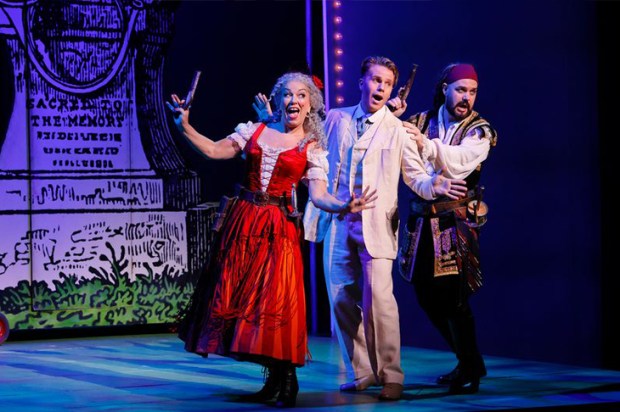
The trick with this – which is pretty droll on screen – is that it becomes hilarious when you play it as breakneck farce. All the roles in this production are played by a handful of actors. Ian Stenlake is an urbane and beleaguered Hannay and Lisa McCune manages to characterise the range of women who fall like petals in Hannay’s path and she does it with a lot of virtuosity filling out the roles (one of which was played by the young Peggy Ashcroft in the movie).
In this production there is a superb symmetry in the lines of characters who scramble to take on new identities with the skills of dancers.
It’s a production where you can abandon yourself to the sheer madcap escapades of the farce or you can sit back and take in the elegance of the lines of human interaction which make this production a feast for the mind as well as a prodigious bit of hilarity.
None of which is to deny the brilliance of the decision to engage the forces of the Umbilical Brothers whose starriness in the physicality of their interaction is a wonder. On reflection though David Collins and Shane Dundas are as elegant as they are scarifying and disgustingly funny. They are prodigious connoisseurs of the art of comedy and if they populate this show – turning into every character by some principle of physical cartoonery – they also have a precision of effect which is a form of high artistry that is even more boggling than the upshot into wild laughter.
It’s a show everyone will like, a tour de force which is a monument to Hitchcock’s sly humour and a notable improvement to a story that was already an instant classic in John Buchan’s ripping yarn mode.
What Hitchcock did with Buchan was to amp up the high jinks and the stage version highlights the absurdity of what is already masterly storytelling.
It helps though, like a reanimation of Robert Donat’s sobriety in the Hitchcock film, that Ian Stenlake’s Hannay is so urbane and so much the master of a world gone mad with the intoxications of amusement. But the whole thing is a tremendous homage on the part of the theatre at its most commercial to the auteur-like elegance of the man who could happily turn a book into a cartoon and still achieve a semblance of sanity and a very impressive and very British sangfroid.
But the question of what’s left out and what remains will always haunt the theatre when it’s in adaptive mode.
Got something to add? Join the discussion and comment below.
You might disagree with half of it, but you’ll enjoy reading all of it. Try your first month for free, then just $2 a week for the remainder of your first year.