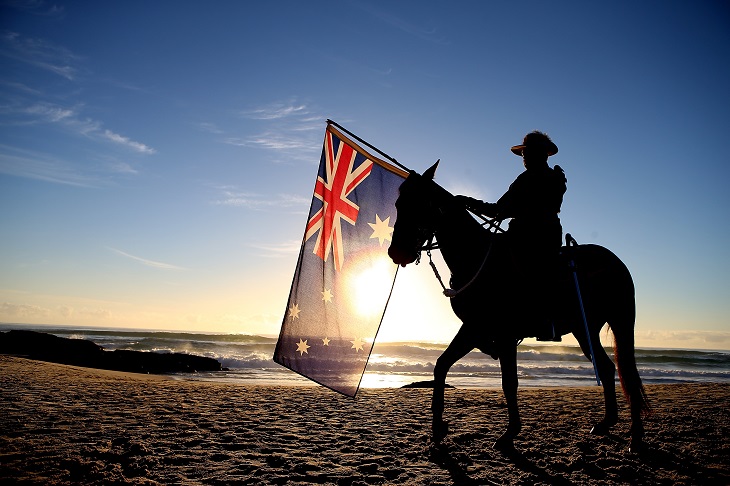
The Gallipoli Club organised a commemoration event for the 110th anniversary of the Battle of Lone Pine on August 5, 2025, held at The Mint in Sydney. The evening focused on honouring the historical significance of the battle, which occurred from August 6-10, 1915, during the Gallipoli Campaign in the first world war.
The last few weeks included numerous important events in the Anzac calendar, and while I will be covering some of those other events (and a few controversies) in due course, the opportunities provided to the descendants of our original Anzacs are worthy of particular attention.
The event brought together members of the Gallipoli Club, the Gallipoli Scholarship Foundation, armed services personnel, and guests for an evening of reflection, history, and connection. It highlighted the sacrifices made by the Anzacs and their Turkish counterparts, and emphasised themes of loyalty, courage, comradeship, and the enduring legacy of the campaign.
The audience was brought to tears on numerous occasions. Not through laughter, but pride and humility.
As a standalone commemoration of all that is good about Australia and her veteran heritage, the Gallipoli Club’s commemoration gave me hope for out future.
The reading of a letter by 18-year-old Edward ‘Teddy’ Sheean, a posthumous recipient of the Victoria Cross for his heroic actions during the second world war aboard HMAS Armidale, was a stand-out moment. This emotional element of youthful sacrifice underscores Australia’s military history. It is often disregarded by contemporary political narratives.
It made me wonder if our youth would behave with such valour if in a similar situation today.
The Battle of Lone Pine was a fierce diversionary assault by Australian troops to draw Ottoman forces away from other Allied operations during the August Offensive at Gallipoli. It resulted in heavy casualties – over 2,000 Australians killed or wounded, and an estimated 5,000-7,000 Ottomans lost – but saw seven Victoria Crosses awarded to Australians for valour in close-quarters combat.
The commemoration underscored the sobering scale of these losses and their role in shaping Australian national identity.
Key addresses were delivered by three prominent figures.
General Sir Peter Cosgrove, former Governor-General of Australia and decorated military veteran (including a Military Cross from Vietnam), provided reflections on the events at Gallipoli. His remarks emphasised the intensity of the battle, the bravery of the Anzacs, and the broader historical context of Australia’s involvement in the first world war as a defensive necessity aligned with national interests.
My veteran mate and I were awestruck by the good general’s straight-forward and honourable acknowledgement of Australia’s contribution and the importance of her role in early 20th Century global affairs.
Dr Brendan Nelson, former Director of the Australian War Memorial, Leader of the Opposition, and current Boeing executive, shared insights into the human cost and strategic aspects of the Gallipoli Campaign. He provided the address last year, too, and I am amazed at his energy and ability to engage a room without so much as a scrap of a note. Dr Nelson in full swing while giving a speech is something to behold. When he speaks about Australian service men and women, you will cry, guaranteed.
Dr Nelson’s address drew on his extensive experience in commemorating Australian military history, focusing on the values of courage and mateship exemplified at Lone Pine. Similar to his past speeches on Gallipoli, he highlighted personal stories of soldiers to connect past sacrifices with contemporary reflections.
But Dr Nelson stated he is not a fan of posthumous recognition. He believes that posthumously, all those who gave their lives in the service of Australia deserve recognition, so it was no easy call to push for Teddy Sheean’s recognition for the VC.
Gerard Henderson, Executive Director of The Sydney Institute, a noted political commentator, introduced the speakers and delivered comments on Australia’s role in the first world war. Drawing from historical analysis, he critiqued myths (such as those in films like Gallipoli) that portray the campaign as ‘other people’s wars’, arguing instead that Australia’s participation was in its national interest to counter Imperial German and Ottoman threats. He referenced the Gallipoli Memorial Club’s creed of loyalty, respect, love of country, courage, and comradeship, and stressed the importance of educating young Australians about the sacrifices, including those from schools like The Southport School, which lost 47 alumni.
In an era where military service is seen by some as anti-peace and anti-humane, I was struck by the positive nature of the Gallipoli Club and the recipients of the Gallipoli Scholarship Foundation. To hear from two recipients of the scholarship, both direct descendants of working-class Anzacs, was a poignant reminder not to discount Australian youth when it comes to matters of national pride. We often assume our youth do not have the same patriotic fervour but having taught more than 20,000 young Australians over the years, and after listening to the Gallipoli Scholars, you will be pleased to know that patriotism is not dead but rather hiding in a closet.
We neglect our youth if we allow those who do not have Australia’s best interests at heart to prioritise their ideological agenda over national pride.
Speccie author Scott Heathwood was the Master of Ceremonies for the Gallipoli Club event. Last year he wrote an article about the event for this masthead. His ongoing commitment to the Gallipoli Club is testament to our Anzac heritage and I am proud to call him a friend.
Dr Michael de Percy @FlaneurPolitiq is the Spectator Australia’s Canberra Press Gallery Correspondent. If you would like to support his writing, or read more of Michael, please visit his website.