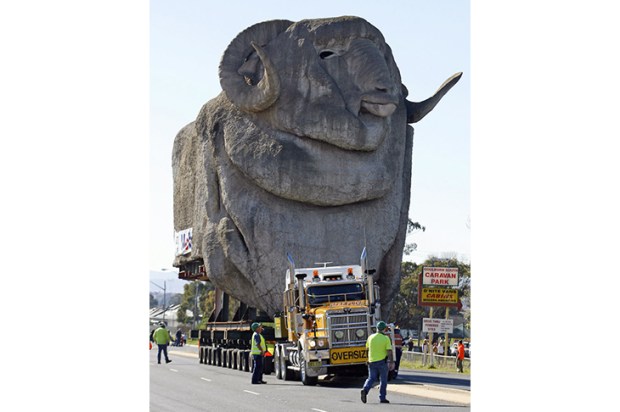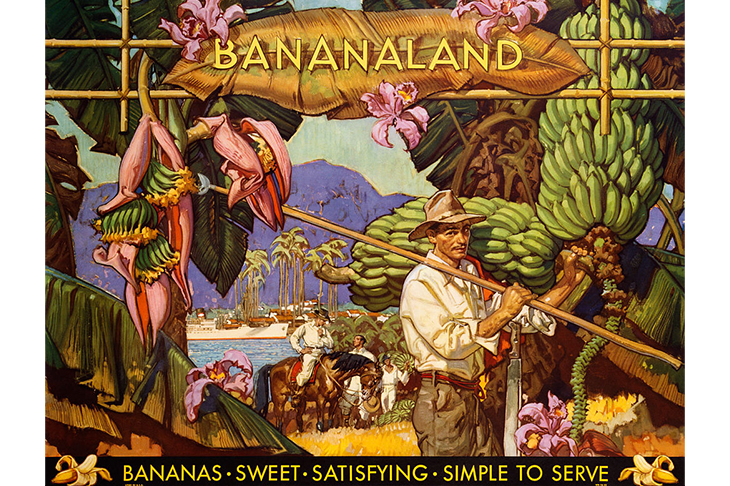
The dictionary definition of a banana republic refers to a country that has an economy dependent solely on revenue from exporting a single product or commodity. Political commentators also use the term to describe nations where there is corruption, repression, and failures to control executive power.
Many readers would know the term from a radio interview then-treasurer Paul Keating gave to John Laws back in May 1986. In that interview, Keating conveyed the gravity of Australia’s predicament as a commodity-dependent trading nation that was at risk of economic failure. He explained to Laws that if necessary economic reforms were not undertaken, ‘then Australia is basically done for. We will end up being a third-rate economy, a banana republic’.
Fast-forward some nearly 40 years and Australia is at a tipping point of becoming the banana republic Keating predicted. We are witnessing the consequences of living beyond our means, of complacency and of living off the fat of a narrow commodity-based economy in which now more are living off the government than are contributing in taxes.
Look at Western Australia as an example.
Western Australian premiers love to boast how they are funding mendicant states like Tasmania. Yet, despite record revenue thanks to a resources boom not seen since the gold rush of the 1890s, state debt is predicted to go past $42 billion by 2028. WA has hospitals that are literally falling apart; ambulance ramping at over 7,000 hours is the worst in the country (it was 1,000 hours when Labor came into office in 2017); the Perth CBD is littered with ‘For Lease’ signs; the city is the methamphetamine capital of Australia and police are resigning faster than they can be replaced.
However, Premier Roger Cook is obsessed with building a $200-million-plus racetrack near Perth Stadium that nobody – not even his political allies in the Greens – wants. All the while, Cook declares that blackouts over summer and hospital delays are ‘part and parcel’ of the system.
How often do people call Australia the ‘Lucky Country’, totally unaware that the luck Donald Horne, the author of that homonymous book, was referring to came despite that fact that Australia was generally run by second-rate people creating a situation where that luck was largely unearned by many who enjoyed its spoils, and that it will eventually run out? The last 10 years in particular in this country have seen the creation a rent-seeker’s paradise, where sprawling corporate interests feast on public funds while ordinary households grapple with soaring power bills.
Back in April, the Economist declared that Australia has the most bloated government bureaucracy in the world.
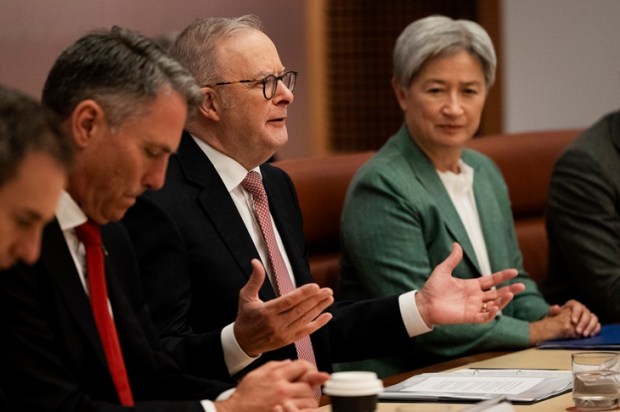
Now, with a former Trotskyite as a prime minister, rather than introduce reform to enhance productivity, big deficits and uncontrolled government spending will continue, meaning more punitive taxes on capital and property ownership that shrink opportunity and future potential and punish those who have worked hard all their lives to give their children more than what they had and live a comfortable retirement. Now their children may never be able to own their own home.
Many of those retirees are migrants who left war-torn Europe with their parents to flee communism, and came to this country committing themselves and their deeds to its culture and values, because that is what was expected of them. Now we have a situation where a sizeable number of migrants – and our leaders – no longer believe in Australia or what it stands for.
The economic effects of uncontrolled immigration were underlined by former Hawke government finance minister Peter Walsh. In his memoirs he stated that immigration was seriously aggravating Australia’s short-term economic problems, noting that, ‘Social infrastructure spending driven by population growth bleeds fund away from productive investment. Migration adds more to demand than it does to supply.’
Add to this that at all levels of government there has been poor planning, not to mention excessive red and green tape, and you don’t need to be Einstein to work out why we have an acute housing shortage.
What is more, excessive migration also puts downward pressure on wages especially for the poorest and those with the fewest skills. Real wages have gone back to 2012 levels mostly through inflation.
On the education front, the most recent Naplan results, released last month, showed one-third of students still fall short of the proficiency benchmark in literacy and numeracy. Clearly, our education system is failing to deliver on the most basic learning outcomes. Moreover, this dismal result is despite record amounts of money being spent by state and federal governments on education, obsessed as they and the bureaucrats are with forcing their social ideology onto schoolchildren.
All the while, governments around the country, and the federal government in particular, dismiss legitimate voter concerns as ‘populism’ or ‘stoking division’ and devise laws to stifle free speech. As well, they trample over private property rights in the name of a ‘clean energy transition’ that is making no difference to the world’s temperatures while sacrificing economic growth and living standards since it attacks the sectors responsible for Australia’s prosperity – agriculture and mining. Is it any wonder Prime Minister Anthony Albanese was chased out of Ballarat by some angry tractors following a disastrous Bush Summit?
What happens in Britain and Europe is often a harbinger of what is to come here. Last week in the Telegraph, Isabel Oakeshott called the situation in the UK a ‘tipping point’, which ‘has seen tens of thousands of ordinary people take to the streets in protest this summer, but has been in the making for a long time’.
On the other side of the Channel, France is facing the consequences of the high-taxing welfare state, with its government losing a vote of confidence on 8 September over a budget that only fiddles at the edges of an economic crisis due to government spending that is 58 per cent of GDP, while taxes drain 47 per cent of the economy.
Economic stagnation, social unrest, a lower class that is feeling increasingly unable to climb the ladder of aspiration, politicians buying votes with unsustainable debt, welfare and handouts leading to a culture of entitlement and increasingly higher taxes that struggle to fund the most basic services people expect their governments to provide.
Australia is at the tipping point of a banana republic.
Got something to add? Join the discussion and comment below.
You might disagree with half of it, but you’ll enjoy reading all of it. Try your first month for free, then just $2 a week for the remainder of your first year.