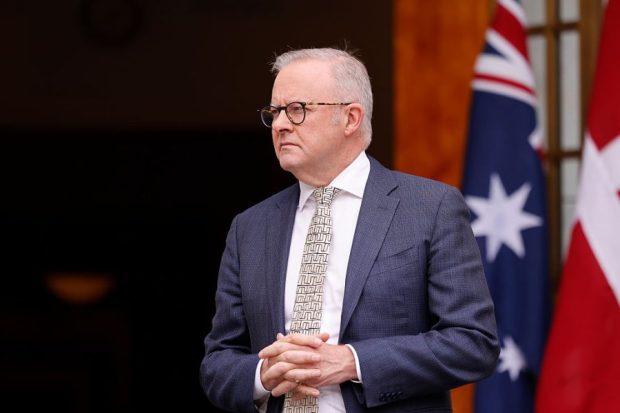
The Albanese government has finally made a long-overdue decision to expel Iran’s Ambassador to Australia. While the decision is welcome, it raises the critical question: What took so long?
Iran’s regime has a well-documented history of sponsoring terrorism, both domestically and internationally. This fact alone should have prompted decisive action far sooner. The government’s delay raises concerns about its priorities, commitment to national security, and ability to protect Australians from a clear and present threat.
Since the 1979 Revolution, Iran’s theocratic regime has oppressed its citizens while exporting violence and instability worldwide.
In 1984, the United States, under the Reagan administration, designated Iran a State Sponsor of Terrorism – a label that remains in place for good reason.
In 2006, then-US Secretary of State Condoleezza Rice described Iran as a ‘central banker for terrorism’, highlighting its role in funding, arming, and training terrorist groups across the Middle East and globally. From Hezbollah in Lebanon to militias in Iraq and proxies in the Palestinian Territories, Iran’s support for terrorism has been extensive, deliberate, and deadly. Beyond the Middle East, Iran has pursued diplomatic, economic, and military ties in Latin America and Africa, providing significant financial aid to countries like Venezuela, Nicaragua, Bolivia, Senegal, Zimbabwe, and South Africa. These efforts are part of a broader strategy to counter Western influence – particularly that of the United States, while advancing its global revolutionary agenda.
Iran’s ambitions include the restoration of an Islamic empire, rejecting the legitimacy of modern nation-states in the Middle East, which its fundamentalist leaders view as infidel Western constructs. The regime’s primary goal has been to establish a ‘Shiite Crescent’ stretching from Iran through Iraq and Syria to Lebanon, where its proxy, Hezbollah, has wielded significant influence. Its longer-term aim is to internationalise its Islamic revolution, using diplomacy, economic leverage, and violence to achieve its ends.
What makes Iran’s actions particularly brazen is its repeated and criminal misuse of diplomatic privileges to facilitate terrorism. Iranian embassies have served as operational hubs for attacks around the world.
In 1992 and 1994, Iranian diplomats in Buenos Aires orchestrated devastating bombings targeting the Israeli embassy (killing 29) and the AMIA Jewish community centre (killing 85). In 2018, an Iranian diplomat based in Vienna was implicated in a plot to smuggle explosives for a planned bomb attack. That same year, the Netherlands expelled two Iranian diplomats for their involvement in the 2017 assassination of an Iranian Arab activist in Amsterdam. Between 2016 and 2018, it is alleged Iranian embassy-linked agents in Berlin surveilled Jewish and Israeli targets, including a kindergarten, leading to the conviction of an Iranian agent for spying. Similar incidents have occurred in Kenya (2016), where Iranian operatives were arrested for planning an attack on the Israeli embassy; in Montevideo (2015), where a senior diplomat was expelled for plotting a bombing; in Albania (2020), where diplomats, including the ambassador, were expelled for activities threatening national security; and in Turkey (2019), where Iranian diplomats were accused of orchestrating the assassination of a dissident in Istanbul.
Iran’s track record means that the revelation that Iran’s embassy directed antisemitic terror attacks in Australia should have come as no surprise to the government. The warning signs were already evident. In 2023, the Senate’s Foreign Affairs, Defence and Trade References Committee, chaired by Liberal Senator Claire Chandler, recommended designating Iran’s Islamic Revolutionary Guard Corps (IRGC) as a terrorist organisation and expelling Iran’s Ambassador and diplomatic staff. The committee’s report highlighted the risk of Australia becoming a target of terrorism orchestrated through Iran’s embassy. Yet, the Albanese government spectacularly failed to act on these recommendations, allowing the threat to persist until intelligence reports linked Iran to the attacks on the Adass Israel Synagogue in Melbourne and a Sydney café, forcing its hand.
The Albanese government’s inaction is not merely a failure of foresight; it suggests a troubling lack of urgency and competence in addressing national security threats. It is arguable that hostility towards Israel within the Labor Party may have clouded the government’s judgment. The delay in confronting the Iranian threat left Australia’s Jewish community – and the nation as a whole – vulnerable to a regime proven to have a history of abusing diplomatic cover to facilitate terrorist activities. The attacks in Melbourne could have had far graver consequences, and Australia is fortunate that no lives were lost.
The expulsion of Iran’s Ambassador is a necessary step, but it comes too late to absolve the Albanese government of its delayed response. Australians deserve a government that prioritises their safety over political ideologies. The failure to act decisively on clear warnings about a known state sponsor of terrorism raises questions about the government’s competence in national security matters.
Iran, governed by a regime driven by ideological fanaticism, shows every sign of continuing its global campaign of influence and violence. Australia cannot afford further delays or missteps. The Albanese government must face scrutiny for its inaction, and voters should hold it accountable at the next election. Expelling the Ambassador is a start, but restoring confidence in the government’s ability to protect the nation will require sustained resolve and action – qualities that Prime Minister Albanese and his Labor colleagues have not demonstrated. Australians deserve to live free from the fear of terrorism, and that requires a government prepared to act decisively.