Destiny was the first work commissioned under Anne-Louise Sarks’ directorship of the Melbourne Theatre Company and it’s appropriate that it should be a triumph given the risks involved. Who would have thought that a play set in the troubled South Africa of 1976 with the horror of the Sharpeville massacre in the background and the Soweto demonstration and its massive toll of blood looming should be presented with such verve and authority and sweeping impassioned drama?
It is presented in terms of the pain and the desire of one coloured family in a world that can turn nightmarish when death and destruction infringe but Zindzi Okenyo’s production scarcely puts a foot wrong. You may baulk a bit at Clare Chihambakwe’s very striking characterisation of Mrs Jones but this is nothing compared to the sweep and integration of the whole play which manages to treat the tribulations of family life as a paradigm of politics gone wrong with a striking power and panache.
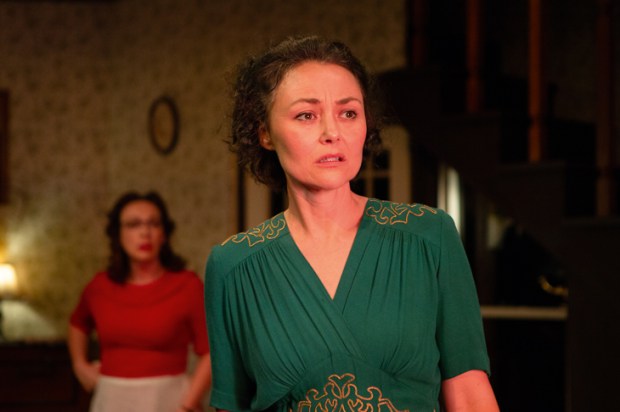
The Seventies furniture, the lamps and lounges and rickety outdoor chairs have an intimate familiarity as an anthology of shared culture but the most ravishing thing about Destiny is the very grand contribution of Kirsty Marillier who has not only written an intense and riveting political drama but plays the leading character with a grace and savagery that has a searing power and an overall effect of grandeur.
Kirsty Marillier looks and moves like a goddess and this effect of histrionic mastery is all the more manifest in a show where ordinary family intimacy – its agitations and annoyances – is transfigured to the point of tragedy in terms of the heartbreak of the drama Kirsty Marillier articulates with stunning confidence and a passionate dance in the shadow of death.
She is a star and it’s clear that she would be stunning in all manner of roles classic and modern. She captures the everyday steaminess of her irritation with her teen brother Gaz Dutlow but this adds to rather than diminishes the catastrophe when it comes and the camp character of the brother toys skilfully with off-putting, even alienating effects which are at once brave and artful.
Then there is Kirsty Marillier’s relationship with the hyper-political Barry Conrad who can lead a cohort into the valley of the shadow of a destiny which is the face of dread and death. It’s also bracing and risky to have Barry Conrad and Kirsty Marillier engaged in a pulled back but pulsating love play. And the fact that she is gorgeous and he has a pretty stunning body heightens the sense of danger in a world we come to identify with.
It’s humbling to have such a lassoingly strong dramatic interplay of personal life with the cruelty of political oppression brought together without compromise. We listen rapt to the father Patrick Williams and his comfortable intimate medley of everyday life, beautifully spoken and sung, and we are immediately made aware of the different ways of being alive in his recital of the everyday with studied calm but eventually the music of a quiet manner is not enough.
It takes a long time for us to get John Sheaman’s policeman – such an apparent walking cliché – but then the words of vengeance and persecution come, like a mantra of oppression and cruelty that we realise has always underlaid what sometimes looked like a bearable world.
Kirsty Marillier is open to every whisper of betrayal and compromise and to every kind of vulnerability the characters have to endure like a predestined fate. It is remarkable how she can take the threads of an intimate world and use them to create a flag of resistance which carries the audience into dark and ravaged places without compromise or simplification.
Zindzi Okenyo as director fuses the action with the greatest assurance: we believe in the drama of the politics because it is made so continuous with everyday life and it’s to her credit that she allows the different aspects of Kirsty Marillier’s script to melt into each other. It’s striking that her performance is on a heroic scale without ever seeming too big or over the top.
Sophie Woodward has effected a high stage with an angular sideways thrust which works subliminally to accentuate the historic nature of the drama but the costumes make it clear that at some level this is our world, or almost.
Destiny is such an unexpected surprise because we’re intimate with the aspects of South African political culture that are shared with our own even though most of the time we just keep our distance and count ourselves lucky. Still, we have our affinities with the accents paraded with such skill in Destiny.
Who would have thought that with the wand-like touch of a commission, Kirsty Marillier as a triumphant writer and star and Zindzi Okenyo as her empathic (hand-in-glove) director could achieve something as turbulent – but also as tight – as this?
Destiny is a remarkably successful attempt to extrovert the elements of murder and oppression to be found – at least as a paradigm – within any colonial system if it is pushed to extremity. Some quantity of people will object to the whole dramatic endeavour of Destiny but they will be surprised if they take the trouble to witness the dramatic world Okenyo and especially Kirsty Marillier have created.
Prejudices abound (not without reason) when it comes to post-colonial theatre or indeed to women’s theatre in a programmatic sense but Destiny will dispel them.
It’s a new radically dynamic attempt to create a work of art out of the most fundamental elements: the death of a child, the erotic dance of two beautiful young people, the quiet, reasonable voice of a father, the seething alarm that clings to the form of revolution and along with it the brutish hand of reaction that destroys what is young and true.
So make yourself see Destiny. It represents the new face of the MTC at a moment of power and glory. It shows what theatre can achieve when it is untrammelled and is backed by a management that knows its own mind and is willing to find a South Africa open to being brought alive in Australia now, even though it recapitulates with starkness the sorrow and the pity of a word nearly 50 years ago which will always have a deep and terrible pertinence.
Got something to add? Join the discussion and comment below.
You might disagree with half of it, but you’ll enjoy reading all of it. Try your first month for free, then just $2 a week for the remainder of your first year.