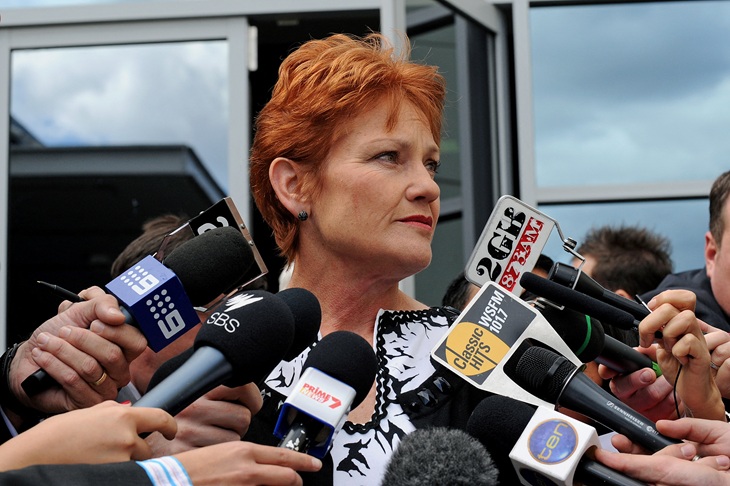
In an age when political decisions are often dictated by focus groups, moral relativism, and international bureaucracies, One Nation stands out – not merely as a dissenter in the political field, but as a party that appears guided by something far rarer: principle.
This article is not merely about policy comparison. It is about the deeper moral architecture – or lack thereof – that underpins our political choices.
The modern Australian left, like much of the global progressive movement, has embraced a politics devoid of fixed foundations. It is driven by convenience, sentimentality, and technocratic control. Its policies are held together not by coherence or vision, but by the pursuit of short-term approval and ideological fashion.
In stark contrast, One Nation’s policies consistently reflect three timeless and interconnected philosophical and theological principles:
At the heart of One Nation’s worldview is the recognition that some things are sacred – chief among them, human life. Their pro-life stance is not a matter of religious dogma or cultural nostalgia, but an affirmation of the intrinsic worth and potential of every human being. To recognise the sacred is to acknowledge that life begins before it is convenient and extends beyond what is economically productive. It is to believe that a society’s strength is measured by how it treats its most vulnerable members, especially the unborn.
In an era where ‘misinformation’ and ‘malinformation’ have become tools of state control, One Nation insists on the inviolability of free speech – not as a political tactic, but as a moral duty. Truth cannot be determined by popularity or suppressed for expediency. Whether in their opposition to speech codes, gender ideology, or politicised science, One Nation affirms that the search for truth must remain above political convenience. Without truth, democracy decays into manipulation.
From international treaties to family law, One Nation insists that decision-making should rest with those closest to the issue: parents, families, local communities, and the Australian people – not distant global bodies or Canberra technocrats. This is the ancient principle of subsidiarity: that governance should begin from the bottom up, not the top down. It is a recognition that responsibility and authority must be united, and that the health of a nation depends on the strength of its foundational units – families, communities, and cultural traditions.
Each of One Nation’s policies can be seen as an expression of these core principles. Their immigration policy respects cultural cohesion and national identity (subsidiarity). Their education policy resists ideological indoctrination and revives critical thinking (truth). Their economic and tax policies affirm the family unit as the bedrock of society (the sacred). And their approach to national sovereignty reflects a belief in the moral obligation of self-governance (subsidiarity and truth).
By contrast, Australia’s left-leaning parties reveal a stark philosophical vacuum:
- They desecrate the sacred through policies that treat human life as disposable and reduce family to a lifestyle choice.
- They suppress truth by policing speech, pathologising dissent, and embedding ideological orthodoxy in schools and media.
- And they erode subsidiarity by surrendering authority to unelected international bodies and centralising control over every aspect of civic life.
This is not merely a political divergence. It is a civilisational choice.
Australia must choose: will we ground our politics in enduring principles that respect the sacred, defend the truth, and empower the local? Or will we continue to drift into a directionless relativism that sacrifices life, truth, and sovereignty for the illusion of safety and progress?
One Nation is not perfect, but it is, at this moment, the only party that dares to ask the deeper question: What kind of country ought we to be?