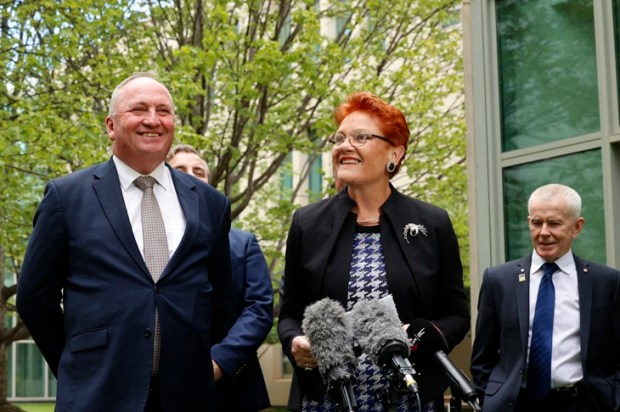
After a couple of weeks of wound-licking following the election, the Coalition has blown apart. Whilst their signature policy to adopt nuclear energy was the obvious weeping sore, the rift that split the Coalition almost certainly ran closer to one purpose that nuclear served: targets for Net Zero.
The Nats are now free to openly differentiate, and they should. For a not-so minor party to openly abandon Net Zero would help correct a confused energy narrative that has hobbled their side of politics, and the nation.
The election result has taught us that the Mary Poppins approach to policy proposals doesn’t work. A spoonful of sugary platitudes for renewables and Net Zero did certainly not help the nuclear medicine go down.
To decide what to do about nuclear, the Liberals will have to decide what ailment exactly it is treating.
Is it the blight of carbon emissions, which must be expunged at any cost?
Or is it a slow-burning economic crisis, with living costs creeping ever higher, and industrial output and real wages slumping into decline?
If the Nats have made up their mind, they should tell the nation clearly which priority pulls rank.
The Coalition’s attempt at a bet both ways failed spectacularly. It’s impossible to sound authentic when arguing that the warp-speed adoption of wind and solar is half the solution to the carbon problem and half the cause of the economic one.
What was the electorate supposed to think?
At least Labor argued with conviction that the rush to renewables is the solution to both.
But no party can call Labor’s bluff whilst opining that Net Zero is where we must go anyway. The key to winning the argument will be to expose the economic cost of Labor’s plan.
By dropping the targets, the Nats can help expose the lies of the Labor party, but also expose the soul of the Liberal Party, as they wander in the wilderness seeking new direction.
We all know support for Net Zero is a mile wide and an inch deep. The last time Australians were given a clear and transparent signal of what the cost to reduce emissions the carbon tax was emphatically rejected in the 2013 election.
Ever since, the public acceptance of the pursuit of Net Zero has been underpinned by the pretence that pursuing Net Zero carbon is not just cost-free, but will actually deliver an industrial boom while crushing living costs.
Evidence to the contrary abounds. Our electricity prices are rising steadily as we add wind and solar, as they have everywhere else in the world.
Only an appeal to Australian exceptionalism allows the claim to persist: Unlike Canada, Germany, Denmark, the UK, and Ireland, Australia is so exceptionally blessed with resources in wind and solar that it’ll be different here.
We’re told not to trust our lying eyes when reading an electricity bill, the truth belongs with the experts at the Net Zero Wizard of Aus: AEMO, the Australian Energy Market Operator. They claim they have mapped the ‘lowest cost way to supply electricity to homes and businesses…’ The Australian exception is thus proven! Or so it seems.
Like little Toto tugging at the curtain, the Nats alone might be enough to expose the machinery AEMO operates to deliver this dazzling illusion.
The sleight of hand on AEMO’s part is in an oft-omitted qualifier to their ‘lowest cost way to supply electricity’. It is only lowest cost ‘through Australia’s transition to a Net Zero economy’.
The sting in the tail of that sentence has lethal economic consequences.
What it really means is that AEMO has taken the accomplishment of every single government target – including Net Zero by 2050 and the 82 per cent renewable energy target for 2030 – as an accomplished fact, at the very start of their modelling.
Whether the targets are technically feasible or what they might cost is never tested. Success is assumed.
This is a bit dubious because they have effectively elevated the last objective of the electricity system (carbon targets) as supreme over the others (such as cost are reliability).
But so far, it has been accepted because of broad support for 2050 Net Zero targets.
Chris Bowen cashed in, politically speaking. During the election debate with his opponent he said: ‘We base our plan on the experts.’
The opposite is true.
As explained by the CEO of AEMO before a Senate hearing on December 5, 2024, ‘The ISP is not a tool to evaluate government policy. It’s a tool to say what needs to be delivered in order for that government policy to succeed.’
Australia has been deprived of the essential second step: if what is required for a policy to succeed looks implausible or unaffordable, the policy should be rejected.
Instead, Australia’s electricity regulations force network utilities to adopt all government targets as given, inadvertently spawning an army of credulous nodding heads in the electricity sector, who profit from the allocation of billions of dollars to transmission projects regardless of whether they stack up.
The simple fact is that almost no one with the resources and knowledge to credibly expose the cost of hitting the targets has a strong incentive to do so.
By openly rejecting the policy of Net Zero, the Nats would interrupt a heist of the public policy process. They would shine a light on the hidden machinery that is allocating taxpayers’ money into Net Zero, and expose Labor to critique.
And in the long run, this may help create the conditions for the Liberal Party to rediscover its soul, and return to being a party that prioritises the prosperity of middle-Australia.
Aidan Morrison is the Director of Energy at the Centre for Independent Studies