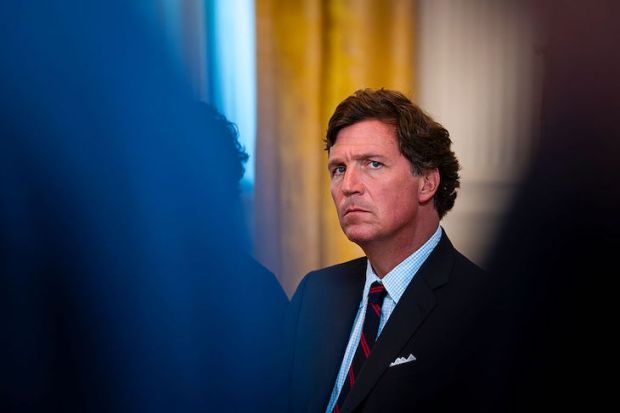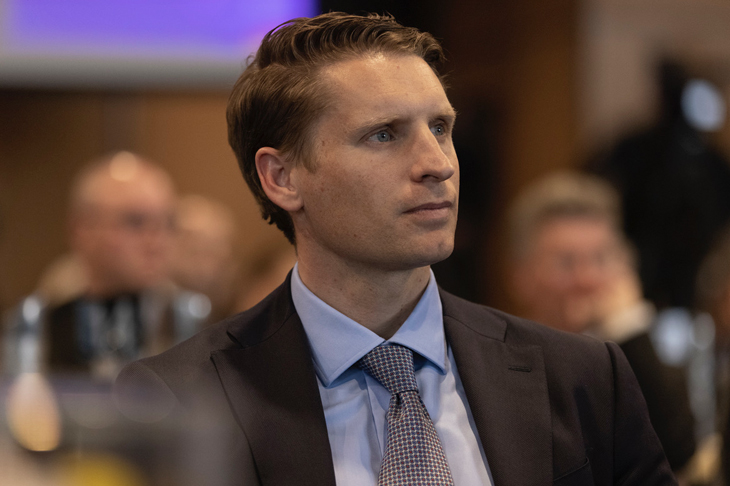
T hree cheers for Liberal MP Andrew Hastie, a potential party leader, for speaking the plain truth on the ABC’s Four Corners. Hastie rightly described the policy of net zero emissions by 2050 as a ‘straitjacket’ – one he’s already cast off.
Hastie also put his finger on the fundamental question too few politicians are willing to address: should Australian families and businesses be paying more for electricity while we continue to sell coal and gas to India and China, but deny it to ourselves?
That’s the debate we need. Instead, we get hollow slogans and magical thinking.
The hypocrisy runs deep. Labor states are happy to lean heavily on fossil fuel exports. During the last federal election, Labor talked up its ‘renewables-led’ path to net zero while sidestepping key gas project decisions. The mask came off once Labor was safely elected with a substantial majority and did not have to worry about relying on the Greens in a minority government.
This week, Environment Minister Murray Watt approved an extension to Woodside’s massive Northwest Shelf gas project through to 2070. Santos’ Barossa offshore gas project near the Northern Territory quietly got the green light in April 2025 and is set to begin production later this year.
Gas exploitation in some states is also proceeding quietly. Over the next 18 months, major expansions of existing operations will come online. Woodside’s Scarborough Energy Project, one of Australia’s largest, is expected to deliver its first LNG cargo in 2026 via the Pluto LNG facility near Karratha. In Queensland, Arrow Energy – owned by Shell and PetroChina – has announced a second-phase expansion of its Surat Gas Project. Shell’s Crux development in the Browse Basin was approved in 2024. Western Gas’s Equus project in the Carnarvon Basin is due to start within two years, and the Dorado oilfield in Western Australia is set to become the only major new offshore oilfield currently in planning.
Elsewhere, however, Santos’ long-delayed Narrabri coal seam gas project still faces native title hurdles. Let’s hope it can surmount them because, if it meets expectations, it could supply nearly half of New South Wales’ gas demand.
The real problem child is Victoria. It has slammed on the brakes, too often encouraged along by a lacklustre Victorian opposition. In 2024, the state government banned new gas connections and adopted wildly unrealistic renewable energy targets.
At a Brisbane conference this week, Santos CEO Kevin Gallagher compared investing in Victoria to investing in ‘North Korea’. In Queensland, South Australia and WA, governments are supportive – but in Victoria, he said, investors risk getting stranded halfway through projects. ‘If I had $1 to spend in PNG, Alaska or Australia today,’ Gallagher said, ‘it would be PNG or Alaska.’
That’s music to Greenpeace. CEO David Ritter condemned the Northwest Shelf extension, claiming we don’t need ‘more polluting gas’ and declaring that Australia is ‘over 40 per cent’ of the way to powering itself with renewables.
Such claims ignore the reality that the more renewables are forced into the system, the more unreliable the grid becomes. Witness the catastrophic shutdowns in Portugal and Spain, which had just celebrated reaching 100 per cent renewable electricity – only to suffer nationwide blackouts that crippled transport, banking, and the internet. A sobering wake-up call for the European Union, if not for green ideologues.
While 107 countries have pledged to reach net-zero emissions, only a tiny fraction are reportedly on track – and take a close look at who they are.
According to the Climate Action Tracker, as of 2024, countries such as Nigeria, Ethiopia, Morocco, Kenya, Costa Rica and Nepal are deemed to be on track to meet the 1.5°C goal using a ‘fair share’ approach. How credible is that?
Morocco is considered on track because it is exploring green hydrogen production. Good luck with that. Last year, South Korea mandated that 25 per cent of its metropolitan bus fleet be hydrogen-powered by 2030. Three months later, a hydrogen-fuelled bus exploded. This week, Hyundai recalled all 1,269 hydrogen buses pending a safety review. Who’s surprised? Even before the Hindenburg airship burst into flames while docking in New Jersey in 1937, we knew flammability was hydrogen’s Achilles heel.
While these comical attempts to cut emissions play out across the globe, look at China – the world’s industrial engine and largest emitter of greenhouse gases.
In 2025, China operates more than 1,100 coal-fired power stations with a total installed capacity of 1,100 gigawatts. Australia, by comparison, has just 20 coal-fired plants contributing a mere 25.5 gigawatts – less than a thirtieth of China’s capacity.
China has no intention of slowing down. In 2024 alone, it approved 66.7 GW of new coal-fired capacity – more than double the capacity of all Australian coal plants – and began construction on 94.5 GW, the highest annual figure since 2015. Another 3.3 GW of previously shelved projects also resumed construction. In just one year, China added nearly four times Australia’s total coal-fired capacity.
Meanwhile, Australia’s Energy Market Operator projects that all our coal plants will close by 2038 – five years earlier than previously forecast. How realistic is that? Not very. The first scheduled closure, Eraring, has already been extended to 2027 to stave off blackouts. There are also urgent talks to delay the shutdown of Yallourn, planned for 2028. Bayswater is due to close in 2030, and the Loy Yang plants in 2035.
So, Australia is racing to dismantle reliable baseload power while China builds coal plants at warp speed.
As of 2025, coal still generates 58 per cent of China’s electricity. Wind and solar now account for over half of China’s installed generation capacity – but deliver less than 23 per cent of actual electricity, due to weak grid infrastructure and prioritisation of fossil fuels. Even Chinese planners struggle to push through unpopular high-voltage transmission lines – a challenge our own governments are unlikely to find easier.
And what’s happening in China reflects global energy reality. Worldwide, renewables (wind, solar, hydro, biomass) make up only 15 to 16 per cent of primary energy consumption. Nuclear accounts for another 4 to 5 per cent. The rest? Coal (26 to 27 per cent), natural gas (23 to 24 per cent), and oil (30 to 31 per cent).
The hard truth is this: Australia cannot decarbonise the planet in isolation. Nor should it impoverish its citizens trying. Our energy policy must be grounded in realism, not slogans. Andrew Hastie has done Australians a service by calling out the contradictions at the heart of net zero orthodoxy.
It’s time more of our leaders had the courage to do the same.
Got something to add? Join the discussion and comment below.
You might disagree with half of it, but you’ll enjoy reading all of it. Try your first month for free, then just $2 a week for the remainder of your first year.