Last week your columnist cut a paragraph stating that the original Melbourne Higgins in My Fair Lady, Robin Bailey, and Richard Wordsworth who was Fagin in the most notable revival of Oliver! were about as good as actors get in any role and that they were notably better than their Australian successors. Well, I was forgetting Barry Humphries who according to legend gave a performance that could never have been equalled, a staggering European Fagin – European in practice tends to mean German-inflected.
Well, the German Film Festival is starting on 1 May in Sydney and 2 May in Melbourne and it includes the documentary Riefenstahl (about the director of the Nazi propaganda epic Triumph of the Will) and its director Andres Veiel will be a guest of the festival. He apparently had access to the files of Leni Riefenstahl who claimed she had no special connection to the Nazis and it’s true that the surging Wagnerian magnificence of Triumph of the Will and its companion doco Olympia represent what happens to be the aesthetic glamour associated with the axiomatically evil regime (which is deeply creepy) but not in itself fascist.
It will be interesting to see what Veiel has unearthed.
Susan Sontag used to say Riefenstahl’s subsequent images of the Nuba people of Southern Sudan were tacitly fascist because they idolised the warrior class and had a palpable association with her depiction of the African-American Olympian Jesse Owens in her Olympia doco. It’s interesting to see that Hysteria by Mehmet Barukataly about an assistant on a film where a Quran is burnt on set will be another highlight.
It’s also intriguing to see that Red Stitch are opening in The Comeuppance by Brandon Jacobs-Jenkins directed by Gary Abrahams who did that superb production of Yentl with Jana Zvedeniuk giving a staggering performance in Yiddish, as well as the great Ellen Burstyn in 33 Variations.
Another truly grand choice on the German Film Festival’s part is the screening at particular cinemas – including Melbourne’s Como and Kino – of Fassbinder’s Berlin Alexanderplatz, his fourteen-hour dramatisation of Alfred Döblin’s modernist masterpiece which is influenced by the Joyce of Ulysses if you can imagine that variegated idiom as the style for a saga of murder and criminality.
Sontag thought Berlin Alexanderplatz was a masterpiece and that the performance of Günter Lamprecht as Franz Biberkopf is equal to anything done by Emil Jannings (in The Blue Angel with Josef von Sternberg directing him and Marlene Dietrich).
On the other hand David Malouf said he thought he could speak German until he tried to understand the demotic street idiom of this extraordinary collection of actors which includes Hanna Schygulla as Eva and Barbara Sukowa as Mieze.
Berlin Alexanderplatz is one of the greatest films ever made and if it anticipates aspects of the contemporary TV streamer it does so with a towering dramatic fluency. It was a tribute to SBS that it showed the whole thing back in 1988. It was weird though that Susan Sontag was so taken by the last episode which is an extended set piece in a swimming pool where people attack each other and expressionism and post-modernism seem to meld to neither’s advantage.
But it doesn’t in the end matter because almost all of Berlin Alexanderplatz has such a dramatic grandeur of an intensely moving kind and this German Film Festival is a chance to experience this panoramic modern tragedy in the setting of a cinema.
The uncompromising slow pace and rough dialect of Berlin Alexanderplatz is in contrast to the Hochdeutsch and pace of the series of snapshots of Germany culminating in Deutschland 89. This is a continuation of the Germany we saw in Berlin Wall but without the local accent and the period clothes. Again, we’re in a world of former heavyweights, of a corrupt East Germany and we’re never sure whose side the hero Martin (Jonas May) is on in a time when the CIA competes with the East German spooks not to mention the KGB. A lot of it is hideously dark – with children and their parents as pawns – as well as a lot of crooked people muttering the pieties of communism while also securing their sackful of dollars.
It’s weird too that Jonas is also an action hero and that there’s so much rough and tumble of an aesthetic kind in this absolutely elegant, energised series about the black ancestral horrors of a divided Germany.
History of a different kind is on show in the neoclassical tragedy of Racine and the tragicomic brilliance of Molière. There is a BBC recording of Tartuffe – the play Goethe used as the greatest example of a dramatic build up – with the dream casting of Antony Sher in the title role.
Molière and Racine are a bit like the great outpouring of dramatic genius without a Shakespeare to realise it like a blinding divinity. The French also did not execute their king so the child Louis XIV wandered about (prime) ministered to by Cardinal Mazarin just as the Port Royal Jansenism that influences Racine for all its deep austerity is not Protestant.
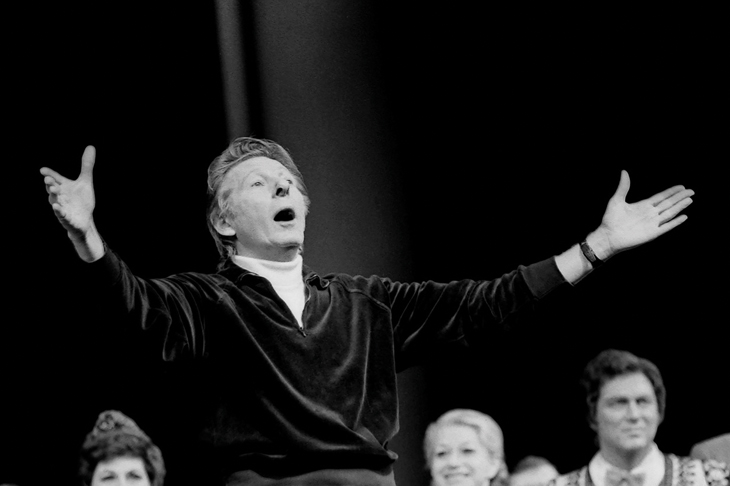
It’s instructive sometimes to see what happens dramatically when everything goes wrong. Research into the career of the late Richard Chamberlain produced a 1969 film of Giraudoux’s The Madwoman of Chaillot. That dazzling comic talent Magda Szubanski was in a truly terrible production of the play but Katherine Hepburn’s film despite her grandeur in the title role and despite one of the greatest casts ever assembled (Yul Brynner, Charles Boyer, Edith Evans, Donald Pleasence) – and a script by Edward Anhalt who did the films of Anouilh’s Becket and Peter Shaffer’s The Royal Hunt of the Sun – is staggeringly bad. You could however put together a good 40 minutes from the ruins of Bryan Forbes’ film, perhaps especially the section where Edith Evans, Margaret Leighton and Hepburn put on trial the rich man ragpicker Danny Kaye.
It was weird watching the most talented people on earth producing such a mess at around the time the truly great pianist Daniil Trifonov was thrilling people with the magnificence of his playing at the MSO. He backed Matthias Goerne doing Schubert’s Winterreise, he did Antonín Dvořák’s Symphony No. 2 and he did Rachmaninoff’s towering Piano Concerto No. 3 and the most seasoned music buffs wept their eyes out.
The zenith of art is a stupendous thing. And it remains true that people will remember Barry Humphries when they have forgotten where the MCG stood.
Got something to add? Join the discussion and comment below.
You might disagree with half of it, but you’ll enjoy reading all of it. Try your first month for free, then just $2 a week for the remainder of your first year.