With a federal election looming, the government will be considerably embarrassed by the growing realisation that its much-vaunted offshore wind energy strategy is becalmed and may yet drift helplessly onto the rocks.
This should not surprise anyone familiar with the offshore wind farm industry in Europe and the US, which was showing signs of trouble even before the Federal Labor, NSW, and Victorian state governments decided it would be cool to have offshore wind farms in Australia.
As the main driver for offshore wind projects in Europe and the US was the lack of suitable land onshore, and there were plenty of windy plains left in Australia, just why we also had to have offshore wind farms was never fully explained. As the pylons are often placed well out to sea, where they have to withstand full gales and rogue waves and be regularly serviced, this source of energy is considerably more expensive than power from onshore wind farms.
As reported in this publication (‘Gone with the wind’, 15 July 2023), state and federal governments brushed aside inconvenient indications from overseas that offshore wind farms were fraught with difficulties and potentially extremely expensive to get up and running, to nominate several major offshore wind production zones.
Of these, three have shown signs of life; one for the Illawarra region south of Sydney and two off the coast of Gippsland in Victoria. The Illawarra zone is now all but dead in the water as the only company still interested in licences for the region, the US-owned Blue-Float Energy, has asked the federal government to pause its application until after the election, due to be called in weeks.
Blue-Float pointed out that opposition leader Peter Dutton has threatened to kill the whole concept if he wins the election, which he may do. In any case, the project has drawn considerable community opposition – no one wants unsightly wind turbines in their ocean backyard – and is inherently risky as it involves semi-submersible wind turbines (semis). If the water is too deep for pylons, floating turbines mounted on pontoons are towed out, and the pontoons filled with water so that they sink to a certain depth. This technology is still relatively new and, as figures from the UK show, semis are considerably more expensive to build and maintain than straight pylon wind generators.
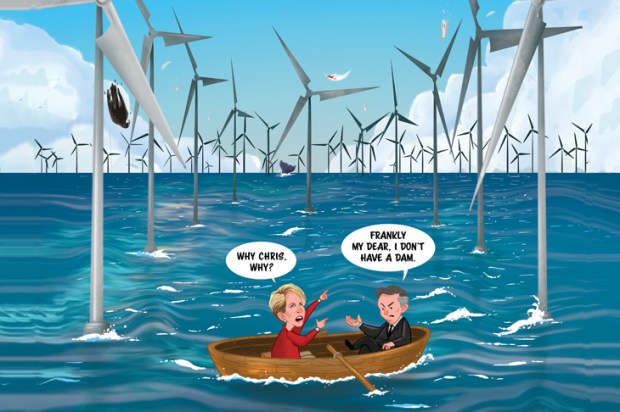
At least the Victorian zones are in relatively shallow waters so that pylons a mere 300 metres high (about the same height as the Eiffel tower in Paris) will do, but all sorts of problems remain. One of these is the federal government, with Energy Minister Chris Bowen in early March rejecting an application for a feasibility licence on one site from the Japanese-backed Flotation Energy on the grounds that a small part of the 700-square-kilometre area overlapped with another proposal.
This action has greatly puzzled the renewables industry, with commentators pointing out that the government could have amended the proposal to exclude the small overlap and then granted it. Flotation Energy also complained that it had spent years on the project, including extensive environmental studies and community consultation, only to have its application rejected on what amounts to a technicality.
In addition to this inexplicable decision, the federal government has been at odds with the Victorian state government over developing the port facilities required to service the vast new fields of turbines, assuming any are actually built. The federal government wants the business to go to the Port of Geelong in Port Phillip Bay, which is part of the electorate of Deputy Prime Minister Richard Marles. The Victorian government, however, has opted for the less-developed Port of Hastings, which is much closer to the wind farm area, and is apparently ignoring a ruling by federal Environment Minister Tanya Plibersek that building facilities at Hastings will endanger nearby wetlands.
Assuming these difficulties are ironed out, the next stage in this tortuous process is a formal bid for contracts to sell power from the pylons. The state government will award those contracts, perhaps around the middle of next year. The wind farms then have to be built and connected to the grid. (The Chinese would have built the wind generators by now and left them to rot.)
However, the real problem may be getting developers sufficiently interested to bid on the project, with the Victorian government reported as considering a more generous version of the contracts for difference (CfD) system, already in use for onshore wind farms. Details aside, such systems are used in Europe, notably in the UK, as a means of guaranteeing a base power price and have proved expensive.
Consumers pay this extra cost, one way or another, all while being lectured by the media about how green electricity is cheap, but the state government provides guarantees. Victoria is already struggling with a debt load projected to reach $188 billion by 2028, thanks to the profligacy of its Labor government, and has a liability of about $500 million for CfDs involving onshore wind. The offshore wind project would involve a massive increase in that liability and, potentially, a huge additional cost if the project goes bad.
But the Victorian government is showing symptoms of delusion and disassociation from reality that, if exhibited by an individual, would require therapy.
For example, the state government is hoping that 95 per cent of the state’s power will come from renewable sources in 2035. This is absurd. Norway’s power grid is 100 per cent renewable, and New Zealand’s grid is more than 70 per cent green power. But Norway has more hydropower (which counts as renewable) than it knows what to do with, while New Zealand has both hydro power and geothermal plants (also renewable). An advanced economy may achieve 100 per cent renewable energy using mostly wind and solar for periods of varying length, but a more likely long-term average is around 70 per cent. At least, that is the average commonly attained by various micro-grids – places such as Coober Pedy, King Island in Bass Strait, and El Hierro in the Spanish-controlled Canary Islands off the coast of Africa. These all have independent grids, which mix renewables and conventional power. They have all achieved 100 per cent renewable generation for long periods, but the long term average is not more than 70 to 80 per cent.
Green power enthusiasts may retort that such grids do not have the depth and geographical spread of major grids, but when asked to name a grid in a developed country that has achieved such high levels of renewable power consistently with wind and solar, they fall mysteriously silent.
Got something to add? Join the discussion and comment below.
Mark Lawson has written Dark Ages – the looming destruction of the Australian power grid (Connor Court) markslawson@optusnet.com.au
You might disagree with half of it, but you’ll enjoy reading all of it. Try your first month for free, then just $2 a week for the remainder of your first year.