It’s funny the preconceptions you have about the Christmas/New Year period. I hadn’t anticipated seeing Juror #2 the new Clint Eastwood film. Nor reading Michel Houellebecq’s Submission about a Muslim government in France. There was always the plan to catch up with Michael Caine’s two Len Deighton films The Ipcress File and Funeral in Berlin but not to have them jostling for attention with the Golden Globes and the fact that Nicole Kidman lost out to Fernanda Torres for Best Female Actor. It’s always been clear that on a good day Kidman is an actor with Maggie Smith-like skills: lightning timing, utter poise and attendant danger.
It’s equally fascinating to speculate about Conclave the Vatican thriller opening here this week with Ralph Fiennes in ecclesiastical mode. It’s been showing in America for a few months and it will be interesting to see if this film, based on a Robert Harris novel, is headed for Best Adapted Screenplay at the Oscars. So a visit to the cinema to confound the graph of expectations?
Len Deighton is one of the most highly regarded spy writers and the second of the two films with Michael Caine at the early height of his powers also has a female spy – wonderfully played by Eva Renzi.
Both the films are taut and drip with a sort of kitchen sink realism. Funeral in Berlin, directed by Guy Hamilton – who directed Roger Moore as James Bond in Live and Let Die and The Man with the Golden Gun – a sumptuous ironic talent, is the richer of the two, although they both exhibit Deighton’s tendency to plot twists like so many rabbits in a hat.
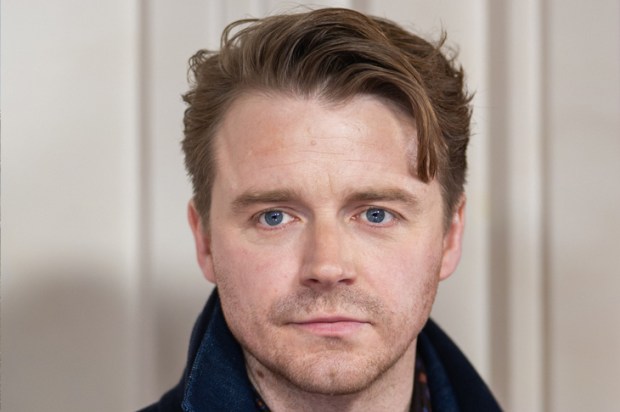
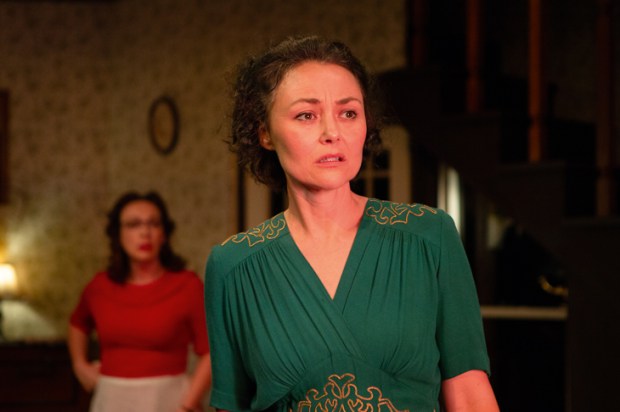
That’s not true of Clint Eastwood’s Juror #2, a superb forensic drama about a potential miscarriage of justice with Nick Hoult causing horror by accident and Toni Collette as a Georgian prosecutor who realises justice may have gone haywire. Both performances are very fine in this taut piteous depiction of how the blindness of justice can encourage the most pessimistic of perspectives.
Submission is Houellebecq’s dazzling enactment of how France could produce a Muslim government that could Islamise teaching at the Sorbonne and regulate the number of wives a man can marry. It’s like a dark and terrible enactment of Levi-Strauss’s remark in his memoir Tristes Tropiques about the affinity between the two civilisations. All of this in the context of close election results, the shadow of Marine Le Pen and a Muslim president who absorbs G.K. Chesterton’s distributism and is sympathetic to Catholic and Jewish private schools but not to secularism.
It’s all done from the point of view of an academic in his forties who has written on the French writers Huysmans (the author of A Rebours (Against Nature) and of the way he eventually embraced the rigours and exultations of monastic Catholicism. This is a dazzling and all but unputdownable book about a culture pulled inside out which is as flawlessly plotted as a first-rate thriller.
And, talking of thrillers, it’s fascinating to see that Joanna Murray-Smith’s Switzerland – the play about that deadly crime writer Patricia Highsmith– is in pre-production with Helen Mirren as Highsmith and with Alden Ehrenreich as the incarnation of her nightmare hero-villain.
Sarah Goodes directed Sarah Peirse in the Sydney Theatre Company production of Switzerland and it has been done by Laura Linney and by one of Joanna Murray-Smith’s favourite actors Annette Bening but Dame Helen is dream casting. You may recall that she did Strindberg’s Dance of Death back in 2001 with Ian McKellen – though Frances de la Tour replaced her in Australia. Dance of Death is arguably the most savage and the most influential play in the modern canon because it is such a palpable influence on Edward Albee’s Who’s Afraid of Virginia Woolf? And Mirren’s capacity for self-possessed savagery has been manifest ever since she did for the BBC The Changeling which T.S. Eliot said was the greatest non-Shakespearean play in the dramatic canon. ‘Oh come not near me, sir, I shall defile you; / I am that of your blood was taken from you / For your better health; look no more upon’t, / But cast it to the ground regardlessly, – / Let the common sewer take it from distinction.’
Readers will recall that Peter Rose, like your columnist, wrote a rave review of the Kat Stewart/David Whiteley revival of Virginia Woolf directed by Sarah Goodes for Red Stitch and seen in Melbourne and Sydney.
His own dramatic work last seen at Melbourne’s fortyfivedownstairs seems to have been in the Albee tradition. Its production coincides with the news that Peter Rose is retiring as the editor of Australian Book Review, a position to which he has brought an incomparable distinction. When the board of ABR was looking for an editor in the wake of Helen Daniel’s death, Robert Manne said of ‘Prose’ – as the distinguished poet is sometimes called – ‘He’s the platonic idea of an editor.’
And so it has proved through every mishap. Peter Rose has not only maintained the literary critical magazine as a monthly journal of record of the highest calibre, he also produces arts reviews each week which are at least on par with the best broadsheet competition but they provide the critic with the space to offer chapter and verse for her opinions. Think of the superb review of Bach’s St John’s Passion which Morag Fraser published in ABR Arts online.
ABR also organises essay and poetry and fiction competitions which work as the most humane and worldly kind of fundraiser and subscription stimulator.
Decades ago, some time in the previous century, Peter Rose was a champagne charlie, a publicist who liked a long lunch – and was with his dear friend Sonja Chalmers superb at them – who was also a strikingly talented poet. He went on to become a distinguished publisher at Oxford and had a close friendship with that great poet Peter Porter. With his partner Christopher Menz he has organised cultural tours and has shown there is no contradiction between worldliness and devotion to art.
Peter Rose wrote a very fine memoir about his brother Robert Rose who suffered a sporting injury that left him a quadriplegic. The Rose Boys is a distinguished heartbreaking work, true to the tenor of the Auden poem Peter quoted at his brother’s funeral. ‘If I could tell you I would let you know.’
One can only assume that poetry and the depths of literary self-expression has called out to him again.
Got something to add? Join the discussion and comment below.
You might disagree with half of it, but you’ll enjoy reading all of it. Try your first month for free, then just $2 a week for the remainder of your first year.