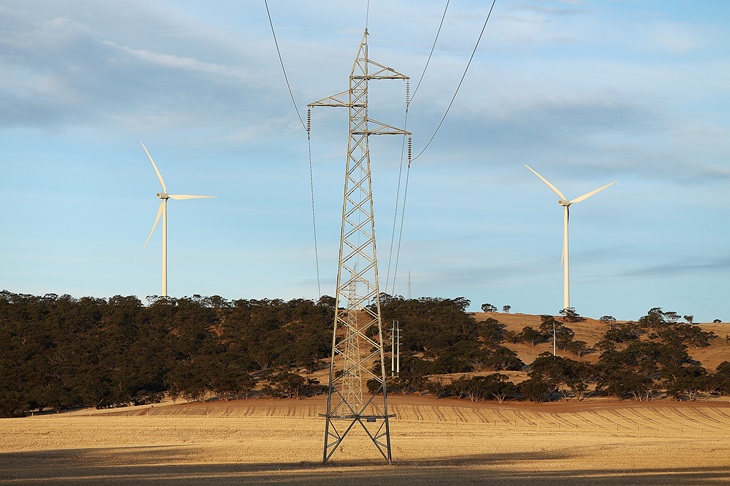
In 2024, I finally checked off a major bucket list item: travelling west across the continent by train and returning east by road. It was fabulous, and I promise to write about it later, but today’s piece is about something I noticed on that journey that was hard to ignore. During the trip, while I soaked in miles of breathtaking scenery, I was surprised by the number of wind turbines and solar panels that are beginning to dominate our landscape.
‘I’m the Cabinet Minister responsible for climate change and energy, so I’ve got my hands on the energy levers and the climate change lever,’ said Chris Bowen, in a recent interview. ‘Since we’ve been in power we’ve introduced an 82 per cent renewable energy target up from around 30 per cent when we came to office … that’s a huge lift. We don’t have time. We’ve got a huge task ahead of us. We need to build transmission towers and everything that goes into the renewable energy supply chain. We are going really fast.’
He’s not wrong. I could barely comprehend the dramatic change from when I travelled through some areas just five years previously. Wind turbines now towered over once-pristine horizons, and sprawling solar farms stretched across the land, having transformed the countryside in ways that both fascinated and alarmed. It occurred to me we are well on the way to fulfilling Bowen’s renewable energy mandate. But at what cost?
Like many, I have closely followed the climate change, Net Zero, and renewable energy debate. Over time, I have changed my mind on several points, such that I now look at my residential solar panels and wonder, ‘Would I make the same choice today?’ Given that I noticed more energy savings from simply changing the curtains, I’m not so sure.
Elements of the ‘climate catastrophe’ and ‘renewables’ narrative demand further scrutiny. For example, is climate change a catastrophe or is it a problem demanding a solution; is ‘Net Zero’ the only answer; are renewables – like wind and solar – so reliable, clean, cheap, and secure; and if renewables are so cheap why the heck is my power bill flying to the moon?
Bjorn Lomborg has long been a voice of reason in this space. Far from being a ‘doomsday-er’, his data-based explanations and common-sense approach call climate change a ‘problem’ to which we have the solution.
Lomborg believes we should avoid making dumb decisions and points to current climate policies as unrealistic and unsustainable. He says renewable energy currently provides 16 per cent of global energy and is projected to reach only 26-34 per cent by the middle of next century. On our current trajectory, we’re 150-250 years away from being 100 per cent renewable.
That’s a long time.
Even worse, the global Net Zero goal comes with the eye-watering price tag of $27 trillion per year, over 25 per cent of global GDP, while only delivering $4.5 trillion of benefit. End result? As electricity costs soar, those who can least afford it will be plunged further into poverty, and economic impacts will likely stall manufacturing, development, and innovation.
‘It’s fine to do something about climate change. It’s not okay to do something dumb,’ concludes Lomborg.
I agree.
So, what should we do? Gerard Holland has a sensible approach: energy needs to be cheap, clean, reliable, and secure. ‘Australia has not been doing such a good job at holding these four crucial policy considerations in balance,’ he said, at the recent ARC conference in Australia. ‘We have arbitrarily legislated a commitment to 80 per cent renewables by 2030 with little to no consideration of the trade-offs. And the trade-offs are legion.’
What are these trade-offs? Firstly, we rely heavily on imports from China to roll out the renewables program. ‘Eighty to ninety per cent of the components in Australian solar panels, wind turbines, and batteries come from China,’ says Holland. ‘And even if these products were to be manufactured here, we would still be totally reliant on China for the refinery of the critical minerals and rare earths that go into making them.’
To make matters worse, once installed, wind and solar power are still not cheap. Holland says government figures show these renewables run at about a third of the capacity factor of coal with solar installations requiring 50 times more land area to produce the same amount of energy as coal or nuclear. This means we would need to ‘overbuild’ to produce the same amount of power – more land, more materials, and more costs. Renewables require significant infrastructure investment in terms of land use, decentralisation of the grid, and storage investments. In addition, the costs are ongoing as the lifespan of wind turbines and solar panels (20-30 years) is a fraction of coal and nuclear (60-80 years).
All up it’s going to cost an estimated $2.5 trillion to create a fully renewable grid to meet Australia’s energy needs over the next 60 years. Compared to an estimated $847 billion for a nuclear solution or $542 billion for coal. And you know who’s going to pay for that? We are. Holland says, ‘Whatever the political impulses of the day … it is immoral for the energy transition to come off the backs of the poor.’
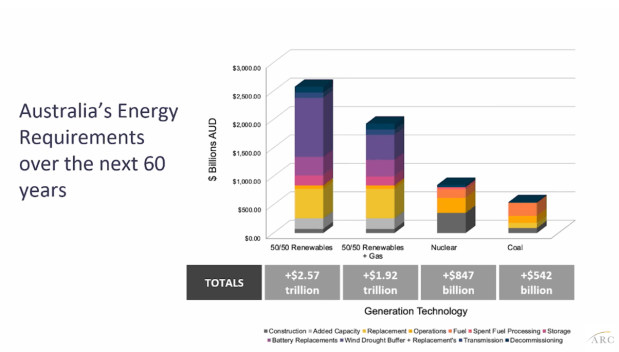
Photo source: http://youtu.be/sRhNOv1Uo4M
Let’s pause to summarise. To meet the Labor government’s goal of 80 per cent renewables by 2030, we need to overbuild using components we can’t make, to establish an inconsistent power source that will need replacing in 20 years’ time. And it’s going to cost us big time.
The current ‘green’ energy path seems hideously expensive and unable to produce the promised result. And I’m not the only one who has reached this conclusion. Australians have started to push back against the government’s wind and solar renewable energy plans while opposition leader Peter Dutton has opposed several offshore wind farms, ahead of his nuclear solution. Overseas, green energy companies face a nervous wait after Trump vowed to dump offshore wind projects from day one.
There must be a better way. There is, says Lomborg: ‘Every problem that humanity has solved has always been about innovation.’ Holland agrees. ‘We actually know what to do … and it is the golden rule of engineering that has powered all of the massive breakthroughs and developments in energy over the last couple of 100 years, and that is the power of power density: the denser your embedded energy source, the cleaner, cheaper and more productively it can be utilised and harnessed and put to work as power.’ It is this principle that 19 of the top 20 economies in the OECD are applying as they turn toward nuclear power.
The breakthrough might not be as far off as we think. On January 7, 2025, energy company Enron launched The Egg. Touted the world’s first micro-nuclear reactor it’s made to power individual homes for up to 10 years and looks like it could fit in a large handbag.
Excuse me while I go check it out.
Dr Julie Sladden is a (retired) doctor. If you’d like to support her caffeine-inspired writing, you can shout her a coffee here.