Australia’s constitution aims to take the best from the constitutions of the UK, the US and Switzerland. But Alfred Deakin persuaded SA Premier Charles Kingston not to argue for Swiss-style citizen-initiated-referendums because he thought the Australianised Westminster system would be just as good. So although it took ten referenda to achieve federation, Australians – unlike the Swiss – aren’t trusted to supervise politicians – the very people who clearly need regular supervision.
In my view, there is no better description of a true constitution than that offered by Bolingbroke half a century before the first Australia Day. He wrote that the constitution is that ‘assembly of laws, customs and institutions according to which the community has agreed to be governed’.
When Governor Philip famously declared the then radical proposition that ‘there can be no slavery in a free land and consequently no slaves’ and that, ‘any man who takes the life of a Native, will be put on his trial as if he had killed one of the Garrison’, he was anticipating what would be at the heart of the nation’s essential values. These declarations demonstrate why the scourge of antisemitism is against everything that is Australian.
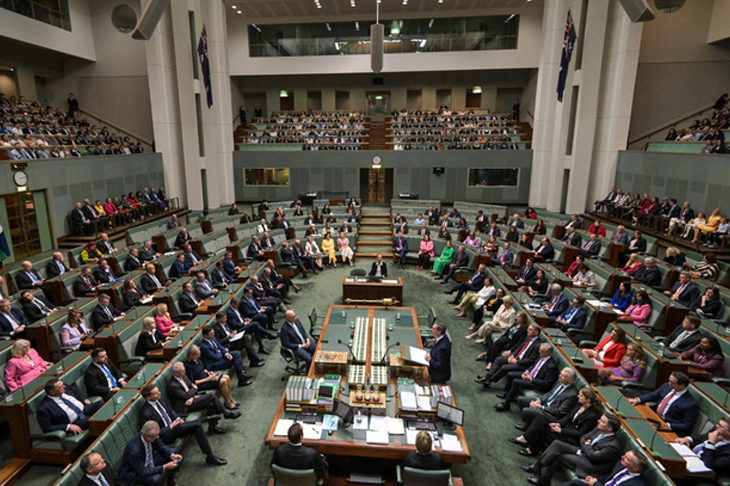
It is clear the politicians currently want something from the people. The Prime Minister has just confirmed that this is our approval, in a referendum, of four-year terms .The politicians insist that their intentions are pure. Four-year terms will, they say, allow them to deliver better government.
Perhaps it is time for the people to enter into a bargain with the political class. If the people give the politicians what they want, the politicians should, by way of return, ensure the people are trusted, as the Swiss are, in matters constitutional.
It was no doubt a coincidence that at about the time the PM raised the issue of four-year terms, the great Serbian tennis player, Novak Djokovic, revealed the ‘trauma’ he still faces whenever he comes to Melbourne. This was the city where he had been unjustly and improperly detained and deported, as if he were an undesirable criminal, days before he was scheduled to walk onto the court as the defending Australian Open champion in January 2022.
One of the biggest issues still facing Australia is surely ensuring that never again can our political leaders behave as they did during Covid. They really let power go to their heads. They behaved as if they were petty dictators.
As this column argued at the time, Australians were effectively put under house arrest, jobs were cancelled, businesses (almost only small ones) destroyed, education interrupted, the country was put into massive debt, people were unlawfully arrested and even fired on with rubber bullets, insufficiently tested vaccines were imposed even on vulnerable children, andcruel and sadistic regulations prevented families even from seeing their dying parents.
We are told that this was worth the benefit but as stated here regularly, with all the advantages of a remote island nation, we could have done far better.
What was done at the time was never envisaged in the plan a dedicated minister of health – Tony Abbott – had already designed and for which he had received international plaudits. Presumably, the Abbott plan was read and rejected and not just ignored.
To return to Djokovic, arguably the world’s greatest tennis player of all time, he is clearly a caring and generous man, evidenced by his personal contributions to and his support for charitable causes.
The fact is that that Djokovic had indeed entered Australia with a valid medical exemption. Yet he was held on arrival as if he were a criminal, denied immediate access to lawyers and Tennis Australia, and put into detention.
The then minister for immigration, citizenship, migrant services and multicultural affairs, Alex Hawke, admitted that Djokovic was of good character and most unlikely to infect others but he had someting else up his sleeve, something parliament surely never intended to be exercised in this case – a personal ministerial power to cancel a visa while ignoring the rules of natural justice. He did this on the extraordinary ground that Djokovic could be a role model for those Australians who dared to take a different view of Covid vaccines than the political class.
Yet on the morning of the deportation, PM Morrison claimed Jokovic’s entry was unlawful saying, ‘We have very clear rules as to who can come into this country.’
Apart from Jokovic, the other public figure to emerge from this sad affair with his reputation mightily enhanced was Judge Anthony Kelly who was clearly disturbed by the injustice visited upon Djokovic at the time of the first attempt at cancelling his visa. He pointed out that a ‘professor and an eminently qualified physician have produced and provided to the applicant a medical exemption… That medical exemption and the basis on which it was given was separately… (verified) by a further independent expert specialist panel established by the Victorian state government. And that document was in the hands of the delegate’. In view of all this he asked, ‘And the point I’m somewhat agitated about is, what more could this man have done?’
After the way politicians behaved during Covid, ordinary Australians need to be restored to the authority they enjoyed in relation to matters constitutional at the time of Federation.
Australians should therefore only agree to four-year terms for representatives and eight-year terms for senators if the constitution is amended by the same referendum to allow Australian voters in a state or territory to petition a recall election in respect of a representative or senator for the remainder of his or her term.
Each election would be triggered by a petition signed by verified publicly available signatures representing five per cent of the relevant electorate.
And to end the politicians’ scandalous monopoly over initiating constitutional change, Australians should also be able to trigger a constitutional referendum by a petition, signed by one per cent of electors nationally and one per cent in a majority of states, i.e. four states. The referendum details could best be left to an unpaid, half-elected convention on the 1998 Howard-Minchin model.
Got something to add? Join the discussion and comment below.
You might disagree with half of it, but you’ll enjoy reading all of it. Try your first month for free, then just $2 a week for the remainder of your first year.